Flashing Lights & Floaters: When Are They a Tamarac Eye Emergency?
Should You Be Worried About Eye Floaters?Eye floaters — the tiny specks, threads, or cobweb-like shapes drifting across your vision — are extremely common and usually harmless. In most cases, they result from normal, age-related changes inside the eye. However, a sudden increase in floaters, flashes of light in your peripheral vision, or a dark shadow spreading across your sight are serious warning signs that require same-day emergency evaluation by an eye care professional. If you are experiencing these symptoms right now in the Tamarac, FL area, contact West Broward Eye Care immediately at 954-726-0204.
What Are Eye Floaters and Flashing Lights?
You are sitting in a bright room or looking up at a clear blue sky when you notice something odd — a small speck, a squiggly line, or a faint shadow drifting lazily across your field of view. You try to look directly at it, and it moves away. This is a floater. For millions of people, this is a familiar and harmless experience. But what exactly is happening inside your eye — and when does this familiar nuisance become a reason to call your eye doctor immediately?
Understanding the anatomy behind these symptoms is the first step toward knowing when to act.
What Causes Eye Floaters?
The inside of your eye is filled with a clear, gel-like substance called the vitreous humor, which gives the eye its round shape and allows light to pass through cleanly to the retina. As we age, this gel gradually liquefies and shrinks, causing microscopic collagen fibers within it to clump together. These clumps cast tiny shadows on the retina — and those shadows are what you perceive as floaters.
This process, known as posterior vitreous detachment (PVD), is a natural part of aging and is the most common cause of floaters. It typically begins after age 50, though highly nearsighted individuals, have had eye surgery, or have experienced eye injuries may develop it earlier.
What Causes Flashing Lights (Photopsia)?
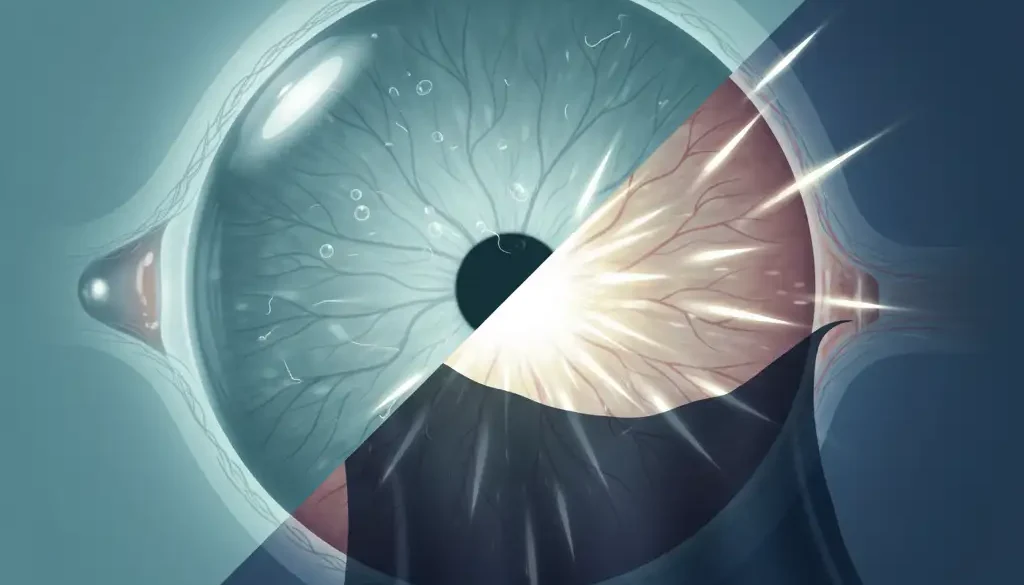
Flashing lights — medically referred to as photopsia — occur when the vitreous gel pulls on or tugs against the retina. The retina interprets this mechanical stimulation as light, producing the perception of flashes, streaks, or arcs in your vision, even in a dark room.
It is important to distinguish between two types of visual flashes:
- Retinal flashes: Brief, spark-like flashes in the peripheral vision, often associated with vitreous pulling. These require prompt evaluation, as they can signal a retinal tear.
- Ocular migraine aura: A shimmering, zigzag pattern of light that typically expands across the visual field and lasts 20–30 minutes. While concerning in their own right, these are neurological in origin and distinct from retinal flashes.
Both types deserve professional attention, but retinal flashes carry a higher risk of serious underlying pathology and should never be ignored.
Normal Floaters vs. a True Eye Emergency: How to Tell the Difference
This is the question most patients are asking when they search for answers online. The honest answer is: context matters enormously. A single, long-standing floater that has been present for years is very different from a sudden explosion of new floaters appearing overnight. Knowing the difference could protect your vision.
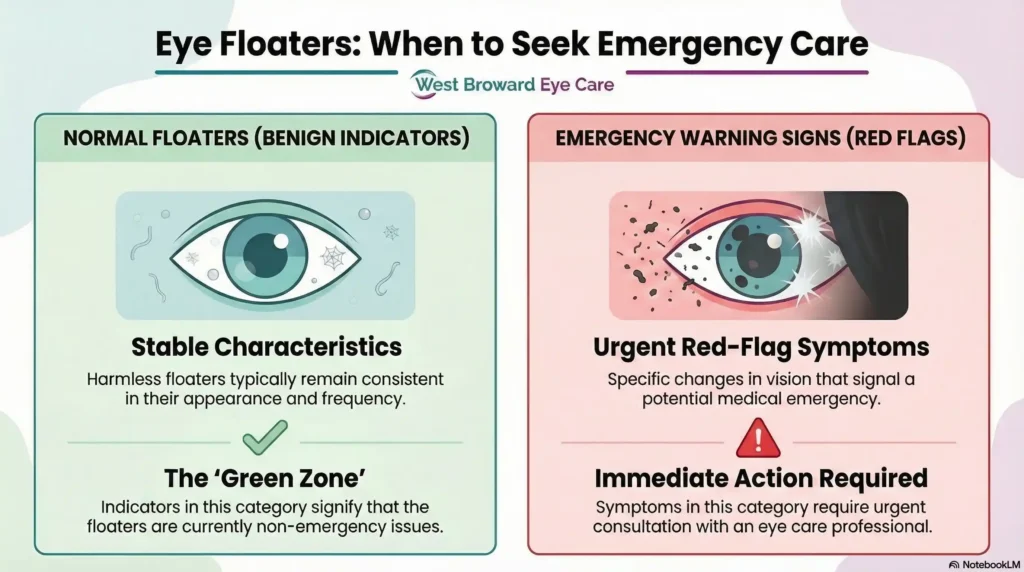
When Floaters Are Considered Normal
The following characteristics are associated with benign, age-related floaters that, while worth mentioning at your next annual exam, do not typically constitute an emergency:
- Floaters that have been present gradually over months or years
- Small, semi-transparent specks or threads that move with your eye and drift out of view when you stop moving
- Floaters that are more visible in bright light or against a plain background like a white wall or blue sky
- No associated flashes of light, vision loss, or shadows
- No significant change in number, size, or intensity over time
For many adults over 50 in the Tamarac community, this type of floater is a normal companion of aging. Annual comprehensive eye exams remain the best way to monitor these changes and confirm that no underlying condition is developing.
When Flashing Lights and Floaters Are a Medical Emergency
The following symptoms are red flags that demand immediate, same-day evaluation by an eye care professional. Do not wait for a routine appointment if you experience:
- ⚠️ A sudden shower of new floaters appearing all at once
- ⚠️ Flashes of light in your peripheral (side) vision, especially if new or recurring
- ⚠️ A dark curtain, shadow, or veil spreading across any part of your vision
- ⚠️ Blurred or lost vision in a specific area of your visual field
- ⚠️ A gray or darkened area that does not clear up
- ⚠️ Any combination of flashes and new floaters occurring together
These symptoms may indicate a retinal tear or retinal detachment — a sight-threatening emergency where every hour of delay increases the risk of permanent vision loss.
⚡ Don’t Wait to Find Out
Experiencing sudden floaters, flashes of light, or a shadow across your vision? These symptoms can signal a retinal emergency. Contact West Broward Eye Care immediately for same-day evaluation.
📞 Call or Text: 954-726-0204 📍 7822 N. University Dr., Tamarac, FL 33321
| Feature | Normal Floaters ✅ | Emergency Warning Signs 🚨 |
|---|---|---|
| Onset | Gradual, over months/years | Sudden, within hours or minutes |
| Quantity | Few, stable in number | Sudden shower of many new floaters |
| Flashing Lights | Absent | Present, especially in peripheral vision |
| Vision Changes | None | Dark curtain, shadow, or vision loss |
| Duration | Long-standing, unchanged | New symptom, rapidly changing |
| Action Required | Mention at next annual exam | Call eye doctor immediately |
The Dangerous Conditions These Symptoms Can Signal
When floaters and flashes appear suddenly and dramatically, the eye is often sending a distress signal. Understanding the conditions behind these symptoms reinforces why prompt professional evaluation is not optional — it is essential.
Posterior Vitreous Detachment (PVD)
Posterior vitreous detachment is the most common cause of sudden floaters and flashes. It occurs when the vitreous gel fully separates from the retina. While PVD itself is not a medical emergency in most cases, the process of detachment can create dangerous traction on the retina, sometimes leading to a tear.
Approximately 10–15% of patients with symptomatic PVD develop a retinal tear during the detachment process. This is why every new episode of sudden floaters or flashes — even if eventually diagnosed as benign PVD — requires a thorough dilated retinal examination to rule out complications.
Retinal Tear and Retinal Detachment
A retinal tear occurs when the vitreous pulls strongly enough on the retina to create a break in the tissue. Left untreated, fluid can seep through the tear and lift the retina away from the back of the eye — a condition known as retinal detachment.
Retinal detachment is a true ocular emergency. Without treatment, it leads to permanent, irreversible vision loss in the affected eye. The warning signs are precisely those described above: a sudden shower of floaters, persistent flashing lights, and the ominous appearance of a dark curtain spreading across the visual field.
Time is the critical variable. Patients who receive treatment before the macula — the central area of the retina responsible for sharp, detailed vision — becomes involved have a significantly higher rate of full visual recovery. Every hour matters.
Diabetic Retinopathy and Macular Degeneration
For patients living with diabetes or age-related macular degeneration, floaters can carry an additional layer of concern. In diabetic retinopathy, damaged blood vessels in the retina can leak or bleed into the vitreous, causing a sudden appearance of dark spots, strings, or a reddish haze in the vision. This is called a vitreous hemorrhage and requires urgent evaluation.
Similarly, certain forms of macular degeneration can cause visual distortions and new floater-like symptoms as the disease progresses. Regular monitoring with advanced retinal imaging is the most effective strategy for catching these changes early — before vision is lost.
Why Tamarac and Broward County Residents Face Elevated Risk
Floaters and flashes are not equally distributed across all populations. Several factors unique to the Tamarac community and the broader South Florida environment create a higher-than-average risk profile for many local residents.
Seniors and Age-Related Vision Changes
Tamarac is home to a substantial population of retirees and older adults — a demographic for whom PVD, retinal degeneration, and macular disease are statistically more prevalent. Age is the single greatest risk factor for vitreous detachment, retinal tears, and macular degeneration. For older residents, annual comprehensive eye exams are not a recommendation — they are a necessity.
Patients Living with Diabetes
Broward County has a significant diabetic population, and diabetic retinopathy remains one of the leading causes of preventable blindness in the United States. Many patients with diabetes are unaware that floaters or sudden vision changes can be the first visible sign of retinal bleeding. A dedicated diabetic eye exam, including advanced retinal imaging, provides the earliest possible detection of these dangerous changes.
Children and Young Adults with Myopia
Nearsightedness (myopia) is not just a prescription issue — it is a structural one. Higher degrees of myopia cause the eye to be physically longer than normal, which stretches and thins the retina, increasing the risk of tears and detachment. Children whose myopia is progressing rapidly are in a particularly vulnerable category. This is one of the reasons that Myopia Management — a specialty program offered at West Broward Eye Care — is so critical for the long-term eye health of children in the Tamarac community.
⚡ See the Full Picture of Your Retinal Health
Our board-certified physicians use advanced Optomap retinal imaging to evaluate your eye health with unmatched precision — detecting retinal changes often before you notice any symptoms.
📅 Book Your Comprehensive Eye Exam Today 📍 West Broward Eye Care | 7822 N. University Dr., Tamarac, FL 33321 📞 Call or Text: 954-726-0204
| Technology | What It Examines | Key Patient Benefit |
|---|---|---|
| Optomap | 200° panoramic retinal view | Detects tears, detachments & disease in a single scan — no dilation required |
| Optovue (OCT) | Microscopic retinal layer cross-section | Identifies retinal thinning, fluid & early macular changes before vision loss occurs |
| SMap3D | Corneal topography mapping | Precision lens fitting for Keratoconus and specialty contact lens patients |
How West Broward Eye Care Diagnoses Floaters and Flashes
When a patient arrives at West Broward Eye Care reporting sudden floaters or flashing lights, they are not met with a brief, rushed examination. They are met with a thorough, technology-driven diagnostic process backed by 35 years of clinical experience and a team of board-certified optometric physicians who take the time to explain exactly what is happening with their vision.
Optomap: The Full-Picture Retinal Exam
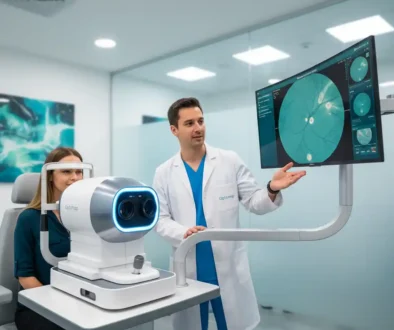
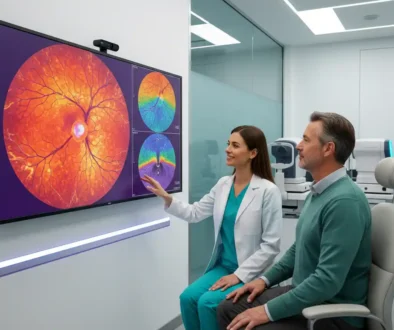
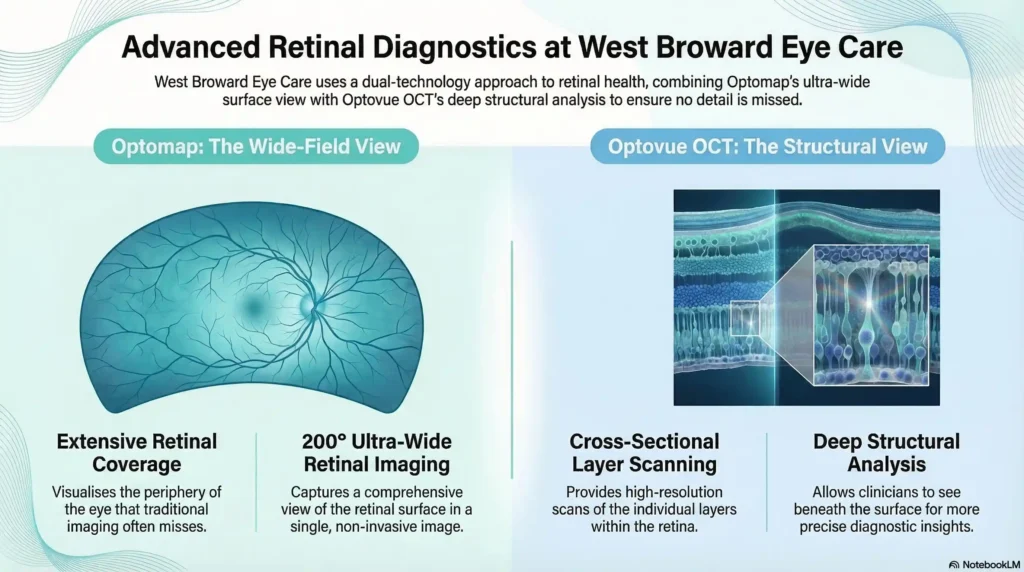
The Optomap ultra-widefield retinal imaging system captures a panoramic 200-degree view of the retina in a single, non-invasive scan. This remarkable technology allows our physicians to examine the peripheral retina — precisely the area where retinal tears and detachments most commonly begin — with unparalleled clarity.
For patients presenting with floaters or flashes, Optomap provides a comprehensive baseline image that allows the doctor to identify any tears, areas of thinning, or early signs of retinal disease with speed and precision. We see the full picture of your eye health, often before you see any symptoms.
Optovue: Microscopic-Level Detection
The Optovue OCT (Optical Coherence Tomography) system allows our physicians to examine the individual layers of the retina at a microscopic level. Think of it as an ultrasound for the eye — producing a detailed cross-sectional image that reveals fluid accumulation, retinal thinning, macular changes, and other structural abnormalities that would be invisible to conventional examination.
Together, Optomap and Optovue give West Broward Eye Care a diagnostic advantage that few practices in Broward County can match — ensuring that no critical finding goes undetected.
What to Expect at Your Appointment
We understand that arriving at an eye care office with a concerning new symptom can feel anxious and overwhelming. At West Broward Eye Care, our goal is to transform that anxiety into confidence and clarity from the moment you walk through our door.
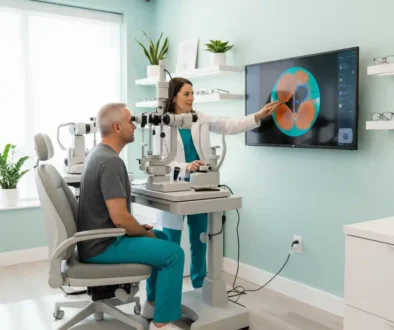
For patients presenting with floaters or flashes, a typical evaluation includes a detailed review of your symptom history, a comprehensive dilated fundus examination, and advanced retinal imaging with Optomap and/or Optovue. Our board-certified physicians will walk you through their findings with the thoroughness and clarity that our patients have praised for decades — ensuring you leave with a complete understanding of your eye health and a clear plan for any necessary follow-up care.
For urgent cases, same-day appointments are available. Do not hesitate to call or text us directly at 954-726-0204 if your symptoms are new or rapidly changing.
🏛️ Local Resources & Citations
1. National Eye Institute (NEI) — Floaters The NIH’s official eye health authority — use this federal (.gov) resource to understand what floaters are, when they signal a retinal emergency, and what a dilated eye exam involves so you can arrive at your appointment informed.
2. National Eye Institute (NEI) — Retinal Detachment. The definitive federal (.gov) clinical reference on retinal detachment — confirms the exact red-flag symptoms (sudden floaters, flashing lights, dark curtain) that require same-day emergency evaluation at a practice like West Broward Eye Care.
3. Florida Board of Optometry — License Verification Florida’s official state (.gov) licensing authority for all optometric physicians — use this tool to verify that your eye care provider holds a current, active board certification before your appointment.
4. Broward College — Vision Care Technology Program The only accredited (.edu) opticianry and ophthalmic technician training program in Broward County — a local educational institution that underscores the region’s deep infrastructure of credentialed eye care professionals serving the Tamarac community.
Protecting Your Vision Long-Term: Eye Health in South Florida
Living in South Florida presents a unique set of challenges for long-term eye health. The region’s intense UV radiation is a well-established risk factor for accelerating retinal aging, contributing to cataract formation, and increasing the risk of macular degeneration. Protecting your eyes with high-quality UV-blocking lenses — available through West Broward Eye Care’s full-service optical — is one of the most effective preventative steps any Tamarac resident can take.
Beyond UV protection, the single most powerful tool for preserving your vision is annual comprehensive eye examination. Regular retinal evaluations create a documented baseline of your eye health, allowing our physicians to detect even subtle changes early — when treatment options are most effective and outcomes are best.
Your vision is irreplaceable. The investment of one annual exam is among the most important health decisions you can make for yourself and your family.
⚡ Tamarac’s Trusted Eye Care Team — For Every Generation
For 35 years, West Broward Eye Care has been the eye health partner of choice for families across Tamarac and Broward County. From pediatric myopia management to emergency retinal care for seniors, our board-certified team is equipped, experienced, and genuinely committed to your long-term vision health.
📅 Book Your Appointment Today 📞 Call or Text: 954-726-0204 📧 info@wbeca.com 📍 7822 N. University Dr., Tamarac, FL 33321 🕐 Mon–Thu: 9:00 AM–5:00 PM | Fri: 9:00 AM–4:00 PM
Frequently Asked Questions
-
No — but they should never be ignored. Occasional flashes of light can result from harmless vitreous changes as the eye ages. However, sudden, persistent, or new flashing lights — especially when combined with a shower of new floaters or a shadow across your vision — are a medical emergency requiring same-day evaluation. If you are experiencing these symptoms in the Tamarac, FL area, contact West Broward Eye Care immediately at 954-726-0204.