Why Retinal Photography Is the Most Important Part of Your Eye Exam
Retinal photography is a painless, non-invasive imaging technique that captures a detailed digital picture of the back of your eye — the retina, optic nerve, and blood vessels — in under one second. Using advanced tools like the Optomap system, board-certified optometrists can detect serious eye diseases such as diabetic retinopathy, macular degeneration, and glaucoma before any symptoms appear. At West Broward Eye Care in Tamarac, FL, retinal photography with Optomap is a cornerstone of every comprehensive eye exam, giving patients a 200-degree panoramic view of their retinal health and a permanent digital baseline to monitor changes over time.
What Is Retinal Photography? (And Why Your Eyes Can’t Tell You What It Sees)
Your eyes may feel perfectly fine. Your vision may seem sharp. But inside the back of your eye, a slow, silent process could already be underway — one that has no pain, no warning flashes, and no early symptoms. That is the defining challenge of serious eye disease: by the time you feel something is wrong, significant damage may already be done.
Retinal photography changes that equation entirely. It is a fast, painless, and non-invasive technique that captures a high-resolution digital image of your retina — the light-sensitive tissue at the back of your eye that acts as the command center of your vision. Think of your retina as the film in a camera. Without a healthy, intact retina, no image reaches your brain, no matter how perfect the lens in front of it.
By photographing this critical tissue, your eye doctor can see the earliest biological signs of disease — changes so subtle they produce no symptoms at all — and act before your vision is ever at risk. For patients in Tamarac and across Broward County, this technology is not a luxury. It is the standard of care at West Broward Eye Care.
📅 Book Your Eye Exam Today
Think your eyes are healthy because they feel fine? So did most patients before their first Optomap scan.
Call or Text: 954-726-0204 West Broward Eye Care | 7822 N. University Dr., Tamarac, FL 33321
How Optomap Technology Works — The 200° View That Changes Everything
Not all retinal photography is created equal. At West Broward Eye Care, board-certified optometric physicians use the Optomap system — the most advanced wide-field retinal imaging technology available in outpatient eye care. Here is why that distinction matters enormously for your health.
Traditional eye exams use a technique called dilation, where medicated drops widen your pupils so the doctor can peer inside. This approach provides a view of roughly 15 degrees of your retina — a narrow keyhole into a space that spans 200 degrees. Peripheral retinal disease, which includes some of the most dangerous and treatable conditions, can hide entirely outside that 15-degree window.
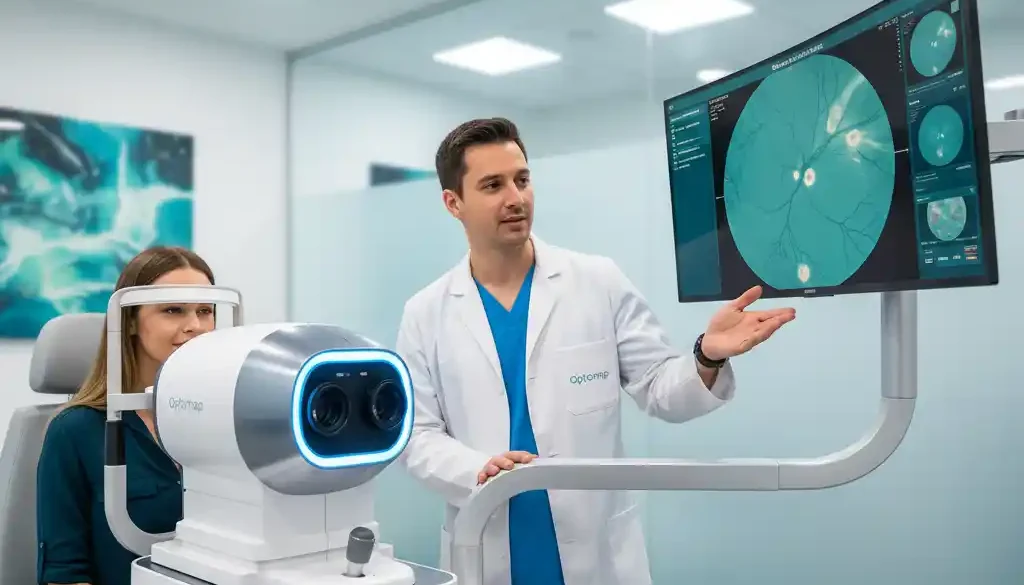
The Optomap system uses low-intensity scanning laser technology to capture a 200-degree panoramic image of your retina in a single half-second scan. Both eyes. No drops. No blurred vision. No one to drive you home. You walk in, rest your chin on the device, look at a small target, and it is done. Your doctor reviews the full-color, high-resolution images with you in real time.
Optomap vs. Traditional Dilation — A Side-by-Side Comparison
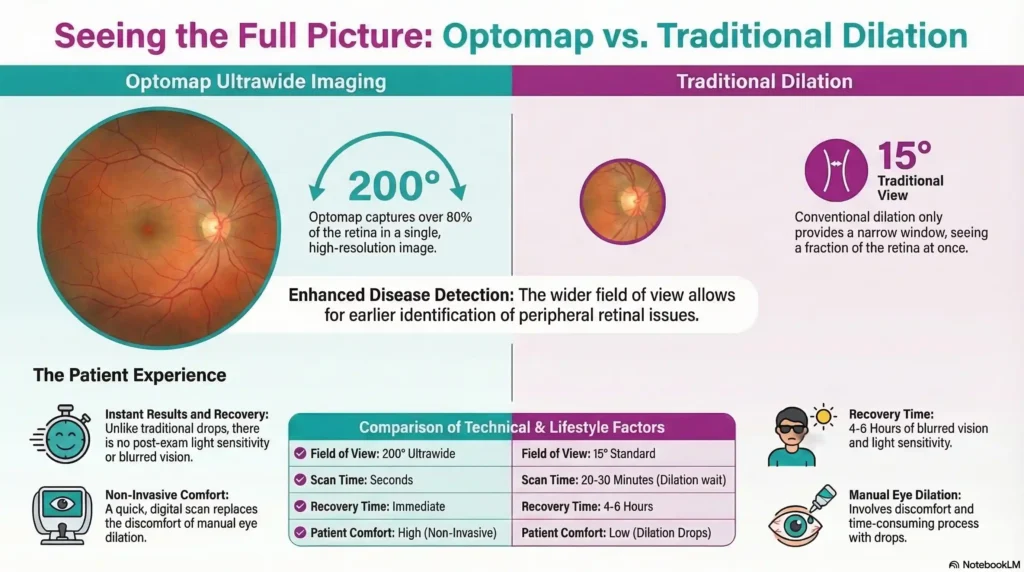
| Feature | Optomap (West Broward Eye Care) | Traditional Dilation |
|---|---|---|
| Field of View | 200° panoramic | ~15° limited |
| Scan Time | 0.5 seconds | 20–30 min prep |
| Recovery Time | None — drive yourself | 3–6 hours blurred vision |
| Suitable For | All ages including children | Adults (drops not always safe) |
| Disease Detection | Early-stage, pre-symptomatic | Moderate-to-advanced |
| Permanent Record | Yes — digital baseline | No |
For South Florida patients with busy schedules — parents, working professionals, active retirees — the zero-downtime advantage of Optomap is significant. But the clinical advantage is even more important: a technology that sees more catches more.
The Silent Diseases Retinal Photography Can Detect Before You Feel Anything
The most dangerous eye diseases share one terrifying characteristic: they are entirely asymptomatic in their early stages. You will not feel pain. Your vision may remain clear. Yet the damage accumulates quietly until, one day, it cannot be reversed. Retinal photography is the tool that breaks this silence.
Diabetic Retinopathy — The #1 Cause of Preventable Blindness
Florida has one of the highest rates of diagnosed diabetes in the United States, and Broward County is no exception. When blood sugar levels damage the tiny blood vessels inside the retina, the result is diabetic retinopathy — a condition that affects millions of Americans and is the leading cause of new blindness in working-age adults.
The critical clinical fact: diabetic retinopathy begins with microscopic changes called microaneurysms — small bulges in retinal blood vessels — that are completely invisible to the patient but clearly visible under Optomap imaging. Catching this condition at the microaneurysm stage, before any vision is lost, allows for treatment interventions that can preserve sight for life. Waiting for symptoms means waiting too long.
West Broward Eye Care’s board-certified physicians specialize in diabetic eye disease management, providing the monitoring and early intervention that patients with diabetes need every single year.
Macular Degeneration — When the Center of Your Vision Is at Risk
Age-related macular degeneration (AMD) is the leading cause of severe vision loss in adults over 50 in the United States. Tamarac and the broader Broward County area have a significant and growing population of retirees — exactly the demographic most vulnerable to this condition.
AMD affects the macula, the small central region of the retina responsible for the sharp, detailed vision you use to read, recognize faces, and drive. Early AMD produces drusen — tiny yellow deposits under the retina — that are invisible to the patient but clearly identifiable on a retinal photograph. With an annual Optomap baseline on file, your doctor at West Broward Eye Care can track changes in drusen size and distribution year over year, catching the transition to advanced AMD early enough to slow it significantly.
Glaucoma — The Sneak Thief of Sight
Glaucoma is perhaps the most insidious eye disease of all. It damages the optic nerve — the cable that carries visual information from your eye to your brain — through elevated eye pressure, and it does so with absolutely no pain and no early vision changes. By the time peripheral vision loss becomes noticeable to the patient, up to 40 percent of optic nerve fibers may already be irreversibly destroyed.
Retinal photography allows your doctor to directly visualize the optic nerve head, evaluate the cup-to-disc ratio, and identify the earliest structural signs of glaucomatous damage. Combined with pressure measurements and visual field testing, Optomap imaging forms a critical pillar of glaucoma detection at West Broward Eye Care.
Retinal Detachment and Other Peripheral Emergencies
The peripheral retina — the outer edges of your visual field — is precisely where the most dangerous acute emergencies begin. Retinal tears, lattice degeneration, and early detachments all originate in the periphery. These conditions are genuine ocular emergencies; untreated retinal detachment can cause permanent blindness within days.
Because traditional dilation only captures 15 degrees of the retina, peripheral pathology can be missed entirely in a standard exam. The Optomap’s 200-degree coverage means your doctor sees the full picture — including the edges where emergencies hide. And if an emergency does arise, West Broward Eye Care offers same-day emergency eye care appointments to address acute problems immediately.
👁️ Has it been over a year since your last retinal scan?
If you have diabetes, a family history of eye disease, or haven’t had an Optomap exam recently, your retinas deserve a closer look.
Call or Text: 954-726-0204 7822 N. University Dr., Tamarac, FL 33321
Why South Florida Patients Face a Higher Risk — And What to Do About It
Living in Tamarac and the greater Broward County area comes with extraordinary benefits: year-round sunshine, outdoor recreation, and a vibrant community. But that same sun-drenched environment creates a unique set of retinal health risks that make annual retinal photography not just advisable — but essential.
☀️ Year-Round UV Exposure
Florida receives more ultraviolet radiation annually than nearly any other state. Cumulative UV exposure is a well-documented driver of both macular degeneration and cataract formation. Unlike sunburned skin, UV damage to the retina is painless and invisible — until it is not. Optomap imaging can detect the earliest signs of UV-related retinal changes, allowing your doctor to recommend protective eyewear and preventive strategies before damage progresses.
👴 An Aging Population With Elevated Risk
Broward County has one of the largest concentrations of adults over 65 in Florida. This demographic carries significantly elevated risk for AMD, diabetic retinopathy, glaucoma, and other age-related conditions. For these patients, a retinal photograph is not a one-time test — it is a living health record that grows more valuable with every passing year.
🩺 Florida’s Diabetes Prevalence
Florida consistently ranks among the top 15 states for diabetes prevalence. For the significant portion of Tamarac residents managing diabetes or prediabetes, annual diabetic eye exams with retinal photography are not optional — they are a medical imperative. West Broward Eye Care’s specialization in diabetic retinopathy monitoring means patients receive expert disease management, not just a routine checkup.
🌊 An Active Outdoor Lifestyle
Golf, tennis, fishing, and waterfront activities are defining features of life in South Florida. Extended outdoor exposure means sustained UV and high-glare environments that work against retinal health over time. Retinal photography creates a documented baseline so that lifestyle-related changes can be identified and addressed proactively.
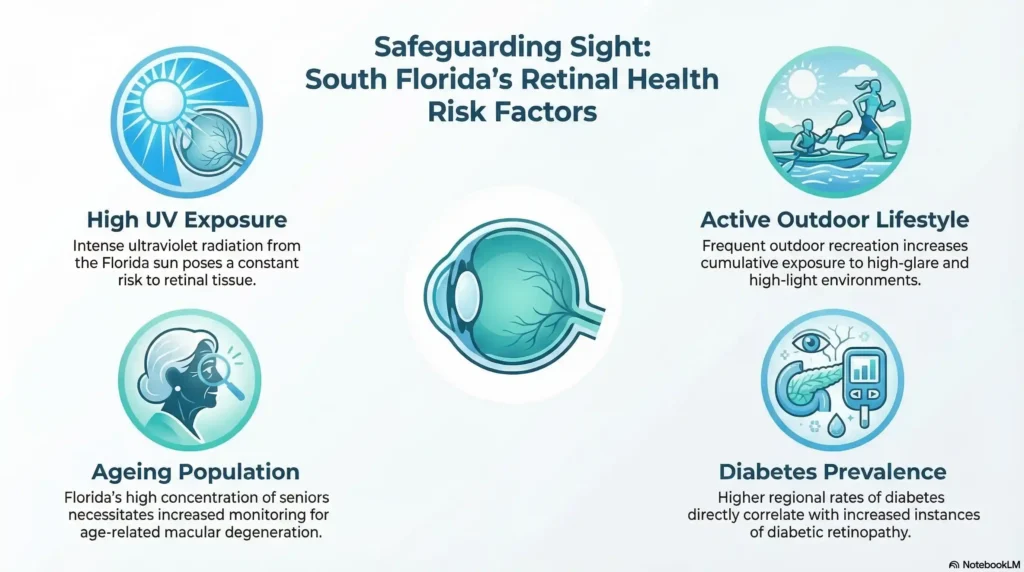
| Risk Factor | Why It Matters for Retinal Health | How Optomap Helps |
|---|---|---|
| Year-Round UV Exposure | Accelerates macular degeneration & cataracts | Detects early UV-related retinal changes |
| Aging Retiree Population | Higher risk of AMD & diabetic complications | Creates year-over-year baseline comparison |
| Florida Diabetes Rates | Leading cause of diabetic retinopathy | Catches microaneurysms before vision loss |
| Active Outdoor Lifestyle | Increased UV/glare exposure & eye injury risk | Documents retinal health pre/post activity |
Retinal Photography as Your Vision’s Permanent Health Record
A single retinal photograph is valuable. A series of retinal photographs taken annually over five or ten years is invaluable. The true power of Optomap technology at West Broward Eye Care is not just what it shows today — it is the longitudinal record it builds over time.
Think of it the way you think about a mammogram, a colonoscopy, or an annual cardiac stress test. Each individual result has meaning, but the baseline — the comparison against your own prior images — is what gives your doctor the ability to detect change. A drusen deposit that has grown 20 percent in twelve months tells a very different story than one that has remained stable for five years. Without the photograph from last year, that distinction is impossible to make.
There is another dimension to this that West Broward Eye Care’s patients consistently describe and value: the ability to see your own diagnosis. When a doctor can show you a high-resolution image of your own retina and explain exactly what they are seeing — the early deposit, the vessel irregularity, the area of concern — the entire experience of healthcare changes. You stop being a passive recipient of news and become an informed partner in your own care. This is the experience one patient famously described as receiving a “mini PhD” on their eye condition. It is what separates West Broward Eye Care from a routine vision center.
🔗 Local Resources & Citations
1. Florida Department of Health in Broward County — (.gov) The official county health authority serving Tamarac residents — check here for local public health programs, community wellness resources, and disease prevention initiatives that support your decision to prioritize annual eye exams as part of your overall preventive care.
2. National Eye Institute — Diabetic Retinopathy — (NIH .gov) The U.S. government’s leading eye disease research authority — visit here for clinically verified information on how diabetic retinopathy develops, why annual retinal imaging is medically essential, and what the latest federal research shows about early detection and treatment outcomes.
3. CDC — Vision Loss & Diabetes — (.gov) The Centers for Disease Control and Prevention’s official resource on diabetes-related eye complications — reference this page to understand why the CDC confirms that over 90% of diabetes-related vision loss is preventable with early detection and annual retinal screening.
4. Optos — Official Optomap Technology Manufacturer — (Official Manufacturer) The maker of the Optomap retinal imaging system used at West Broward Eye Care — visit the official product specifications page to verify the clinical and technical credentials of the 200-degree ultra-widefield imaging technology behind your retinal photography exam, including the device’s FDA clearance status and published clinical trial data.
What to Expect During Your Retinal Photography Exam at West Broward Eye Care
Many patients feel some anxiety before any medical exam. The Optomap experience at West Broward Eye Care is designed to be the opposite of stressful — quick, comfortable, and immediately informative. Here is exactly what happens:
- You arrive for your comprehensive eye exam at 7822 N. University Dr., Tamarac, FL 33321. The warm, welcoming team checks you in and reviews your health history.
- The Optomap imaging step takes approximately 30 seconds total — a brief chin-rest positioning, a small target to focus on, and a half-second scan per eye.
- No dilation drops are needed in the vast majority of cases. Your vision remains completely clear throughout and after the exam.
- Your board-certified physician reviews the high-resolution, full-color retinal images with you on-screen in real time. Every finding is explained in plain language.
- If anything requires follow-up, you leave with a clear, personalized plan. If everything looks healthy, you leave with peace of mind — and a digital baseline on file for next year.
- Drive yourself home. Return to your day. Zero downtime.
From check-in to departure, a comprehensive eye exam with Optomap retinal photography typically takes under an hour. For the level of diagnostic information it provides — and the diseases it can catch before they change your life — that hour may be the most valuable one you spend in a medical office all year.
35 Years of Seeing What Others Miss — West Broward Eye Care’s Commitment to Your Vision
Since 1989, West Broward Eye Care has been the cornerstone of eye health for families, seniors, and patients of all ages across Tamarac and the greater Broward County community. That 35-year legacy is not simply a number — it represents tens of thousands of patients whose vision has been protected, preserved, and enhanced by a team that treats every appointment as an opportunity to change a life.
The practice’s board-certified optometric physicians hold deep specializations in conditions that most general vision centers cannot manage: Keratoconus, pediatric myopia, macular degeneration, and complex diabetic eye disease. They are supported by state-of-the-art diagnostic technology — Optomap for retinal photography, Optovue for microscopic retinal layer imaging, and SMap3D for precision specialty lens fitting — that places West Broward Eye Care among the most technically advanced optometric practices in South Florida.
Over 885 Google reviews from patients in the Tamarac community validate what the team has always known: that exceptional clinical care and genuine human compassion are not trade-offs. They are the same thing. Patients consistently describe a practice where doctors take their time, explain every finding with clarity, and leave them feeling empowered rather than anxious. For generations of Tamarac families, West Broward Eye Care is not just a provider — it is a partner in lifelong vision health.
🗓️ Don’t Wait for Symptoms. Early Detection Saves Vision.
Schedule your Optomap retinal photography exam today at Tamarac’s most trusted eye care practice — 35 years of excellence and counting.
Call or Text: 954-726-0204 7822 N. University Dr., Tamarac, FL 33321 Mon–Thu 9:00 AM–5:00 PM | Fri 9:00 AM–4:00 PM
Frequently Asked Questions
-
Retinal photography is a painless, non-invasive imaging technique that captures a detailed digital picture of the back of your eye — including the retina, optic nerve, and blood vessels — in under one second, without eye drops or recovery time.
Its importance lies in what it reveals that no other part of your exam can: the silent, early-stage changes of serious eye diseases like diabetic retinopathy, macular degeneration, and glaucoma before any symptoms appear. The retina is the only place in the human body where blood vessels can be photographed non-invasively, making it a window not just into your eye health, but into your cardiovascular and systemic health as well. At West Broward Eye Care in Tamarac, FL, Optomap retinal photography is a cornerstone of every comprehensive eye exam.