Keratoconus Diagnosis in Tamarac, FL: Symptoms, Testing & Scleral Lens Fitting
What is keratoconus, and where can I get diagnosed in Tamarac, FL?
Keratoconus is a progressive eye condition where the cornea thins and bulges into a cone shape, causing distorted vision that glasses alone cannot correct. In Tamarac, FL, West Broward Eye Care provides expert keratoconus diagnosis using advanced SMap3D corneal mapping technology and custom scleral lens fittings — delivering clear, comfortable vision without surgery.
For many patients living with keratoconus, the journey to a correct diagnosis is a long and frustrating one. Vision keeps changing. New glasses prescriptions stop working within months. Contacts become increasingly uncomfortable. And yet, appointment after appointment, no one has a clear answer.
If this sounds familiar, you are not alone — and you are not imagining it.
At West Broward Eye Care, located at 7822 N. University Dr., Tamarac, FL 33321, our board-certified optometric physicians have spent 35 years helping Broward County patients find exactly the answers — and the solutions — they have been searching for. Keratoconus is one of our core specialties, and with technology that many ophthalmology offices do not carry, we are uniquely equipped to diagnose it precisely and treat it effectively.
This guide will walk you through everything you need to know: what keratoconus is, the symptoms to watch for, how it is accurately diagnosed, and why custom scleral lens fitting at our Tamarac practice is changing lives across South Florida.
What Is Keratoconus? Understanding the Condition Before It Gets Worse
How a Healthy Cornea Becomes a Cone
Your cornea is the clear, dome-shaped front surface of your eye. In a healthy eye, it maintains a smooth, rounded shape that precisely focuses light onto your retina — producing clear, sharp vision. In keratoconus, the structural integrity of the cornea gradually weakens. The tissue begins to thin, and instead of holding its dome shape, the cornea slowly bulges outward into the shape of a cone.
This structural change distorts the way light enters the eye. The result is blurred, distorted, and increasingly unpredictable vision that a simple glasses prescription simply cannot fix. As the cornea continues to change shape, even carefully fitted contact lenses may no longer sit correctly on the eye’s surface, making clear vision difficult or impossible to achieve through conventional means.
Keratoconus most commonly begins in adolescence or early adulthood, typically between the ages of 10 and 25, and can progress for one to two decades before stabilizing. Risk factors include a family history of the condition, chronic eye rubbing, poorly managed eye allergies, and prolonged UV exposure — all of which are highly relevant in the South Florida environment.
The Emotional Reality — Years of Misdiagnosis
One of the most underappreciated aspects of keratoconus is how long patients suffer before receiving an accurate diagnosis. Because the early symptoms closely mimic common refractive errors like myopia and astigmatism, many patients are simply given a stronger glasses prescription — time and again — without anyone identifying the underlying cause.
The frustration is real. Patients describe a cycle of worsening vision, expensive new frames, and a persistent feeling that something more is wrong. Some are told their prescription is simply “difficult.” Others are advised to try a different brand of contact lenses. The years pass, and the cornea continues to change.
At West Broward Eye Care, we understand this experience deeply. Our role is not simply to prescribe lenses — it is to get to the root of why your vision keeps changing, and to give you answers that actually hold.
📞 Think your vision changes might be more than a new prescription? Our board-certified specialists are here to help. Call or text West Broward Eye Care today at 954-726-0204.
Warning Signs — Keratoconus Symptoms You Should Never Ignore
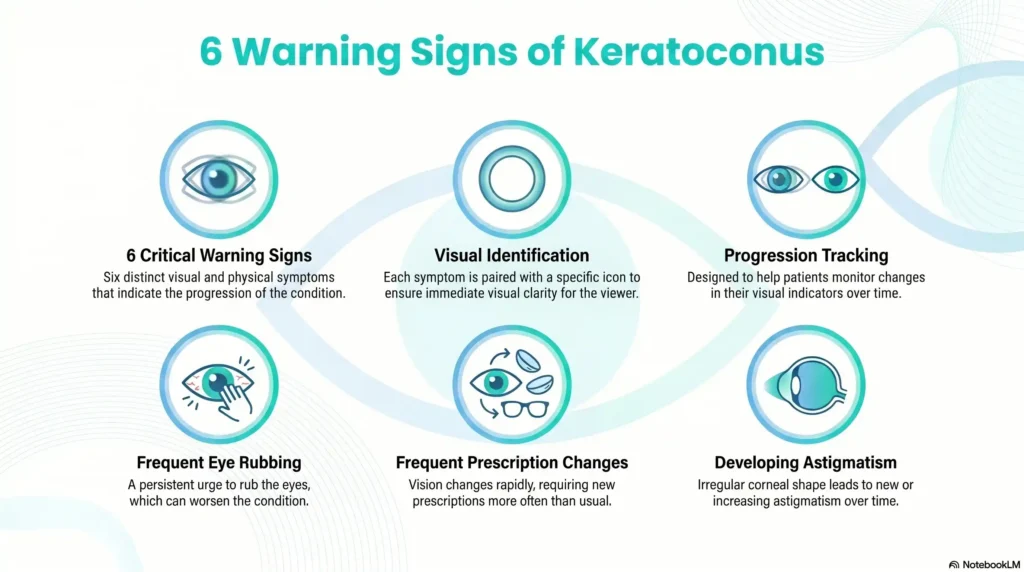
Keratoconus does not announce itself dramatically. It develops gradually, which is precisely why it goes undetected for so long. Knowing the warning signs puts you in a position to seek specialist care before the condition progresses further. Contact our team immediately if you or a family member are experiencing any of the following:
- Blurred or distorted vision that your current glasses or contact lenses cannot fully correct, even with a recent prescription update
- Increased sensitivity to light and glare, including halos or streaking around lights — particularly noticeable when driving at night
- Frequent prescription changes — needing significantly stronger lenses every few months with no period of stable vision
- Difficulty driving after dark, where oncoming headlights appear dramatically flared or distorted
- Noticeably asymmetric vision — one eye performing significantly worse than the other, often with different prescriptions in each
- Ghost images or double vision in a single eye, even when the other eye is closed
| Warning Sign | Description | Action Required |
|---|---|---|
| Blurred / Distorted Vision | Glasses no longer provide clear correction | Specialist evaluation |
| Light Sensitivity & Halos | Glare and halos around light sources | Corneal mapping exam |
| Frequent Prescription Changes | New Rx needed every few months | Keratoconus screening |
| Night Driving Difficulty | Headlights appear flared or streaked | Urgent specialist visit |
| Asymmetric Vision | One eye noticeably worse than the other | Corneal topography test |
| Ghost Images (monocular) | Double vision in one eye alone | Immediate evaluation |
Early detection is the single most powerful tool in managing keratoconus effectively. The sooner an accurate diagnosis is made, the greater the range of treatment options available to you.
How Keratoconus Is Diagnosed — Advanced Testing at West Broward Eye Care
Why a Standard Eye Exam Is Not Enough
A routine eye examination measures your visual acuity and refraction — how well you see and what prescription corrects it. What a standard exam does not do is evaluate the shape, thickness, and structural integrity of the cornea in the detail required to identify keratoconus, especially in its earlier stages.
This diagnostic gap is the core reason so many keratoconus patients go undiagnosed for years. Without advanced corneal imaging technology, a practitioner conducting a standard refraction-based exam simply does not have the data needed to see what is happening beneath the surface of the eye.
At West Broward Eye Care, we go beyond the standard exam. Our diagnostic protocol is specifically engineered to identify keratoconus at any stage of its progression — including early presentations that most practices would miss entirely.
The SMap3D Advantage — Precision Corneal Mapping in Tamarac
The cornerstone of our keratoconus diagnostic process is SMap3D technology — and West Broward Eye Care is proud to be among the first practices in the United States to adopt it.
SMap3D is an advanced corneal topography system that generates a comprehensive three-dimensional map of the entire surface of your cornea. By capturing thousands of data points across the corneal surface with extraordinary precision, SMap3D reveals the subtle irregularities in shape and curvature that are the hallmark of keratoconus — even before you notice significant changes in your vision.
For patients requiring specialty contact lenses, this technology delivers an additional critical advantage: the corneal map produced by SMap3D serves as the precise blueprint from which your custom scleral lenses are designed. The result is a lens fitted specifically to the unique topography of your eye — not an approximation. No guesswork. No uncomfortable trial-and-error. Just a lens engineered for you.
Supporting Diagnostic Technology
SMap3D does not work in isolation at West Broward Eye Care. Our comprehensive diagnostic suite includes:
- Optomap Retinal Imaging: Captures a wide-field, high-resolution image of your retina — providing a complete view of your eye’s internal health and detecting disease changes that may accompany or complicate corneal conditions.
- Optovue OCT Imaging: Uses optical coherence tomography to produce microscopic, cross-sectional images of the corneal layers themselves, measuring thickness at precise points and identifying early structural thinning that is invisible to the naked eye.
Together, these three technologies produce a clinical picture of your eye health that is unmatched in the Tamarac area — giving our physicians the data they need to deliver a diagnosis with complete confidence.
Keratoconus Treatment Options — From Mild to Advanced
The appropriate treatment for keratoconus depends entirely on the stage of the condition at the time of diagnosis. This is why early detection matters so much — a greater range of options is available when the condition is caught early.
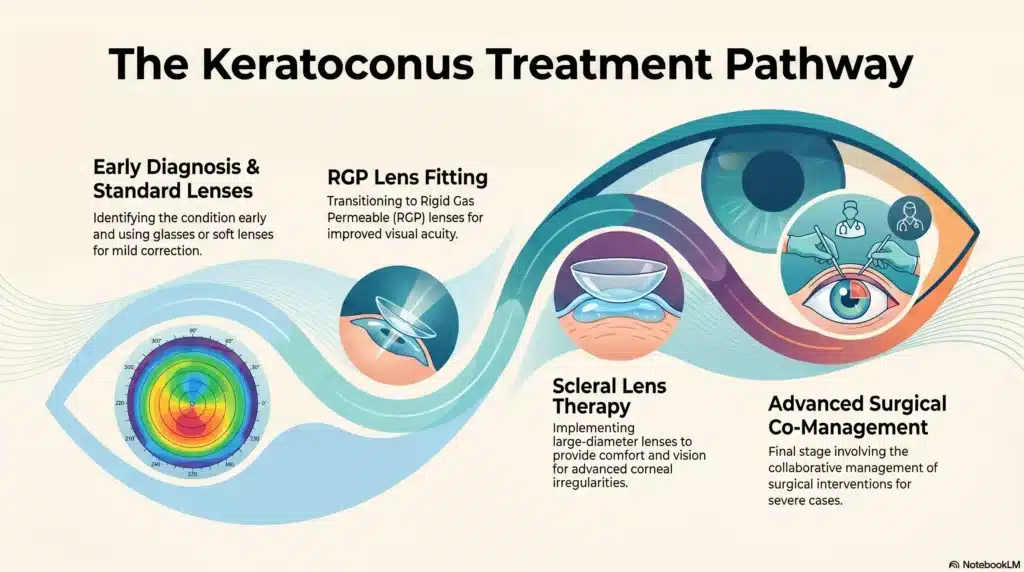
Early Stage: In the earliest presentations, updated glasses or soft contact lenses may provide adequate vision correction as the cornea has not yet changed shape significantly. However, this stage is temporary, and regular monitoring is essential.
Moderate Stage: As the cornea becomes more irregular, rigid gas-permeable (RGP) contact lenses become necessary. Their firm structure creates a smooth, artificial surface over the cone, producing clearer vision than soft lenses can achieve on an irregular surface.
Preferred Standard — Scleral Lenses: For most keratoconus patients requiring specialty lens correction, custom scleral contact lenses represent the gold standard. They provide exceptional comfort, stability, and visual clarity — and they are the primary specialty lens solution offered at West Broward Eye Care.
Advanced Cases: In a minority of patients whose condition progresses beyond what contact lens correction can manage, procedures such as corneal collagen cross-linking (CXL) or surgical co-management may be indicated. Our team provides appropriate referrals and co-management for these cases.
| Stage | Condition Severity | Recommended Treatment | Available at WBEC |
|---|---|---|---|
| Early | Mild corneal irregularity | Updated glasses or soft contacts | ✅ Yes |
| Moderate | Increasing irregular astigmatism | Rigid gas-permeable (RGP) lenses | ✅ Yes |
| Advanced | Significant corneal distortion | Custom scleral lenses (SMap3D fitted) | ✅ Yes |
| Severe | Contact lens intolerance | Surgical co-management / CXL referral | ✅ Co-managed |
Scleral Lens Fitting in Tamarac — What to Expect at West Broward Eye Care
Why Scleral Lenses Are the Gold Standard for Keratoconus
For patients with moderate to advanced keratoconus, scleral contact lenses are not simply a better option — they are frequently life-changing. Understanding why begins with understanding what makes them fundamentally different from every other lens type.
A standard contact lens, whether soft or rigid, is sized to sit directly on the cornea. For a keratoconus patient, this creates an immediate problem: the cone-shaped cornea prevents the lens from sitting stably, making vision correction unreliable and wear deeply uncomfortable.
Scleral lenses solve this problem elegantly. With a diameter significantly larger than conventional lenses, a scleral lens vaults completely over the cornea — making no contact with it whatsoever. Instead, the lens rests gently on the white of the eye, the sclera, which is far less sensitive and far more structurally stable. The space between the back surface of the lens and the front of the cornea is filled with a reservoir of sterile, unpreserved saline solution — creating a smooth, perfectly uniform optical surface through which light passes cleanly into the eye.
The clinical benefits are substantial: dramatically sharper and more stable vision, all-day comfort without the irritation that RGP lenses can cause, continuous corneal hydration from the fluid reservoir, and a protective barrier that shields the delicate corneal surface from exposure throughout the day.
The WBEC Scleral Lens Fitting Process — Step by Step
Fitting scleral lenses for keratoconus is a clinical art as much as a science. At West Broward Eye Care, our process is structured, thorough, and centered entirely on achieving the best possible outcome for each individual patient.
Step 1 — Comprehensive Eye Health Evaluation Your journey begins with a full assessment of your eye health, visual needs, and the current state of your corneal condition. Our physicians review your history, your symptoms, and any previous lens experiences to build a complete clinical picture.
Step 2 — SMap3D Corneal Mapping Using our SMap3D technology, we generate a precise three-dimensional map of your corneal surface. This map is the foundation of your custom lens design — capturing every curve and irregularity of your unique corneal topography.
Step 3 — Custom Lens Design and Trial Fitting Based on your corneal map and clinical assessment, our specialists design a scleral lens precisely matched to your eye. Trial lenses are fitted in-office, and adjustments are made in real time to optimize both comfort and visual acuity.
Step 4 — Patient Training Our team provides comprehensive, hands-on instruction in the correct technique for inserting, removing, and caring for your scleral lenses — including proper filling with sterile saline solution. We remain with you through every step of the learning process until you feel fully confident.
Step 5 — Follow-Up and Optimization Keratoconus is a progressive condition, and your lens needs may evolve over time. Our follow-up care protocol ensures that your lenses continue to provide optimal vision and comfort — with adjustments made as needed to stay ahead of any changes in your corneal shape.
📅 Ready to find out if scleral lenses are right for you? Book your specialty keratoconus evaluation at West Broward Eye Care. Visit us at 7822 N. University Dr., Tamarac, FL 33321 or call or text us at 954-726-0204.
Why Tamarac Patients Choose West Broward Eye Care for Keratoconus
Choosing the right specialist for a progressive condition like keratoconus is one of the most important healthcare decisions you will make. West Broward Eye Care has earned the trust of the Tamarac community — and the broader Broward County region — through a combination of clinical excellence, advanced technology, and a patient-first philosophy that is reflected in every interaction.
35 Years of Community Trust: Since our founding, West Broward Eye Care has been a fixture of the Tamarac community’s healthcare landscape. This longevity is not simply a number — it represents decades of established patient relationships, a deep understanding of our local community’s needs, and a reputation built one patient at a time.
Nationally Recognized Physician Expertise: Our team includes Dr. Brianna Rhue, OD, FAAO — a board-certified optometric physician who completed her residency at the prestigious Bascom Palmer Eye Institute and is a nationally recognized leader in specialty contact lens management. Dr. Isabel Carvajal, OD, brings dedicated expertise in fitting custom therapeutic contact lenses for keratoconus, making our practice one of the most thoroughly credentialed keratoconus teams in Broward County.
Technology That Sets Us Apart: As one of the first practices in the United States to adopt SMap3D corneal mapping technology — combined with Optomap retinal imaging and Optovue OCT — West Broward Eye Care operates at a diagnostic and fitting standard that most area practices simply cannot match.
A Patient Experience Unlike Any Other: Our 885+ Google reviews speak to an experience that goes far beyond a clinical transaction. Patients consistently describe a team that takes time, listens carefully, and explains everything with genuine clarity. One patient described their appointment as receiving a “mini PhD” on their own eye condition — and that level of invested, educational care is standard at West Broward Eye Care, not the exception.
Living With Keratoconus in South Florida — Local Factors That Matter
For patients in Tamarac and across Broward County, the local environment creates a specific set of considerations that residents elsewhere may not face — and that make local specialist access particularly important.
UV Exposure and Corneal Stress: South Florida’s year-round sun intensity places the eyes under persistent ultraviolet stress. While UV exposure is not a direct cause of keratoconus, evidence suggests it may contribute to corneal weakening in already-susceptible individuals. This makes protective eyewear and consistent eye health monitoring especially important for Tamarac residents — and it is a factor our team incorporates into every comprehensive evaluation.
Seasonal Allergies and Eye Rubbing: Broward County’s climate supports year-round allergens, and allergic eye disease is among the most significant behavioral risk factors for keratoconus progression. Chronic eye rubbing — driven by itching and irritation — is strongly associated with accelerated corneal thinning. Our physicians provide guidance on allergy management as part of a comprehensive keratoconus care strategy.
Contact Lens Comfort in a Humid Climate: South Florida’s humidity and heat affect how contact lenses wear through the day. For scleral lens patients, the fluid reservoir design actually provides a natural advantage in this environment — maintaining consistent corneal hydration even in warm, outdoor conditions.
These are not abstract considerations. They are the lived daily reality of our patients — and they are the reason having a dedicated, local keratoconus specialist in Tamarac matters.
🔗 Local Resources & Citations
1. National Eye Institute (NEI) — NIH.gov: Keratoconus & Corneal Conditions The U.S. government’s primary eye health research authority — check here for clinically verified, plain-language information on keratoconus causes, symptoms, and the latest federally funded treatment research.
2. Florida Agency for Health Care Administration — FloridaHealthFinder.gov: Keratoconus Health Encyclopedia Florida’s official state health information portal — use this resource to access the AHCA’s verified clinical overview of keratoconus, including progression stages and treatment pathways recognized under Florida healthcare standards.
3. Florida Board of Optometry — FloridaOptometry.gov: Verify a Provider License The official Florida Department of Health licensing board for optometrists — use the License Look-Up tool here to instantly verify that your eye care provider holds an active, board-certified license to practice in the state of Florida.
4. Nova Southeastern University College of Optometry — Nova.edu: Broward County Eye Care & Corneal Disease Research Florida’s only accredited optometry school, located in Broward County — the same institution where West Broward Eye Care physicians trained; reference here for academic-level information on corneal disease, specialty contact lenses, and South Florida optometric standards of care.
🏥 Don’t wait for your vision to get worse. West Broward Eye Care’s keratoconus specialists are ready to help you see clearly — and comfortably — again.
📍 7822 N. University Dr., Tamarac, FL 33321 📞 954-726-0204 (Call or Text) ✉️ info@wbeca.com
Office Hours: Monday – Thursday: 9:00 AM – 5:00 PM Friday: 9:00 AM – 4:00 PM
[ BOOK YOUR APPOINTMENT ] [ ORDER CONTACTS ] [ SHOP EYEWEAR ]
Frequently Asked Questions
-
The earliest signs of keratoconus include blurred or distorted vision that your glasses cannot fully correct, increased sensitivity to light and glare, and the need for frequent prescription changes. Many patients also notice halos around lights at night or ghost images in one eye. These symptoms often appear gradually in adolescence or early adulthood and are frequently mistaken for standard nearsightedness or astigmatism — which is why a specialist evaluation with advanced corneal mapping is essential if you notice these patterns
Disclaimer: The information provided in this article is for educational and informational purposes only and is not intended as a substitute for professional medical advice, diagnosis, or treatment. Always seek the advice of a qualified optometrist or ophthalmologist with any questions you may have regarding a medical condition or vision changes. If you are experiencing sudden vision loss or eye pain, contact an eye care professional or visit an emergency room immediately.