Macular Degeneration Eye Exam: Early Detection & Treatment Options
What Is a Macular Degeneration Eye Exam?A macular degeneration eye exam is a comprehensive diagnostic evaluation that assesses the health of the macula — the central part of your retina responsible for sharp, detailed vision. Using advanced imaging technology such as Optomap ultrawide retinal scanning and Optovue OCT, eye doctors in Tamarac, FL can detect early signs of age-related macular degeneration (AMD) before symptoms appear, allowing for timely intervention that preserves vision and quality of life.
| Key Facts | Details |
|---|---|
| Condition | Age-Related Macular Degeneration (AMD) |
| Who It Affects | Adults 50+; higher risk with UV exposure, family history, smoking |
| Early Symptom | Often none — detected only through comprehensive eye exam |
| Detection Tools | Optomap Retinal Imaging, Optovue OCT |
| Local Provider | West Broward Eye Care, Tamarac, FL |
| Contact | 954-726-0204 (Call or Text) |
If you or someone you love is over 50 and living in the Tamarac area, there is one eye condition that demands your attention — even if your vision feels perfectly fine right now. Age-related macular degeneration, known as AMD, is the leading cause of permanent central vision loss in older adults in the United States. It progresses quietly, often without any noticeable symptoms in its earliest and most treatable stages.
At West Broward Eye Care, located at 7822 N. University Dr., Tamarac, FL 33321, our board-certified optometric physicians have been helping Broward County families protect their sight for over 35 years. Using state-of-the-art diagnostic technology, we are uniquely equipped to detect macular degeneration at its earliest stage — giving you the best possible chance of preserving the vision you depend on every day.
What Is Macular Degeneration? A Tamarac Patient’s Guide
The macula is a small but extraordinarily important structure located at the center of your retina — the light-sensitive tissue lining the back of your eye. It is responsible for the sharp, central vision you rely on for reading a book, recognizing a loved one’s face, driving safely through Tamarac’s neighborhoods, and seeing fine detail in everyday life.
Macular degeneration occurs when the cells of the macula begin to deteriorate over time. As this damage accumulates, your central vision gradually dims, blurs, or distorts — while your peripheral, or side, vision typically remains intact. Left undetected and unmanaged, AMD can progress to a point where central vision is lost entirely, making independent daily living significantly more challenging.
Understanding the two distinct forms of this disease is the first step toward protecting yourself.
Dry AMD vs. Wet AMD — Understanding the Difference
Dry AMD is by far the most common form, accounting for the vast majority of diagnoses. It develops when tiny yellow protein deposits called drusen accumulate beneath the macula, gradually causing the light-sensitive cells in that region to thin and lose function. Dry AMD tends to progress slowly over months or years, and in its early stages, it may cause no noticeable vision changes whatsoever. However, as it advances, patients may experience blurred or dim central vision, increased difficulty reading small print, and a need for brighter light to perform close-up tasks. In some cases, dry AMD advances into the more serious wet form.
Wet AMD, while less common, is considerably more aggressive. It occurs when abnormal blood vessels grow beneath the retina and begin to leak fluid or blood into the macular tissue. This leakage causes rapid distortion and deterioration of central vision. Patients with wet AMD often notice that straight lines appear wavy or bent — a phenomenon detectable using a simple tool called an Amsler Grid. Unlike dry AMD, wet AMD can cause significant vision loss in a matter of weeks if not treated promptly.
Who Is at Risk? Risk Factors Specific to South Florida Residents
While AMD can affect anyone as they age, certain factors significantly elevate your risk. Age is the most powerful predictor — adults over 50 face meaningfully higher risk, and that risk increases with each passing decade. A family history of AMD, cigarette smoking, obesity, and high blood pressure are all well-established contributors.
For residents of Tamarac and the broader South Florida region, there is an additional and often overlooked risk factor: chronic UV exposure. South Florida’s intense year-round sunshine means that residents accumulate far more cumulative ultraviolet radiation exposure than those in cooler, cloudier climates. Prolonged UV exposure has been linked to oxidative stress in retinal tissue — a mechanism believed to accelerate macular degeneration in susceptible individuals. Protecting your eyes with high-quality UV-blocking lenses is one of the most impactful preventative steps a South Florida resident can take, and it is a conversation our team is always ready to have with you.
The Silent Threat — Why AMD Has No Early Warning Signs
Here is what makes age-related macular degeneration particularly dangerous: in its earliest and most treatable stages, it produces absolutely no symptoms you can feel or see on your own.
There is no pain. There is no sudden blurring. There is no dramatic signal that something is wrong. The drusen deposits that mark early dry AMD are invisible without specialized imaging equipment. The gradual thinning of macular cells happens so slowly that your brain often compensates, masking the early changes from your awareness.
By the time a patient notices that their central vision feels off — that words on a page seem smudged, that faces look less defined, that a straight door frame appears slightly bent — the disease has typically already progressed beyond its earliest stage.
This is the single most important reason why a comprehensive eye exam with advanced retinal imaging is not optional for adults over 50. It is your only reliable defense against a disease that will not announce itself. The doctors and staff at West Broward Eye Care understand the anxiety that comes with any vision concern, and we are here to give you clarity, answers, and a proactive plan — not just an eye chart reading.
📅 Don’t wait for symptoms to appear. Schedule your AMD screening at West Broward Eye Care today. Call or text 954-726-0204 — our friendly team is ready to help you protect what matters most.
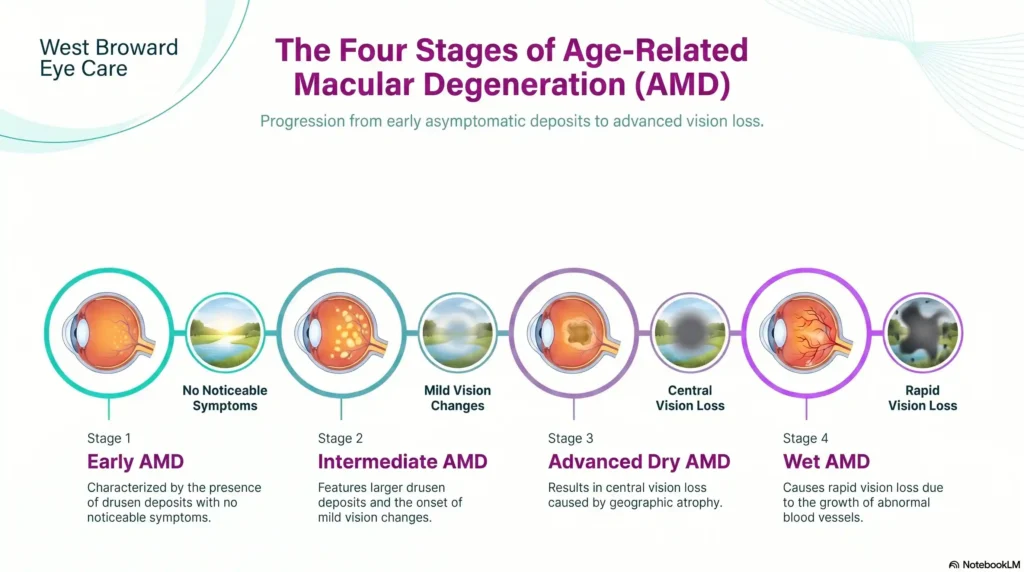
| AMD Stage | Key Characteristics | Typical Symptoms | Action Required |
|---|---|---|---|
| Early Dry AMD | Small drusen deposits under macula | None | Annual Optomap screening |
| Intermediate AMD | Medium-to-large drusen; pigment changes | Mild blurring; need more light | Monitoring every 6 months |
| Advanced Dry AMD | Geographic atrophy; macular cell death | Blurry or blank central vision | Active management + AREDS2 |
| Wet AMD | Abnormal leaking blood vessels | Rapid distortion; wavy lines | Urgent anti-VEGF treatment |
Advanced AMD Detection at West Broward Eye Care — Our Technology Advantage
Not all eye exams are created equal. A standard vision screening at a retail optical chain checks your prescription. A comprehensive AMD detection exam at West Broward Eye Care does something entirely different — it gives our physicians a detailed, high-resolution map of your retinal health, enabling detection of changes that would be completely invisible to traditional methods.
This is where our investment in advanced diagnostic technology becomes your most powerful asset.
Optomap Ultrawide Retinal Imaging — Seeing 80% of Your Retina in One Scan
The Optomap ultrawide retinal imaging system represents a fundamental leap forward in retinal health assessment. Traditional retinal examination methods capture approximately 10–15% of the retinal surface in a single view, requiring multiple images and, in many cases, uncomfortable dilating eye drops to achieve an adequate examination.
Optomap changes this entirely. In a single, comfortable, non-invasive scan that takes less than half a second, Optomap captures more than 80% of your retina in one panoramic image. You simply look into the device — like peering through a keyhole — and a gentle flash of light creates a high-resolution map of your retinal health. No physical contact. No discomfort. No waiting for dilation to wear off before you can drive home.
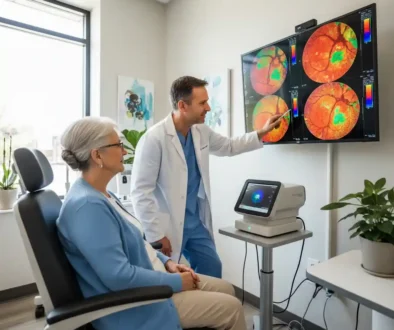
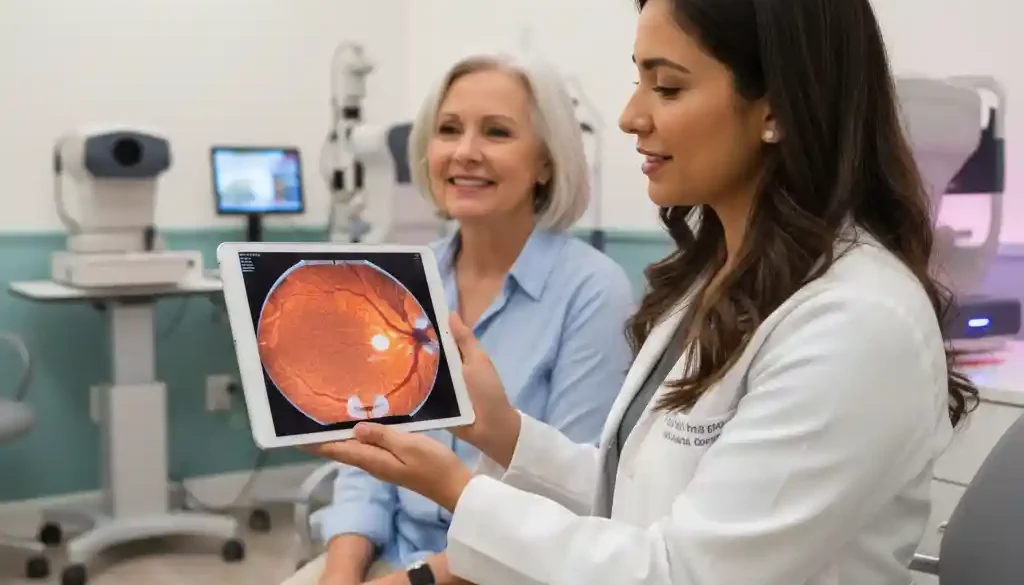
For AMD detection specifically, Optomap gives our physicians the ability to identify the earliest accumulations of drusen beneath the macula, observe pigmentary changes that signal disease activity, and track retinal health changes from year to year using your saved imaging history. Our doctors can show you your own retinal image and walk you through exactly what they see — putting you in the driver’s seat of your own eye health.
Optovue OCT — Microscopic Precision for Early-Stage AMD
While Optomap provides the wide view, the Optovue Optical Coherence Tomography (OCT) system provides the deep view. Think of it as the difference between a panoramic photograph of a landscape and a geological cross-section of the ground beneath it. Both perspectives are essential for a complete understanding.
Optovue uses light waves — without any radiation — to create extraordinarily detailed cross-sectional images of the individual layers of your retinal tissue. For AMD monitoring, this capability is invaluable. OCT imaging allows our physicians to measure the precise thickness of macular tissue layers, detect the earliest accumulations of sub-retinal fluid that signal the transition from dry to wet AMD, and quantify the degree of geographic atrophy in advanced dry AMD cases. Changes that are entirely invisible to standard examination — or even to Optomap alone — become clearly visible with Optovue OCT.
How Optomap and Optovue Work Together for Superior AMD Detection
This dual-technology approach is what truly separates West Broward Eye Care from standard vision centers in the Tamarac area — and from most eye care providers in Broward County.
Optomap delivers the broad, ultrawide retinal map — identifying areas of concern across the full retinal landscape. Optovue then focuses precisely on those areas of concern, providing microscopic cross-sectional detail that confirms findings and tracks progression with clinical precision. Together, they create a comprehensive picture of your macular health that is far greater than either technology could produce alone.
This is not simply advanced technology for its own sake. It is a deliberate, strategic investment in your ability to detect AMD at the stage when intervention is most effective — before you have lost a single line of vision. It reflects the same commitment to excellence that West Broward Eye Care has brought to this community for 35 years.
What to Expect During a Macular Degeneration Eye Exam at Our Tamarac Office
We understand that stepping into any medical office can feel daunting, especially when you are concerned about your vision. At West Broward Eye Care, our entire team is committed to making your visit feel as comfortable, clear, and reassuring as possible.
When you arrive at our office at 7822 N. University Dr., Tamarac, FL 33321, you will be welcomed by a friendly front desk team and typically seen with minimal wait time. Our patients consistently note in their reviews that our office runs promptly and that the atmosphere is warm and professional.
Your AMD evaluation will typically follow this comfortable progression. Your doctor will begin with a thorough review of your medical and family history, including any risk factors for retinal disease. Your Optomap ultrawide retinal scan will be performed — a quick, painless process that takes seconds. Where indicated, your Optovue OCT imaging will follow, providing the detailed cross-sectional analysis of your macular layers. Your board-certified physician will then review both sets of imaging with you directly, walking you through what each image reveals about your retinal health. Patients frequently tell us they leave feeling like they have received a thorough, personalized education on their own eye health — not just a clinical verdict. Finally, your doctor will outline a clear, individualized care plan — whether that means annual monitoring, proactive lifestyle recommendations, or a referral for advanced treatment if needed.
With over 885 Google reviews reflecting the consistent experience of feeling genuinely cared for and thoroughly informed, you can walk through our door with confidence.
Treatment Options for Macular Degeneration — What Our Doctors Recommend
While there is currently no cure for AMD, the treatment landscape has advanced significantly in recent years. The goal of treatment is to slow progression, preserve as much central vision as possible, and maintain your quality of life and independence for as long as possible. The right approach depends on the type and stage of your condition.
Managing Dry AMD — Nutrition, Lifestyle & AREDS2 Supplements
For patients diagnosed with intermediate or advanced dry AMD, the landmark Age-Related Eye Disease Study 2 (AREDS2), conducted by the National Eye Institute, demonstrated that a specific formulation of antioxidant vitamins and minerals can meaningfully reduce the risk of progression to advanced AMD. The AREDS2 formula includes Vitamin C, Vitamin E, lutein, zeaxanthin, and zinc — nutrients that support macular cell health and help combat the oxidative damage believed to drive AMD progression.
Our physicians will advise you on whether AREDS2 supplementation is appropriate for your specific stage of disease, and will pair this recommendation with practical lifestyle guidance — protecting your eyes from UV exposure with quality sunwear, maintaining a leafy-green-rich diet, managing blood pressure and weight, and ceasing tobacco use if applicable. We will also teach you how to use an Amsler Grid at home — a simple self-monitoring tool that allows you to detect changes in your central vision between appointments and report them promptly.
Treating Wet AMD — Advanced Therapies Available in Broward County
For patients who develop wet AMD, prompt treatment is essential, as this form of the disease can cause rapid and irreversible vision loss if left unaddressed. The current gold standard treatment for wet AMD is anti-VEGF (anti-vascular endothelial growth factor) therapy — a series of precisely administered injections that block the growth of the abnormal blood vessels responsible for fluid leakage and macular damage.
Anti-VEGF therapy has transformed the prognosis for wet AMD patients, with many experiencing not only a halt in progression but measurable improvement in vision. In cases where anti-VEGF therapy is needed, our board-certified physicians will coordinate your care with trusted retinal specialists in the Broward County network, ensuring seamless continuity between your ongoing optometric care with us and any specialist treatment you receive. You will never be left to navigate a complex diagnosis alone. We serve as your trusted guide and primary advocate through every step of your eye health journey.
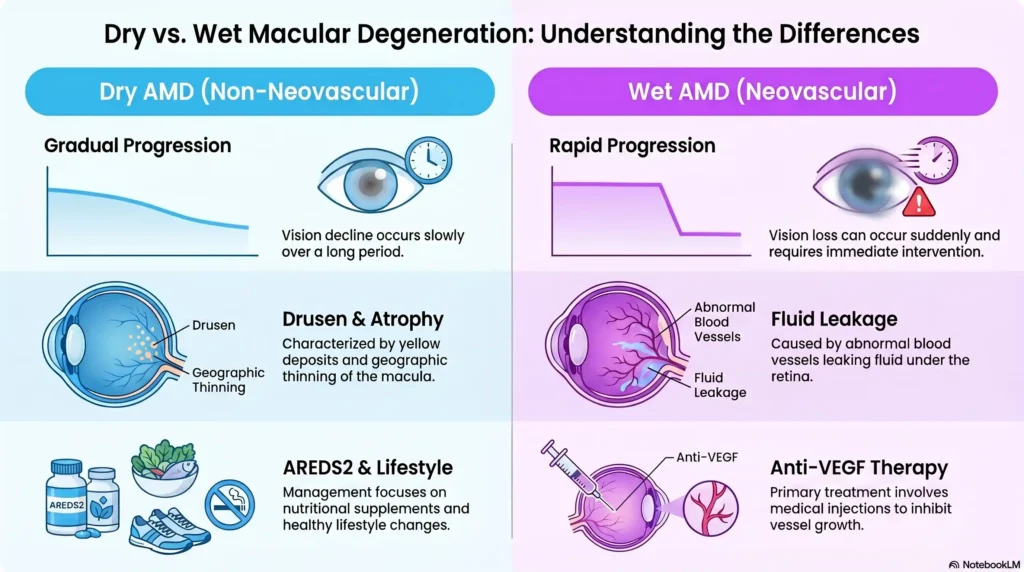
| Dry AMD | Wet AMD | |
|---|---|---|
| Prevalence | ~85–90% of AMD cases | ~10–15% of AMD cases |
| Progression Speed | Slow (months to years) | Rapid (weeks to months) |
| Key Marker | Drusen deposits; geographic atrophy | Abnormal blood vessel growth; fluid leakage |
| Primary Symptom | Gradual blurring; need more light | Distorted/wavy lines; sudden vision decline |
| Detection Tool | Optomap + Optovue OCT | Optomap + Optovue OCT (urgent) |
| Treatment Approach | AREDS2 supplements; lifestyle; monitoring | Anti-VEGF injections; specialist co-management |
| Vision Outcome | Managed decline; independence preserved | Stabilization or improvement with prompt care |
Serving Tamarac & Broward County for 35 Years — Our Commitment to Your Vision
West Broward Eye Care is not a chain. We are not a pop-up optical. We are a fixture of this community — a practice that has cared for Tamarac families, seniors, and neighbors across every stage of life for more than three decades.
The Tamarac community has one of Broward County’s most significant senior populations, and the trust those residents place in their healthcare providers is something our team does not take lightly. We have watched children grow into adults, guided families through first prescriptions and first diagnoses, and been the steady hand that catches serious eye disease early — before it has the chance to steal someone’s independence.
Our board-certified optometric physicians bring that same depth of commitment to every AMD examination. When you sit across from one of our doctors, you are not speaking with someone who will rush you through an appointment. You are speaking with a physician who will take the time to make sure you understand exactly what is happening with your vision, what your options are, and what the road forward looks like — clearly, compassionately, and completely.
That is the West Broward Eye Care difference. And it is a difference that 35 years of Tamarac families have trusted with the most precious sense they have.
🌟 Join thousands of Tamarac neighbors who trust West Broward Eye Care with their vision. Book your comprehensive AMD eye exam online or call/text 954-726-0204. We are proud to serve you Monday–Thursday 9:00 AM–5:00 PM and Friday 9:00 AM–4:00 PM.
🔗 Local Resources & Citations
1. National Eye Institute (NEI) — nei.nih.gov The federal government’s lead agency for eye disease research, providing patients with clinically verified information on AMD symptoms, stages, AREDS2 supplement guidance, and the latest treatment advances — use this to verify any information your eye doctor shares about macular degeneration.
2. Broward County Elderly & Veterans Services Division — broward.org The official Broward County government division providing health support services, community care programs, and referral assistance for seniors 60 and older in Tamarac and surrounding areas — contact them at 954-357-6622 to explore resources that may support your eye care journey.
3. Area Agency on Aging of Broward County (ADRC) — adrcbroward.org Broward County’s official one-stop senior services hub offering Medicare guidance, health referrals, and caregiver support for residents 60 and older — call their Elder Helpline at 954-745-9779 to find assistance programs that can help cover vision care costs.
4. Nova Southeastern University College of Optometry — optometry.nova.edu Florida’s only accredited optometry college, located in nearby Davie, FL, whose published clinical research and training standards in retinal disease and macular degeneration directly inform the advanced level of care practiced by board-certified optometric physicians in the Broward County region.
Protect Your Central Vision — Schedule Your AMD Exam Today
Age-related macular degeneration is one of the most serious threats to your long-term vision health. But it is not inevitable. And it is not unmanageable. With the right diagnostic technology, the right clinical team, and a commitment to regular monitoring, AMD can be detected early, managed proactively, and robbed of its ability to rob you of your sight.
At West Broward Eye Care, we have the tools, the expertise, and the 35-year community legacy to be the partner you need in that fight. Our Optomap and Optovue technology gives our board-certified physicians a level of diagnostic precision that is simply unavailable at standard vision centers — and our compassionate, patient-first team ensures that every visit leaves you feeling informed, reassured, and genuinely cared for.
Do not wait for symptoms. Do not assume that clear vision today means healthy vision tomorrow. Take the proactive step that could preserve your sight for years to come.
📍 West Broward Eye Care 7822 N. University Dr., Tamarac, FL 33321 📞 Call or Text: 954-726-0204 ✉️ info@wbeca.com 🕐 Mon–Thu: 9:00 AM–5:00 PM | Fri: 9:00 AM–4:00 PM
Frequently Asked Questions
-
In its earliest stage, macular degeneration typically produces no noticeable symptoms — which is precisely why regular eye exams are essential. As AMD progresses, early signs may include blurry or fuzzy central vision, difficulty reading small print even with glasses, a need for increasingly bright light for close-up tasks, and straight lines appearing slightly wavy or distorted. If you notice any of these changes, contact West Broward Eye Care at 954-726-0204 promptly — early intervention makes a significant difference in outcomes.
Medical Disclaimer: The information provided in this article is for educational and informational purposes only and is not intended as medical advice. It should not be used as a substitute for professional diagnosis, treatment, or consultation with a qualified eye care provider. Always seek the advice of your optometrist or ophthalmologist with any questions you may have regarding your vision, eye health, or specific medical conditions. Do not disregard professional medical advice or delay in seeking it because of something you have read on this website.