The Hidden Link Between Chronic Headaches and Your Vision
 Introduction: When the Pain Isn’t Just “Stress”
It starts as a dull throb behind your brow at 2:00 PM. By the time you’re driving home along University Drive, hitting that inevitable traffic near Commercial Blvd, it’s a full-blown pounding sensation. You assume it’s stress, dehydration, or maybe just the relentless Florida heat. You take an ibuprofen, drink some water, and hope it passes.
But what if your headache isn’t starting in your head? What if it’s starting in your eyes?
At West Broward Eyecare Associates, we often see patients who have visited neurologists, ENTs, and primary care physicians seeking relief for chronic headaches, only to find the solution in our exam chair. As your “Trusted Vision Guardians,” we believe in looking deeper than the prescription. We don’t just want you to see 20/20; we want you to live pain-free.
For many residents in Tamarac and Coral Springs, the connection between ocular health and chronic pain is the missing piece of the puzzle. This comprehensive guide will help you understand the critical connection between your vision and your headaches, and how to know when it’s time to see an eye doctor instead of reaching for the pill bottle.
Part 1: The “Eye Strain” Headache (Digital Visual Distress)
In our modern lives, our eyes are under siege. Between smartphones, tablets, and office workstations, the average Tamarac resident spends over 9 hours a day looking at screens. This leads to a specific condition known as Computer Vision Syndrome (CVS) or Digital Eye Strain.
The Mechanism of Pain: Why It Hurts
Unlike a migraine, which is neurological, an eye strain headache is fundamentally muscular. Your eyes have tiny muscles (the ciliary muscles) that contract to focus on close-up objects. Imagine holding a 5-pound weight at arm’s length. After a minute, your arm shakes. After an hour, your shoulder screams in pain.
Your eyes are doing this “heavy lifting” all day. When these muscles fatigue, the pain refers—or radiates—often feeling like a tight band across the forehead or a deep, bruising ache behind the eyes.
Signs Your Headache is Screen-Related:
-
The “5 PM Fade”: The pain typically worsens as the day progresses, peaking in the late afternoon or early evening.
-
Orbital Localization: The pain is centered specifically behind the eyes or directly above the eyebrows, rather than at the base of the neck.
-
Visual Accompaniments: Often paired with dry, gritty eyes, or specialized blurriness where text goes in and out of focus.
The “Blue Light” Factor
Many patients ask us if blue light glasses are the cure. While blue light can disrupt sleep cycles, the headache is usually caused by focusing fatigue, not just the light spectrum. While we recommend blue-light filtering coatings for protection, they are not a magic cure if your prescription is outdated or your alignment is off.
Expert Tip: Follow the 20-20-20 Rule. Every 20 minutes, look at something 20 feet away for 20 seconds. This fully relaxes the focusing muscle, “resetting” your eye strain meter.
Part 2: The Silent Culprit – Binocular Vision Dysfunction (BVD)
This is the most overlooked cause of chronic headaches we see at West Broward Eyecare Associates. It is estimated that up to 10% of the population suffers from some form of binocular vision issue, yet it often goes undiagnosed in standard “20/20” screenings.
Binocular Vision Dysfunction (BVD) occurs when your two eyes are slightly misaligned. It might be such a tiny vertical or horizontal misalignment that a standard eye exam misses it. However, your brain refuses to see double, so it forces your eye muscles to constantly strain to realign the images.
The “Micro-Correction” Cycle
Your brain is making thousands of micro-corrections every minute to keep your vision singular. This constant physical effort leads to a condition called Trigeminal Dysphoria—overstimulation of the trigeminal nerve, which is responsible for most head and neck sensations.
Common Symptoms of BVD include:
-
Dizziness or Vertigo: Especially in large, open spaces with visual clutter—like walking down the aisles at the Publix on Commercial Blvd or navigating the sawgrass mills mall.
-
Motion Sickness: Feeling queasy in cars, or being unable to read as a passenger.
-
The Head Tilt: You might notice you tilt your head to one side slightly to help your eyes align vertically.
-
The Temple Headache: A severe, persistent ache at the temples or base of the skull.
The Solution: If we diagnose BVD, specialized prism lenses can be prescribed. These lenses bend the light to meet your eyes where they are, allowing your muscles to finally relax. We have had patients suffer for years find relief in a single week with the right prism prescription.
Part 3: Is it Sinus Pressure or Your Eyes?
Living in South Florida, allergy season is practically year-round. Many patients confuse sinus headaches with eye-related headaches because the pain centers are inches apart. Here is how to tell the difference:
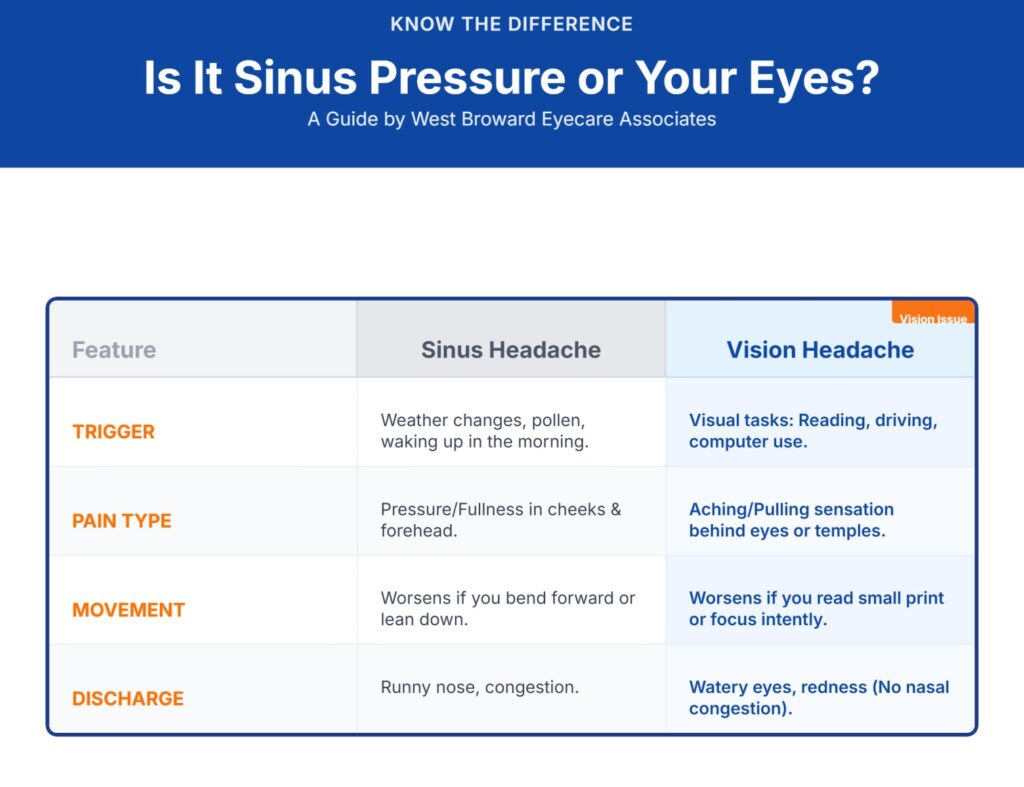
If you treat your “sinus” headache with decongestants for weeks and see no improvement, it is rarely a sinus issue. It is time to schedule an eye exam.
Part 4: The “Red Flag” Headaches – When to Seek Emergency Eye Care
While most eye headaches are muscular or refractive, some are warnings of serious ocular health issues. As a practice that offers Emergency Eye Care, we want you to be vigilant about these symptoms.
1. Acute Angle-Closure Glaucoma
This is a medical emergency.
-
Symptom: Sudden, excruciating eye pain accompanied by a severe headache, nausea, vomiting, and seeing “halos” or rainbows around lights.
-
Action: Call us immediately or go to the ER. High eye pressure can damage the optic nerve permanently within hours. Learn more about Glaucoma symptoms.
2. Giant Cell Arteritis (GCA)
Common in patients over 50.
-
Symptom: A persistent throbbing headache in the temples, accompanied by scalp tenderness (it hurts to brush your hair) and jaw pain when chewing.
-
Risk: Can lead to sudden, permanent blindness.
3. Ocular Migraines
These can be terrifying but are often harmless. You may see a jagged, shimmering line (like a heat wave) move across your vision for 20 minutes, followed by a headache. While often benign, a sudden onset of visual auras needs to be checked to rule out retinal tears.
Part 5: Pediatric Headaches – A Parent’s Guide
For our “Family Health Managers,” nothing is scarier than a child in pain. If your child complains of headaches—especially after school—do not assume they are just tired or avoiding homework.
Undiagnosed Vision Issues in Children:
-
Hyperopia (Farsightedness): Kids have strong focusing muscles and can “mask” farsightedness, but the effort gives them headaches.
-
Convergence Insufficiency: The inability to keep eyes turned inward while reading. This is a leading cause of reading avoidance.
-
Myopia (Nearsightedness): Squinting to see the whiteboard creates tension headaches.
Watch for these clues:
-
Does the headache occur Monday-Friday but disappear on weekends?
-
Does your child skip words when reading or use a finger to track?
-
Do they rub their eyes frequently or close one eye to read?
At West Broward Eyecare Associates, our pediatric exams go beyond the “letter chart” to test how the eyes work together as a team.
Part 6: The West Broward Difference – Our Headache Protocol
When you come to us with a complaint of chronic headaches, we don’t just check if you need glasses. We perform a Binocular Vision Assessment.
1. Comprehensive Refraction
We check for small amounts of Astigmatism or hyperopia that other exams might gloss over. Even a 0.50 diopter uncorrected prescription can cause massive headaches for a computer user.
2. Ocular Motility Testing
We test how your eyes move, track, and team together. Can they converge on a single point without one drifting away?
3. Retinal Health Check
Using our advanced Optomap® technology, we can see the back of your eye without dilation drops (in many cases). This allows us to rule out high intracranial pressure (swollen optic nerve), which can be a sign of neurological issues causing headaches.
4. Personalized Lens Technology
We don’t just sell glasses; we prescribe medical devices.
-
Anti-Fatigue Lenses: These have a small “boost” of power at the bottom to relax your focusing muscles during screen time.
-
Prism Correction: For BVD patients, this is life-changing.
-
Contact Lenses: Often a better option for those with high prescriptions to reduce peripheral distortion.
Part 7: Lifestyle Adjustments for the Florida Resident
Living in Tamarac presents unique challenges for your eyes that can trigger headaches. Here is how to headache-proof your environment.
1. Manage the Glare The Florida sun reflects off pavement and car hoods, causing “disability glare.” This forces you to squint, triggering tension headaches.
-
Solution: Polarized sunglasses are non-negotiable here. They block horizontal glare that standard tinted lenses miss.
2. The A/C Factor Air conditioning runs 24/7 in South Florida. This dries out the tear film. A dry cornea is an imperfect optical surface, forcing your eye to strain to focus—leading to headaches.
-
Solution: Use preservative-free artificial tears throughout the day. What options do you have for dry eyes? Check our guide to relief.
3. Workspace Ergonomics If you work from home, ensure your monitor is slightly below eye level. Looking up exposes more of the eye surface (drying it out) and strains the neck muscles, which can trigger tension headaches.
Conclusion: Your Path to a Pain-Free Life
You do not have to live with chronic headaches. You do not have to accept that “work just hurts.”
If you have ruled out other medical causes, or if your headaches seem linked to your screen time or visual habits, the answer may be right in front of your eyes.
At West Broward Eyecare Associates, we combine the latest diagnostic technology with the compassionate care of a “Wise Family Doctor.” We don’t just check your prescription; we check the health of your visual system to ensure it’s supporting your life, not causing you pain.
Strategic Summary & Next Steps
-
Schedule a Comprehensive Exam: Specifically mention your headaches when booking.
-
Ergonomic Assessment: We can discuss your workspace setup during your visit.
-
Advanced Testing: Consider testing for binocular vision misalignment if you experience chronic dizziness or anxiety in crowded areas.
Contact West Broward Eyecare Associates today at (954) 726-0204 or schedule an appointment online to begin your journey to relief.
3. Recent Scientific Support
-
Digital Eye Strain & Headaches: A comprehensive review by the National Institutes of Health (NIH) confirms that digital eye strain encompasses symptoms like headaches and foreign body sensation, with prevalence rising up to 60% in children.
-
Binocular Vision Anomalies: Research published on PubMed highlights that subtle binocular vision anomalies (like heterophoria) are more common in migraine sufferers, suggesting a link between visual alignment and headache duration.
-
Environment & Myopia: The Myopia Profile institute outlines how the visual environment (screen time vs. outdoor time) directly impacts visual fatigue and long-term eye health in children.
-
Source: The Visual Environment in Myopia
-
FAQs
-
This is often caused by digital eye strain or a condition called Binocular Vision Dysfunction (BVD). When your eye muscles are overworked trying to focus or align images, the pain radiates directly behind the orbital bone.