Glaucoma Screening in Tamarac, FL: Who Needs It, How Often & What the Test Feels Like
Can you have glaucoma with no symptoms? Yes — and that is precisely what makes it dangerous. Glaucoma is a progressive optic nerve disease that causes permanent vision loss before most patients notice any change. A glaucoma screening is the only way to detect it early. At West Broward Eye Care — located at 7822 N. University Dr., Tamarac, FL 33321 — board-certified optometric physicians have been providing advanced glaucoma screenings using Optovue OCT and Optomap technology for over 35 years. Anyone over 40, or with a family history of glaucoma, should be screened. Call or text 954-726-0204 to schedule today.
Imagine losing your peripheral vision so gradually that your brain compensates — filling in the gaps — until one day, the damage is irreversible. That is the quiet, devastating reality of glaucoma. Unlike a sudden eye injury or the blurry vision that sends you reaching for reading glasses, glaucoma offers no early warning. No pain. No red flags. Just slow, silent damage to the optic nerve until the vision it once carried is gone forever.
For the families, retirees, and working adults of Tamarac, FL, this is not a distant medical statistic. Broward County’s aging population, its diverse communities, and South Florida’s unrelenting UV environment create a local landscape where glaucoma risk is very real — and very often overlooked. The good news is that early detection through a simple, comfortable screening can stop glaucoma in its tracks.
This guide answers the three questions Tamarac patients ask most: Who actually needs a glaucoma screening? How often should it happen? And what does the test actually feel like?
What Is Glaucoma — And Why Tamarac Residents Should Pay Attention
The “Silent Thief of Sight” — Understanding How Glaucoma Damages Vision
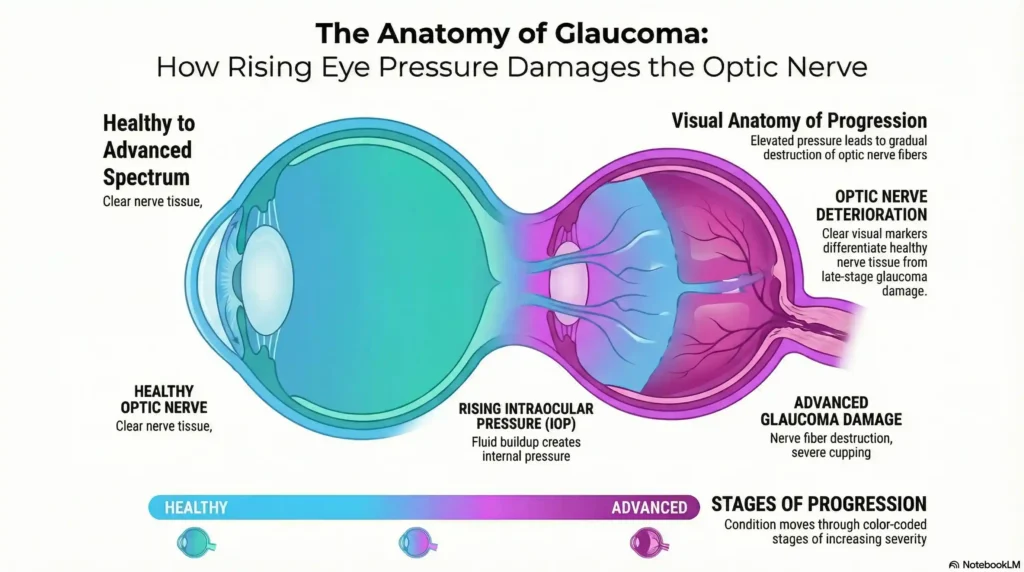
Glaucoma is not a single disease but a group of eye conditions that damage the optic nerve — the critical pathway that transmits visual information from your eye to your brain. In the most common form, open-angle glaucoma, the eye’s internal drainage system gradually becomes less efficient, causing intraocular pressure (IOP) to rise. Over time, that elevated pressure compresses and destroys optic nerve fibers. Once those fibers are gone, they do not regenerate.
What makes glaucoma uniquely dangerous is its silence. In the early and middle stages, it claims peripheral vision first — the edges of your visual field that your brain is remarkably skilled at ignoring. By the time central vision is affected and a patient finally notices something is wrong, significant, permanent damage has already occurred. According to the World Health Organization, glaucoma is the leading cause of irreversible blindness globally. Early screening is the only intervention that changes this outcome.
Why South Florida’s Demographics Make This a Local Priority
Tamarac and the surrounding Broward County communities face a convergence of glaucoma risk factors that makes awareness especially critical here.
The region’s substantial senior population is a primary concern — the risk of developing glaucoma increases significantly after age 60, and Broward County consistently ranks among Florida’s counties with the highest proportion of residents aged 65 and older. Beyond age, Tamarac’s rich demographic diversity brings additional clinical considerations. Research has consistently shown that individuals of African-American descent face a glaucoma risk three to four times higher than the general population, with onset often occurring earlier — as young as age 40. Hispanic and Latino adults over 60 also carry an elevated risk profile that warrants proactive screening.
South Florida’s climate adds another layer. Prolonged exposure to high-intensity UV radiation has been associated with oxidative stress in ocular tissues, a contributing factor to conditions like ocular hypertension — a key glaucoma precursor. Living in one of the sunniest regions in the United States is a genuine, local-specific risk factor that Tamarac residents should take seriously.
| Stage | IOP Level | Optic Nerve Status | Vision Impact |
|---|---|---|---|
| Normal | 10–21 mmHg | Healthy | No impact |
| Ocular Hypertension | 22–29 mmHg | Early stress | Usually asymptomatic |
| Early Glaucoma | 25+ mmHg | Early damage begins | Peripheral vision loss starts |
| Advanced Glaucoma | Uncontrolled | Significant damage | Tunnel vision / blindness risk |
Who Needs a Glaucoma Screening in Tamarac? (Your Risk Factor Guide)
High-Risk Groups That Should Be Screened Immediately
Some patients carry a risk profile that makes glaucoma screening not just advisable — it is essential. If any of the following apply to you or a family member, a screening should be scheduled without delay.
Age 60 and older represents one of the clearest risk thresholds in ophthalmology. After age 60, the likelihood of developing glaucoma increases substantially with every passing decade. African-American patients aged 40 and older face a particularly elevated risk — both in terms of likelihood and severity — making age 40 the appropriate screening starting point for this community. Hispanic and Latino adults over 60 also face a higher-than-average risk that too often goes unscreened due to a lack of awareness.
Family history is among the most powerful risk multipliers in eye care. If a parent or sibling has been diagnosed with glaucoma, your personal risk increases dramatically. Previous eye injuries, chronic steroid medication use — whether eye drops, oral, or inhaled — and a prior diagnosis of ocular hypertension are additional high-risk indicators that warrant immediate professional evaluation.
Moderate-Risk Groups That Should Not Wait
Even without the highest-tier risk factors, a range of common health conditions and physical characteristics can meaningfully elevate your glaucoma risk. Adults between 40 and 59 with measured ocular hypertension — elevated eye pressure without yet-detectable nerve damage — are considered glaucoma suspects and require regular monitoring. Patients managing diabetes face a dual concern: diabetic retinopathy and glaucoma can develop simultaneously, and the vascular changes associated with diabetes affect the optic nerve’s vulnerability. Those with high myopia, or severe nearsightedness, have physically longer eyes that place mechanical stress on the optic nerve. Thin corneas — a structural characteristic identified only through a clinical measurement called pachymetry — are also associated with increased glaucoma risk because they can cause IOP readings to appear lower than they actually are.
Even “Healthy Eyes” Need Baseline Screening
Perhaps the most important message in this entire guide is this: the absence of symptoms is not the same as the absence of disease. Many patients who receive a glaucoma diagnosis had no prior concerns about their vision. They saw clearly. Their eyes felt fine. The damage was happening anyway.
For all adults aged 40 and older, establishing a baseline glaucoma screening — even without identifiable risk factors — is a foundational act of preventive eye care. At West Broward Eye Care, glaucoma screening is integrated into our comprehensive eye examinations, meaning that every patient who comes in for a routine check is also receiving the monitoring that could save their sight.
If you recognize yourself in any of these risk categories, do not wait for symptoms that may never come. Call or text West Broward Eye Care at 954-726-0204 to schedule your glaucoma screening today. Our board-certified physicians are ready to help at 7822 N. University Dr., Tamarac, FL 33321.
How Often Should You Get a Glaucoma Screening? (A Tamarac Patient’s Frequency Guide)
Screening Frequency by Risk Tier
One of the most common questions patients ask is simply: “How often do I actually need to come in?” The answer depends on your individual risk profile. The following framework reflects established clinical guidance and the personalized approach our physicians take with every patient at West Broward Eye Care.
Patients under 40 with no identifiable risk factors can generally follow a screening interval of every five to ten years, though a baseline exam is still recommended. Adults aged 40 to 54 with some risk factors — whether family history, elevated IOP, or demographic considerations — should plan for screening every one to three years. For those 55 and older, or anyone carrying multiple risk factors, an annual to biennial schedule is strongly recommended. Patients who have already been diagnosed with glaucoma or are under active management should expect appointments every three to six months, as directed by their physician, to monitor disease progression and treatment effectiveness.
Why Annual Comprehensive Eye Exams Are Your Best Defense
A glaucoma screening is not a standalone, isolated event — it is most powerful when it is part of an ongoing relationship with a trusted eye care provider. At West Broward Eye Care, our comprehensive eye examinations include glaucoma assessment as a standard component, using both Optomap ultra-widefield imaging and Optovue OCT technology to build a year-over-year picture of your optic nerve health.
This longitudinal approach is clinically significant. A single pressure reading tells one story. A series of readings and imaging scans taken over several years tells a far richer, more accurate story — one that can reveal subtle progression patterns long before they become vision-threatening. Your annual exam is not just an appointment. For glaucoma detection, it is your most powerful preventive tool.
What Does a Glaucoma Screening Actually Feel Like? (A Step-by-Step Patient Guide)
This is the question that holds many patients back from scheduling — and it deserves a thorough, honest answer. The short version: a glaucoma screening at West Broward Eye Care is gentle, brief, and far more comfortable than most patients expect. Here is exactly what happens, step by step.
Step 1 — The Eye Pressure Test (Tonometry)
The intraocular pressure test is the cornerstone of glaucoma screening. The most common version most patients have already experienced is non-contact tonometry — the “air puff test.” A gentle, precisely calibrated burst of air is directed at the surface of your eye, and the instrument measures how the cornea responds to calculate your IOP. It is startling for a fraction of a second and completely painless.
For patients who require a more precise measurement, Goldmann applanation tonometry may be used. A mild numbing drop is applied to the eye’s surface — you will feel a brief, cool sensation — and a small probe gently touches the cornea to take a direct pressure reading. The entire process takes only moments, and because of the numbing drop, there is no discomfort. Patients frequently express surprise at how quick and easy this step is.
Step 2 — The Optic Nerve Examination
To directly examine the optic nerve, your physician will use dilating drops — eye drops that widen your pupil to allow a clear, magnified view of the nerve head at the back of the eye. The drops take approximately 20 to 30 minutes to take full effect. During this time, you may notice some light sensitivity and mild blurring of close-up vision, which are normal, temporary effects that typically resolve within a few hours.
Once dilated, your doctor uses a slit lamp — a specialized microscope — to examine the optic nerve for signs of cupping, asymmetry, or structural changes that may indicate glaucomatous damage. You will be asked to look in different directions. The light from the instrument is bright, but the examination itself is gentle and non-invasive. This step is where clinical experience matters enormously — a board-certified physician who has performed thousands of these examinations brings a level of interpretive skill that no instrument alone can replicate.
Step 3 — Advanced Imaging with Optovue OCT at West Broward Eye Care
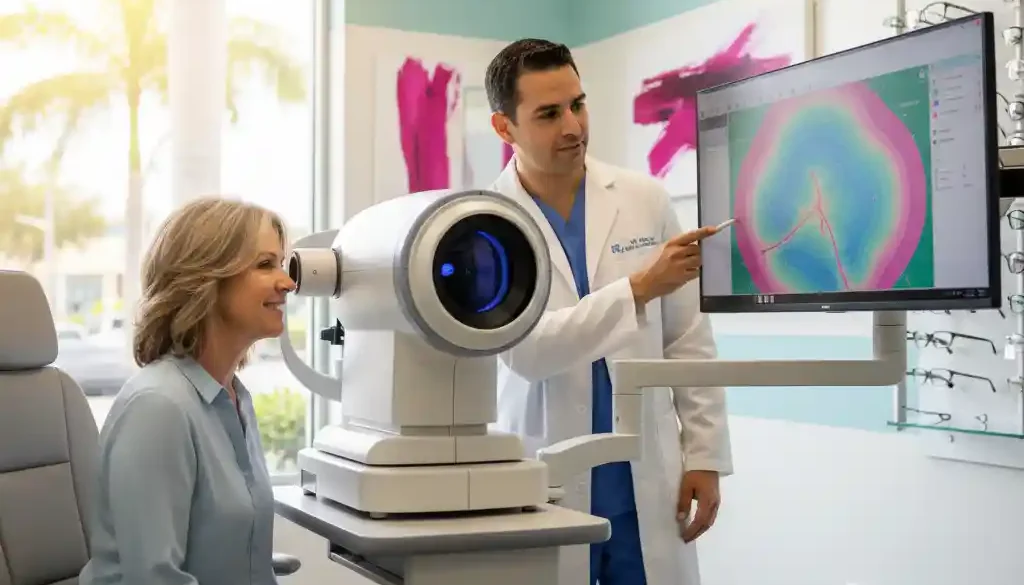
This is where West Broward Eye Care’s investment in advanced technology directly benefits you as a patient. Optovue OCT — Optical Coherence Tomography — uses precise light waves to create cross-sectional images of the retinal nerve fiber layer, the ganglion cell layer, and the optic nerve head in extraordinary microscopic detail. For glaucoma detection, this technology can identify nerve fiber thinning that is too subtle to detect through clinical examination alone — often years before functional vision loss begins.
From your perspective as a patient, the OCT scan is among the most comfortable steps in the entire process. You simply rest your chin on a support, look at a target light, and the machine does the rest. There is no contact with your eye, no air puff, no drops required for this step. It feels, quite simply, like having a photograph taken — because that is essentially what it is, at a microscopic level. The scan takes approximately three minutes per eye and produces detailed maps that your physician will use both immediately and as a baseline for future comparison.
Step 4 — Visual Field Test (Peripheral Vision Assessment)
The visual field test, also called automated perimetry, measures the full extent of your peripheral vision — the very territory that glaucoma targets first. You will sit in front of a dome-shaped instrument and focus on a central point while small lights of varying brightness appear at different locations around the periphery. Each time you see a light, you press a button. The test maps your entire visual field and identifies any areas of loss or reduced sensitivity.
This step requires focused attention and can feel slightly fatiguing, but it is entirely comfortable. Most patients find it takes between five and ten minutes per eye. The results provide a functional complement to the structural data from the OCT scan — together, they give your physician a complete picture of both the anatomy and the performance of your visual system.
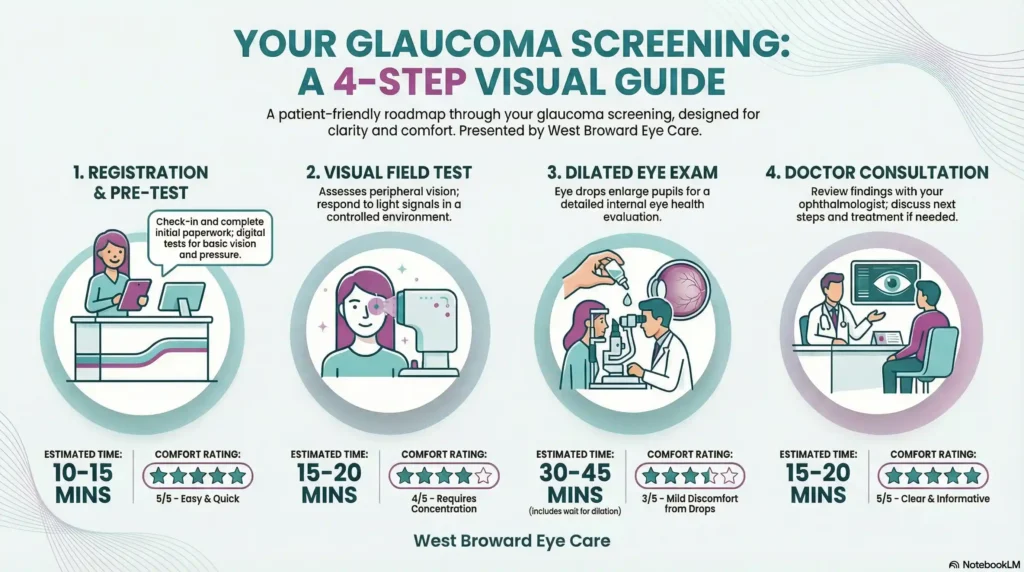
| Screening Step | Technology Used | Duration | Comfort Level |
|---|---|---|---|
| Eye Pressure (IOP) Test | Non-contact Tonometry | ~1 min | ★★★★★ Painless |
| Optic Nerve Exam | Slit Lamp / Dilation | ~5 min | ★★★★☆ Mild light sensitivity |
| Advanced Nerve Imaging | Optovue OCT | ~3 min per eye | ★★★★★ No contact |
| Visual Field Test | Automated Perimetry | ~5–10 min per eye | ★★★★☆ Requires focus |
After Your Screening — What Happens Next at West Broward Eye Care?
Understanding Your Results — What the Numbers Mean
Once your screening is complete, your physician will walk you through your results with the same clarity and thoroughness that has defined West Broward Eye Care’s patient relationships for 35 years. An IOP reading within the normal range of 10 to 21 mmHg, a healthy optic nerve appearance, a full visual field, and normal OCT nerve fiber layer measurements are all reassuring findings — and your physician will tell you exactly that.
If your results fall into a category sometimes called “glaucoma suspect” — meaning one or more measurements warrants closer monitoring — this is not a diagnosis, and it is not cause for alarm. It is a clinical signal that means your physician wants to track your measurements over time to distinguish normal variation from early disease. This is precisely the value of having a trusted, long-term eye care relationship: your history here becomes your protection.
Treatment & Management Options If Glaucoma Is Detected
If glaucoma is confirmed, the most important thing to understand is this: early detection transforms glaucoma from a blinding disease into a manageable one. The earlier it is caught, the more treatment options are available and the more vision can be preserved.
First-line treatment typically involves prescription eye drops — most commonly prostaglandin analogs or beta-blockers — that work to lower intraocular pressure and protect the optic nerve from further damage. For patients who require additional intervention, laser therapy and surgical referral options are available through West Broward Eye Care’s referral network. Ongoing disease management, with regular monitoring appointments every three to six months, ensures that your treatment plan is continuously optimized as your condition evolves. Our board-certified physicians are partners in that journey — not just providers.
With 35 years of trusted eye care in Tamarac, our board-certified physicians are ready to give you the clear answers and advanced screening your vision deserves. Book your appointment online or call or text 954-726-0204. Visit us at 7822 N. University Dr., Tamarac, FL 33321.
🏛️ LOCAL RESOURCES & CITATIONS
1. National Eye Institute (NEI) — National Institutes of Health
2. Florida Department of Health — Broward County Health Department
3. Bascom Palmer Eye Institute — University of Miami Health System
4. Centers for Disease Control and Prevention (CDC) — Vision Health Initiative
Why Tamarac Patients Trust West Broward Eye Care for Glaucoma Screening
35 Years of Community Eye Care — A Legacy of Trust
There is something uniquely valuable about a practice that has served the same community for 35 years. West Broward Eye Care has been a fixture of Tamarac’s healthcare landscape since long before many of our current patients were thinking about glaucoma risk — and that longevity is not accidental. It is the product of consistent, compassionate, expert care delivered to generation after generation of Broward County families. Our 885-plus Google reviews reflect not just satisfaction but trust — the kind that is built over decades, not marketing campaigns.
Advanced Technology That Sees What Others Miss
Our commitment to technology is a direct commitment to our patients’ outcomes. Optovue OCT enables our physicians to detect nerve fiber layer thinning at a microscopic level — changes that are invisible to clinical examination and to standard screening equipment used at retail vision chains. Optomap ultra-widefield retinal imaging captures up to 82% of the retinal surface in a single scan, providing a comprehensive baseline that supports monitoring over time. These are not luxury upgrades. For glaucoma detection, they are the difference between catching a disease early and missing it entirely.
A Patient Experience Designed Around You
Advanced technology means nothing without the human expertise to interpret it and the compassionate environment to deliver it. One patient described their experience at West Broward Eye Care as receiving a “mini PhD” on their eye condition — that is the standard of patient education we hold ourselves to. Our team is genuinely warm, our atmosphere is welcoming, and same-day emergency appointments are available for patients who cannot wait. We are located conveniently on N. University Drive in Tamarac — easy to find, easy to reach, and always ready to welcome you.
Your vision is irreplaceable. Do not let glaucoma steal it silently. The caring team at West Broward Eye Care is here for you — call or text 954-726-0204, or visit us at 7822 N. University Dr., Tamarac, FL 33321. Open Monday–Thursday 9:00 AM–5:00 PM and Friday 9:00 AM–4:00 PM.
Frequently Asked Questions
-
No — a glaucoma screening at West Broward Eye Care is gentle and well-tolerated by the vast majority of patients. The most common component, the intraocular pressure test, uses a brief, calibrated puff of air that is startling for a fraction of a second but entirely painless. Advanced imaging with Optovue OCT involves no contact with the eye whatsoever — it is as comfortable as having a photograph taken. If applanation tonometry is used for a more precise pressure reading, a mild numbing drop is applied first, eliminating any discomfort. Dilation drops may cause temporary light sensitivity for a few hours, but this is a normal, short-lived effect. Most patients leave genuinely surprised by how comfortable the entire process was.