Orthokeratology in Tamarac, FL: How Ortho-K Works, What It Costs & Who Qualifies
Orthokeratology (Ortho-K) is a non-surgical vision correction treatment that uses custom-designed, gas-permeable contact lenses worn overnight to gently reshape the cornea, providing clear daytime vision without glasses or contacts. In Tamarac, FL, Ortho-K is also used as a clinically proven myopia management tool to slow the progression of nearsightedness in children. At West Broward Eye Care — located at 7822 N. University Dr., Tamarac, FL 33321 — our board-certified specialists offer precision Ortho-K fitting using advanced SMap3D technology. Call or text us at 954-726-0204 to schedule your consultation.
Imagine your child waking up every morning, opening their eyes, and heading straight to school — reading the board clearly, catching a ball on the field, living their full day without reaching for glasses or fumbling with contacts. For many families in Tamarac, that is exactly the outcome orthokeratology makes possible.
Ortho-K is not a new idea, but for many parents and patients in South Florida, it remains an unfamiliar one. Questions are completely natural: Is it safe? Is my child a candidate? What will it cost? And why can’t I just get this anywhere?
This guide answers all of those questions with the clarity and care you deserve — from a practice that has been protecting the vision of Tamarac families for 35 years.
What Is Orthokeratology (Ortho-K)?
The simplest way to understand orthokeratology is to think of it as orthodontics for your eyes. Just as dental braces gradually reshape teeth into proper alignment, Ortho-K lenses gently and safely reshape the front surface of the eye — the cornea — while the patient sleeps. By morning, the lenses are removed, and the patient enjoys clear, unaided vision throughout the day.
Unlike glasses or standard contact lenses, which correct vision while worn, Ortho-K works by temporarily changing the eye’s shape. Unlike LASIK, it does this without surgery, without lasers, and without any permanent alteration to the eye. The moment a patient stops wearing the lenses, the cornea gradually returns to its original shape — making Ortho-K one of the most flexible and reversible vision correction options available today.
The U.S. Food and Drug Administration has approved several Ortho-K lens designs for overnight wear, including Paragon CRT, Bausch + Lomb VST, and Johnson & Johnson’s ACUVUE Abiliti — the first lens specifically FDA-approved for myopia management rather than only temporary correction.
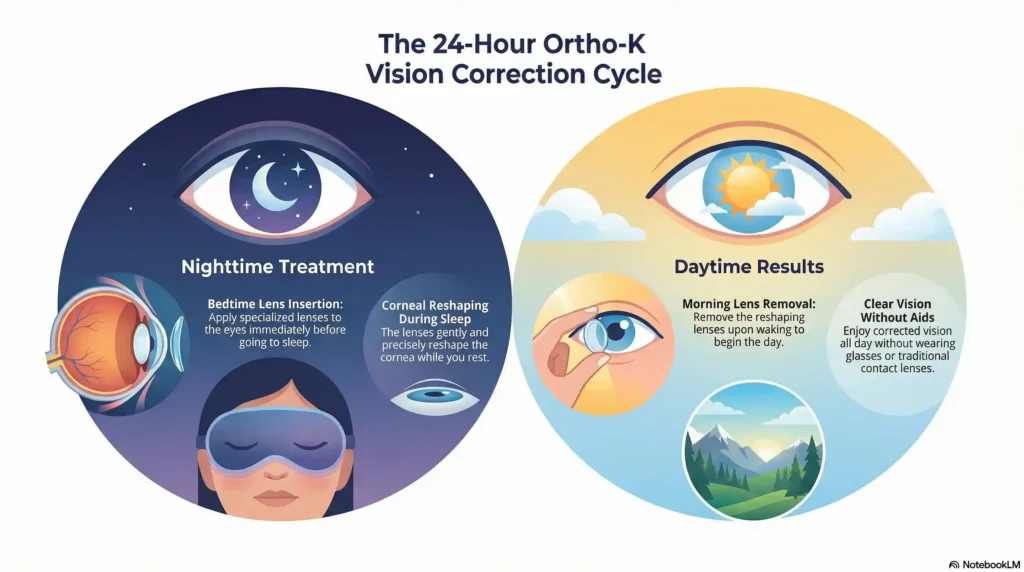
| Stage | What Happens | Timing |
|---|---|---|
| Lens Insertion | Custom Ortho-K lens placed before sleep | Evening |
| Corneal Reshaping | Lens gently flattens cornea center overnight | 6–8 hours |
| Morning Removal | Lenses removed upon waking | Morning |
| Daytime Vision | Clear, unaided vision throughout the day | Up to 24 hours |
How Does Ortho-K Work? The Science Behind Clear Vision Overnight
The Role of the Cornea in Vision
Your cornea is the clear, dome-shaped window at the very front of your eye. It is responsible for roughly 70% of the eye’s focusing power. In a person with myopia (nearsightedness), the eye has grown slightly too long from front to back, causing light to focus just in front of the retina rather than directly on it. The result: distant objects appear blurry, while close objects remain clear.
This is the problem Ortho-K is specifically designed to address.
What Ortho-K Lenses Do While You Sleep
Ortho-K lenses are made from highly oxygen-permeable rigid materials — a critical feature that makes overnight wear safe and comfortable. While the patient sleeps, the lens applies gentle, precise hydraulic pressure through the eye’s natural tear film, gradually flattening the central cornea and redistributing corneal tissue toward the periphery.
That peripheral redistribution is not just a side effect — it is actually the key to Ortho-K’s most powerful benefit for children. The process creates what scientists call peripheral myopic defocus: a specific optical signal that tells the developing eye to slow its lengthening process. Research published in the Cochrane Database of Systematic Reviews in 2025 confirmed that children undergoing orthokeratology showed significantly lower rates of axial elongation — the actual physical growth of the eye that drives myopia progression — compared to children using conventional glasses.
How Long Until You See Results?
Most patients notice meaningful vision improvement within the first few days of wearing Ortho-K lenses. Full correction typically stabilizes within one to two weeks, though this varies based on the degree of refractive error. In clinical studies of FDA-approved lenses, the majority of patients achieved 20/40 vision or better — sufficient for driving and most daily activities without any correction.
It is important to understand that Ortho-K correction is maintained only as long as the lenses are worn consistently each night. If nightly wear stops, the cornea will gradually return to its original shape and the refractive error will return. This is not a flaw — for patients who are not yet ready for permanent correction, this reversibility is a significant advantage.
Who Qualifies for Ortho-K? Candidacy Criteria Explained
One of the most common questions families ask is a simple one: “Is this right for us?” The honest answer is: it depends — and a thorough consultation with a board-certified specialist is the only way to know for certain. That said, the general candidacy guidelines are well-established.
Ideal Candidates: Children
Ortho-K is most commonly recommended for children aged 7 and older with low to moderate myopia — typically a prescription up to -6.00 diopters. The strongest signal that a child is a good candidate is a prescription that has been worsening consistently year over year. Left unaddressed, that progression carries real long-term risk: research shows that patients with high myopia face significantly elevated chances of developing retinal detachment, glaucoma, and early-onset cataracts in adulthood.
For families in Tamarac and across Broward County, the urgency of early intervention is underscored by an additional local reality. South Florida’s year-round sunshine and outdoor lifestyle mean children are spending significant time in high-UV environments. Increased screen time and near-work demands at school further accelerate myopia progression in younger patients. The earlier treatment begins, the greater its protective impact.
Ideal Candidates: Adults
Ortho-K is not exclusively a pediatric treatment. Adults who want to be free of glasses and daytime contacts — but who are not yet candidates for LASIK because their prescription is still changing, or who prefer a non-surgical option — are excellent candidates. Patients with active lifestyles, those who work in dusty or dry environments, and patients whose dry eye symptoms make daytime contact lens wear uncomfortable may find Ortho-K to be an ideal fit. Because the lenses are worn overnight while the eyes are closed, the dry daytime environment is no longer a barrier.
Who May Not Be a Candidate
Candidacy is not universal. Patients with very high degrees of myopia beyond -6.00 diopters, certain corneal shape irregularities, or specific ocular health conditions may not achieve the desired results with standard Ortho-K alone. For these patients, alternative or combination therapies may be more appropriate. This is precisely why a comprehensive corneal mapping evaluation — not a generic screening — is the essential first step.

| Candidate Profile | Qualifies? | Notes |
|---|---|---|
| Child (7+), mild to moderate myopia | ✅ Yes | Best results with early intervention |
| Child with rapidly worsening prescription | ✅ Strong candidate | Myopia Patrol program recommended |
| Adult seeking non-surgical LASIK alternative | ✅ Yes | Reversible, flexible option |
| Patient with daytime dry eye | ✅ Often yes | Worn overnight, avoids dry daytime conditions |
| Myopia above -6.00 diopters | ⚠️ Evaluate | May require combination therapy |
| Severe corneal shape irregularity | ❌ Likely not | Full corneal mapping assessment required |
What Does Ortho-K Cost in Tamarac, FL?
One of the most practical questions families ask — and one that deserves a straight, honest answer. Ortho-K is not inexpensive, but understanding what you are actually paying for transforms the number from sticker shock into a clear-eyed investment decision.
Understanding the Ortho-K Investment
Unlike a box of monthly contact lenses, Ortho-K is not a product purchase — it is a clinical process. The cost reflects a physician’s time, advanced diagnostic technology, custom lens fabrication, and multiple follow-up visits to optimize the fit and outcome. When those components are bundled together, the investment starts to look very different than an off-the-shelf solution.
For families considering Ortho-K as a tool to slow myopia progression in a child, it is also worth framing the cost against the alternative: years of worsening prescriptions, increasingly strong glasses, and the growing risk of serious ocular disease in adulthood. Prevention, as any physician will tell you, is always less costly than treatment.
National Cost Ranges & What to Expect in South Florida
Nationally, the total first-year cost for an Ortho-K program — which typically includes the initial consultation, corneal topography mapping, custom lens fabrication, fitting fees, and follow-up visits — ranges from approximately $1,500 to $4,000, with the national average falling between $2,000 and $2,800. Ongoing annual costs for replacement lenses and follow-up care in subsequent years generally range between $300 and $650.
Practices like West Broward Eye Care that invest in precision fitting technology such as SMap3D corneal mapping do not just add a line item to your bill — they deliver a fundamentally more accurate and comfortable fitting process, reducing the number of adjustment visits needed and maximizing the effectiveness of your lenses from the very first night.
Does Insurance Cover Ortho-K?
Standard vision insurance plans typically classify Ortho-K as an elective procedure and do not provide full coverage. However, many plans include a contact lens material allowance — usually between $130 and $150 — that can be applied toward the cost of Ortho-K lenses. It is always worth reviewing your specific plan details with your provider.
Importantly, Ortho-K qualifies as a medical expense under Health Savings Accounts (HSA) and Flexible Spending Accounts (FSA), which means families can use pre-tax dollars to offset the cost — a meaningful financial advantage. Many practices also offer third-party financing through programs such as CareCredit, which can spread the investment across monthly payments.
📞 Ready to find out if Ortho-K is right for your child or yourself? Call or text West Broward Eye Care at 954-726-0204 or book online. Our team at 7822 N. University Dr., Tamarac, FL 33321 is here to walk you through every step — from your first consultation to your first clear morning.
| Cost Component | Typical Range | What’s Included |
|---|---|---|
| Initial Consultation | $100–$200 | Comprehensive exam + candidacy assessment |
| Corneal Topography Mapping | Included in package | SMap3D precision fitting at WBEC |
| Custom Lens Fitting | $500–$1,500 | Lenses + follow-up adjustment visits |
| Lenses (per pair) | $300–$600 | Custom-designed for each individual eye |
| First-Year Total (Full Package) | $1,500–$4,000 | National average: $2,000–$2,800 |
| Annual Ongoing Cost (Year 2+) | $300–$650 | Replacement lenses + monitoring exams |
| Lens Care Solutions | $100–$200/year | Specialized cleaning and storage required |
Ortho-K vs. Other Myopia Management Options
West Broward Eye Care’s Myopia Patrol program offers a full spectrum of myopia management options because no two patients are the same. Understanding how Ortho-K compares to the alternatives helps families make the most informed decision.
Ortho-K vs. MiSight Daily Contact Lenses
MiSight 1 day, manufactured by CooperVision, is the first and only FDA-approved soft contact lens specifically cleared to slow myopia progression in children aged 8 to 12. Like Ortho-K, it works by creating peripheral myopic defocus. Unlike Ortho-K, it is worn during the day and discarded each evening — a feature that some younger children or parents prefer for its simplicity.
The clinical data on both options is compelling. MiSight has demonstrated an average 59% reduction in myopia progression. Ortho-K studies show a 43–63% reduction in axial elongation, with the added benefit of glasses-free daytime vision. For children who are active in sports, uncomfortable with daytime lens wear, or who want the freedom of waking up and seeing clearly, Ortho-K is often the preferred choice.
Ortho-K vs. Low-Dose Atropine Eye Drops
Low-dose atropine (0.01%–0.05%) is a once-nightly eye drop with a strong clinical record for slowing myopia progression, particularly in younger children aged 4 to 7 who may not yet be ready for contact lenses. Its mechanism is pharmacological — it acts on receptors that regulate eye growth — rather than optical.
One of the most effective strategies in modern myopia management is combination therapy: pairing low-dose atropine with either Ortho-K or MiSight lenses. West Broward Eye Care’s Myopia Patrol program is specifically designed to evaluate each child’s age, prescription, lifestyle, and progression rate and recommend the most effective single or combined approach.
Ortho-K vs. LASIK
LASIK and Ortho-K are both designed to reduce dependence on glasses and contacts, but they serve fundamentally different patients. LASIK requires a stable adult prescription — it is not suitable for children or young adults whose vision is still changing. Ortho-K, by contrast, is designed precisely for that period of active change. It is also fully reversible: if a patient’s needs change, discontinuing Ortho-K simply allows the eye to return to its natural state.
From a cost perspective, LASIK typically ranges from $1,500 to $2,500 per eye — a significant one-time investment. Ortho-K, while requiring ongoing lens replacement and follow-up care, spreads its cost over time and does not involve any surgical risk.
📞 Not sure which myopia management path is right for your family? Our board-certified specialists at West Broward Eye Care will build a personalized plan based on your child’s unique needs — call or text 954-726-0204 to schedule your consultation in Tamarac today.
🏛️ Local Resources & Citations
1. U.S. Food & Drug Administration (FDA) — Types of Contact Lenses The official FDA page explaining how Orthokeratology lenses are regulated as medical devices — check here to verify that your child’s Ortho-K lenses carry proper FDA clearance for overnight wear.
2. Florida Department of Health — Children’s Vision Services Program The Florida DOH’s official school vision program page — check here to understand the state-mandated vision screening process and how a failed screening triggers the need for a comprehensive eye exam like those offered at West Broward Eye Care.
3. Florida Department of Health in Broward County — School Health Services The Broward County–specific DOH school health page — check here to understand the local vision screening requirements and health services provided in partnership with Broward County Public Schools that apply directly to Tamarac families.
4. Broward County Public Schools — Student Health Forms & Vision Resources The official BCPS health services page — check here for the Florida Heiken Children’s Vision Program application, which provides free eye exams and glasses for income-eligible students in Pre-K through 12th grade attending Broward County schools.
Why West Broward Eye Care Is Tamarac’s Trusted Ortho-K Provider
Choosing an Ortho-K provider is not like choosing a pair of glasses off a retail shelf. The outcome depends entirely on the expertise of the clinician, the precision of the technology, and the quality of the ongoing care relationship. These are exactly the areas where West Broward Eye Care stands apart — not just in Tamarac, but in all of South Florida.
Board-Certified Expertise & National Recognition
Dr. Brianna Rhue, OD, FAAO is not simply an optometrist who offers Ortho-K — she is a nationally recognized leader in Myopia Management who lectures extensively throughout the year and currently serves as a principal investigator in active myopia management research. She completed her residency training at the Bascom Palmer Eye Institute in Miami — one of the most respected ophthalmology institutions in the world — and holds Fellowship status in the American Academy of Optometry.
When your child’s vision is in her hands, it is in the hands of someone who is actively shaping the science of the field, not simply following it.
SMap3D Technology: Precision That Changes Outcomes
West Broward Eye Care was among the first practices in the United States to adopt S-Map technology for custom lens fitting. The SMap3D system creates a detailed, three-dimensional topographic map of the corneal surface, enabling the design of lenses that conform precisely to each patient’s unique eye shape.
The practical impact for patients is significant: a more comfortable lens from the very first fitting, fewer adjustment visits, faster adaptation, and results that are tailored — not approximated. For Ortho-K, where the fit of the lens is everything, this technology is not a luxury. It is the foundation of a successful outcome.
The Myopia Patrol Program
West Broward Eye Care’s Myopia Patrol is a comprehensive, evidence-based myopia management program that integrates Ortho-K, MiSight lenses, low-dose atropine, and ongoing axial length monitoring into a single, coordinated care plan. Rather than offering one tool and hoping it works, the program is built around the understanding that every child’s myopia is different — and that the best outcomes come from combining the right treatments at the right time.
The program includes regular progress monitoring, prescription tracking, and adjustment of the treatment approach as the child grows — ensuring that the investment in Ortho-K continues to deliver maximum benefit year after year.
Serving Tamarac & All of South Florida
Located at 7822 N. University Dr., Tamarac, FL 33321, West Broward Eye Care proudly serves patients from Tamarac, Coral Springs, Coconut Creek, Parkland, Sunrise, and throughout Broward County. With 35 years of deep roots in this community, the practice understands the specific vision challenges that come with life in South Florida — from the year-round UV exposure that accelerates certain eye conditions to the active, outdoor lifestyles that make glasses-free vision not just desirable, but practical.
For families looking for an eye care home that will be there not just for this appointment but for the years ahead, West Broward Eye Care offers exactly that: a practice built on longevity, trust, and an unwavering commitment to every patient’s long-term eye health.
📞 For 35 years, West Broward Eye Care has been Tamarac’s trusted vision partner. Take the first step toward clear, glasses-free mornings for your child — or yourself. Call or text 954-726-0204, visit us at 7822 N. University Dr., Tamarac, FL 33321, or book your appointment online today. Open Monday–Thursday 9:00 AM–5:00 PM | Friday 9:00 AM–4:00 PM
Frequently Asked Questions
-
Yes — orthokeratology is safe for children when prescribed and monitored by a board-certified specialist. Ortho-K lenses are FDA-approved for overnight wear and are made from highly oxygen-permeable materials that allow the eyes to breathe normally during sleep. A 2025 Cochrane systematic review confirmed that the safety profile of Ortho-K is excellent, with infection risk comparable to standard reusable daytime contact lenses — provided that proper hygiene and follow-up care guidelines are followed.
Disclaimer:
This content is for informational purposes only and does not constitute medical advice. Orthokeratology (Ortho-K) suitability varies by individual and requires a comprehensive eye examination by a qualified eye care professional. Always consult a licensed optometrist or ophthalmologist before starting any vision correction treatment.