
High Myopia
Comprehensive Eye Care
Monday-Thursday 9:00 AM–5:00PM
Friday 9:00 AM–4:00PM
Closed Saturday-Sunday

High myopia is a serious form of nearsightedness defined by a prescription of -6.00 diopters or higher. Affecting a growing number of children and adults worldwide, it carries significant risks beyond blurry distance vision. At West Broward Eye Care in Tamarac, FL, Dr. Brianna Rhue and Dr. Isabel Carvajal specialize in diagnosing, monitoring, and managing high myopia for patients of all ages.
Meet Our Doctors

BRIANNA RHUE, OD, FAAO
Read Bio >>>

ISABEL CARVAJAL, OD
Read Bio >>>

SARA RASEKHI, OD
Read Bio >>>
Key Takeaways
What Is High Myopia?
To understand the high myopia definition, it helps to know how eye doctors classify nearsightedness by severity using diopters, the unit of measurement for lens power. The term “high myopia power” refers to prescriptions at or beyond -6.00D, while the full high myopia range extends from -6.00D to -20.00D or more in extreme cases.
You may see your eye doctor note “high myopia OU” on your chart. “OU” is a clinical abbreviation from the Latin oculus uterque, meaning both eyes. So high myopia OU simply means high myopia is present in both the left and right eyes. This distinction matters because bilateral high myopia increases the importance of consistent monitoring and proactive management.
Myopia Classifications:
What Causes High Myopia?
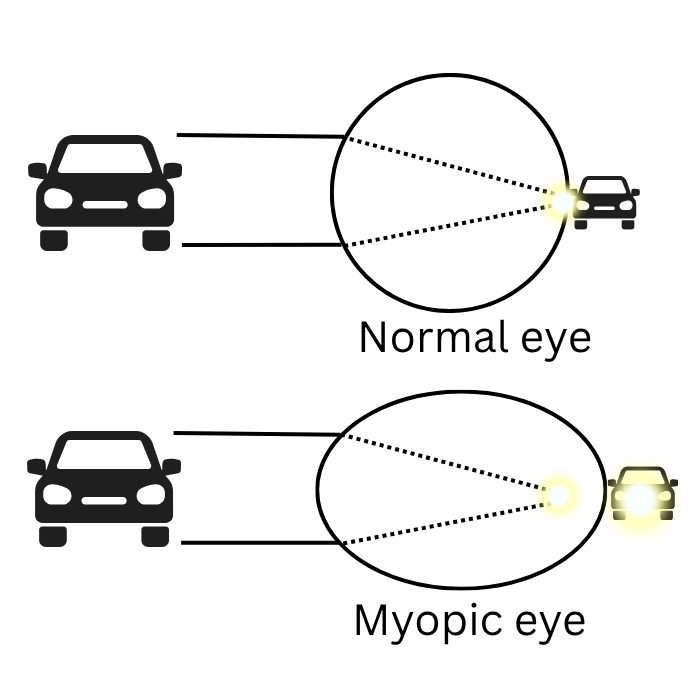
Understanding why high myopia develops requires looking at both biology and behavior. At its core, high myopia occurs when the axial length of the eyeball grows too long. Instead of light focusing directly on the retina, it focuses in front of it, producing blurred distance vision. This elongation is the primary structural change behind nearsightedness.

Genetics play a substantial role. Children with two myopic parents face a significantly higher likelihood of developing myopia themselves, and a family history of high myopia further elevates that risk. However, genetics alone do not explain the rapid global increase in myopia rates over the past few decades.
Environmental and lifestyle factors are increasingly recognized as accelerators. Extended screen time, prolonged reading, and other sustained near work place continuous focusing demands on developing eyes.
Minimal outdoor time deprives children of the protective effects that natural light exposure provides. Research suggests that children who spend more time outdoors have lower rates of myopia onset, making daily outdoor activity one practical step in learning how to prevent high myopia from developing or worsening.
When Does High Myopia Stabilize?
One of the most common questions parents ask is when does high myopia stabilize. The honest answer is that it varies, but there are general patterns. Progressive high myopia tends to accelerate during childhood growth spurts, with the peak progression period occurring between ages 7 and 15. Roughly half of myopic children see their prescriptions stabilize around age 15, but for those with high myopia, progression frequently continues.
Many individuals with high myopia do not reach a stable prescription until their early to mid-20s, and in some cases, gradual changes can occur even later. This extended progression window is precisely why early intervention through myopia management is so critical. The earlier a child begins a management program, the more opportunity there is to slow axial elongation and reduce the final prescription severity.
Risks and Complications of High Myopia
The concern with high myopia extends well beyond needing thick glasses. An elongated eyeball stretches the retina and other internal structures, creating vulnerabilities that accumulate over time.

According to published research, individuals with high myopia face dramatically elevated risks for several serious conditions:
When high myopia leads to structural damage in the retina or optic nerve, it may be classified as pathological myopia (also called degenerative myopia). This condition involves progressive thinning and stretching of retinal tissue, which can result in permanent vision changes if not detected early. Pathological myopia is one of the leading causes of visual impairment worldwide, reinforcing the importance of consistent, thorough eye exams for anyone with a high prescription.
Is High Myopia Curable?
The direct answer to “is high myopia curable” is no. There is currently no treatment that eliminates myopia or reverses the structural elongation of the eyeball. However, high myopia is highly manageable, and for children with progressing prescriptions, several evidence-based strategies may help slow further worsening.
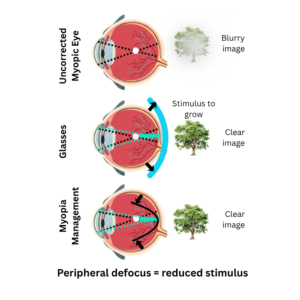
Corrective lenses, including glasses and standard contact lenses, address the refractive error so patients can see clearly. For children experiencing rapid progression, myopia management programs offer more targeted approaches:
These interventions do not claim to stop or reverse myopia. Rather, the goal is to reduce the rate of progression, potentially keeping a child’s prescription out of the high myopia range and lowering their lifetime risk of complications.
How West Broward Eye Care Helps Manage High Myopia
For over 35 years, West Broward Eye Care has served families across Tamarac, Coral Springs, Parkland, Miramar, Weston, and Boca Raton with specialized vision care. Dr. Brianna Rhue and Dr. Isabel Carvajal bring focused expertise in myopia management, offering comprehensive evaluations and individualized treatment plans for children and adults with high myopia.
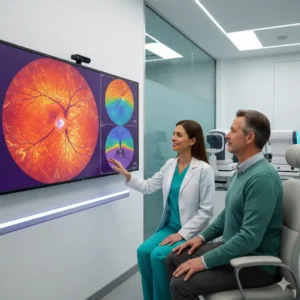
Our practice uses state of the art technology to assess and monitor myopic eyes with precision. The SMap3D corneal topographer provides detailed mapping of the corneal surface, while the Optovue OCT delivers high-resolution imaging of the retina and optic nerve. These advanced diagnostics allow our team to detect subtle structural changes early, well before they affect vision.
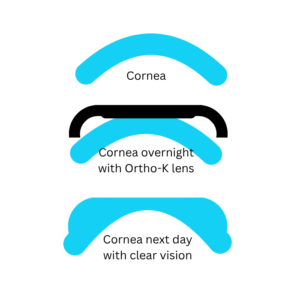
Whether your child has recently been diagnosed with progressive myopia or you are an adult managing a high prescription, our myopia management programs are designed to meet you where you are. From orthokeratology fittings to specialty contact lens prescriptions, every recommendation is tailored to the individual patient’s eyes, lifestyle, and goals.
Individual results may vary. Please schedule a comprehensive eye exam for personalized recommendations.
Whether you need a routine eye exam, high myopia management, or specialty contact lenses, we are here to help.


Frequently Asked Questions
-
In rare cases, yes. Pathological myopia can cause progressive retinal damage, including myopic macular degeneration and retinal tears, that may result in severe, irreversible vision loss if left unmonitored. This is why routine dilated eye exams are particularly important for patients with high prescriptions.