
Progressive Myopia:
What It Is, Why It Worsens,
and How to Slow It Down
Monday-Thursday 9:00 AM–5:00PM
Friday 9:00 AM–4:00PM
Closed Saturday-Sunday

Progressive myopia affects millions of children worldwide, with nearsightedness worsening year after year during critical developmental years. Unlike stable myopia, this condition involves the continuous elongation of the eyeball, leading to increasingly blurred distance vision and heightened risks of serious eye complications. West Broward Eye Care specializes in evidence-based myopia management programs designed to slow this progression and protect your child’s long-term vision health.
Key Takeaways
Understanding Progressive Myopia
What Is Progressive Myopia?
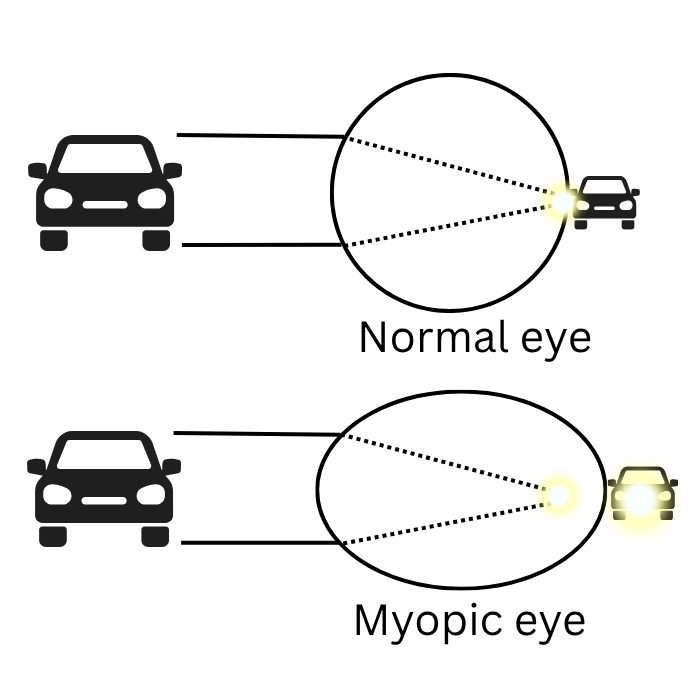
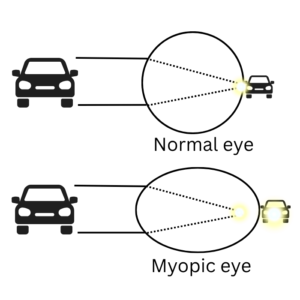
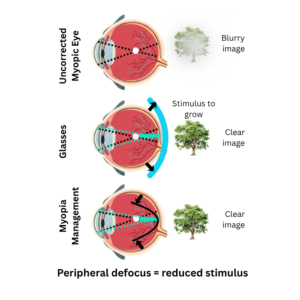
Progressive myopia represents nearsightedness that continuously worsens over time, contrasting sharply with stable myopia where the prescription remains relatively unchanged. The condition involves the axial length of the eye (the front-to-back measurement) elongating beyond normal parameters, causing light to focus in front of the retina rather than directly on it.
This progression typically occurs between ages 6-14, though it can continue into early adulthood. The National Eye Institute defines myopia as a refractive error measured in diopters. Low myopia ranges from -0.25 to -3.00 D, moderate myopia spans -3.00 to -6.00 D, and high myopia exceeds -6.00 D.
The concerning reality is that progressive myopia doesn’t simply stop on its own. Without intervention, children who develop myopia at younger ages often progress to higher levels of nearsightedness, fundamentally altering their eye structure and dramatically increasing their lifetime risk of vision-threatening conditions.
Risks of Unmanaged Myopia Progression
High myopia transforms from a simple refractive error into a serious medical condition. Myopic macular degeneration occurs 845 times more frequently in individuals with high myopia. Retinal detachment risk is 12.62 times higher, and cataracts develop earlier with 4.55 times increased risk.
These statistics, documented by comprehensive myopia research, underscore why slowing myopia progression during childhood is crucial. For families in Coral Springs, Parkland, and Tamarac, understanding these risks emphasizes the importance of proactive myopia management.

What Causes Myopia to Progress?
The development and progression of myopia result from a complex interplay of genetic and environmental factors. Children with myopic parents face significantly higher risks, with the likelihood increasing when both parents are nearsighted.
However, environmental influences play an equally critical role. Excessive near work including prolonged screen time, reading, and close-up activities contribute to eyeball elongation. Research consistently demonstrates that children spending less than two hours outdoors daily show higher rates of myopia development and progression.
According to the American Academy of Ophthalmology, current trends suggest that by 2050, nearly half the world’s population will be myopic if current patterns continue.
Can Progressive Myopia Be Cured?
Progressive myopia cannot be cured, but its progression can be significantly managed and slowed through appropriate interventions. Current treatments focus on slowing myopia progression rather than reversing existing nearsightedness.
For adults with stable myopia, refractive surgery options like LASIK or PRK can provide freedom from corrective lenses. However, these procedures work by reshaping the cornea to compensate for the eye’s elongated structure rather than “curing” the myopia itself.
West Broward Eye Care’s myopia management programs focus on this evidence-based approach, combining the most effective slowing techniques with regular monitoring to optimize outcomes for each child.
Myopia Progression Treatment: How to Slow It Down
Evidence-based myopia management offers multiple approaches to slow progression effectively. West Broward Eye Care specializes in these advanced treatments, providing South Florida families with comprehensive options tailored to each child’s unique needs.
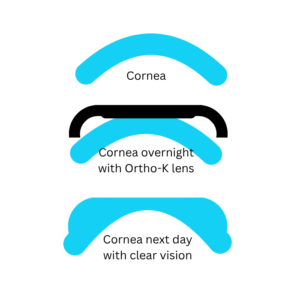
- Orthokeratology (ortho-k) represents one of the most effective approaches. These overnight corneal reshaping lenses gently reshape the cornea while children sleep, providing clear daytime vision without glasses or contacts while significantly slowing axial elongation. Studies demonstrate ortho-k may help slow myopia progression by 30-50% compared to traditional correction methods.
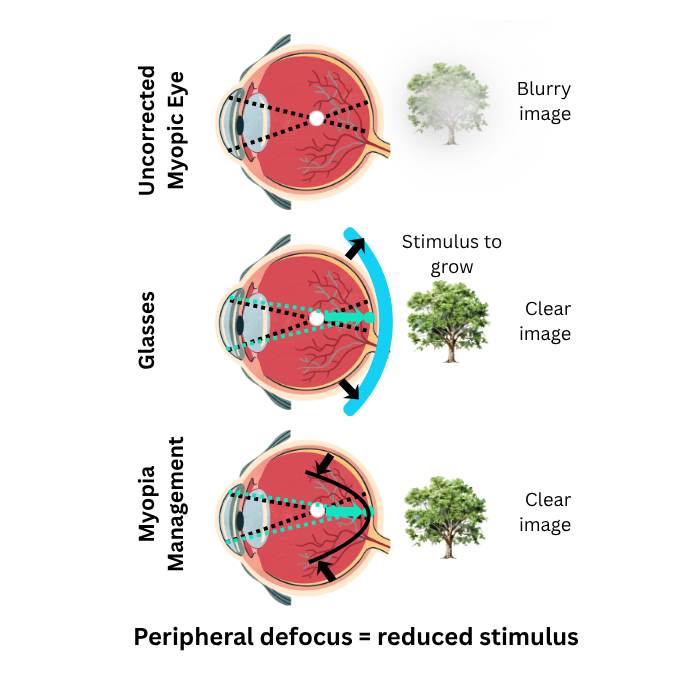
- Myopia control contact lenses offer daytime solutions using specialized designs that create peripheral defocus, signaling the eye to slow its elongation.
- Atropine eye drops in low concentrations (typically 0.01% to 0.05%) may help slow progression when used consistently.
- Myopia control glasses with specialized lens designs can also contribute to slowing progression, particularly when combined with lifestyle modifications.
Lifestyle interventions complement these clinical treatments effectively. Ensuring children spend at least two hours outdoors daily, implementing the 20-20-20 rule, and limiting screen time support overall eye health.
When to Schedule a Myopia Evaluation
Parents should recognize early signs that may indicate progressive myopia development. Children who frequently squint, sit unusually close to screens or books, complain of blurry distance vision, or struggle to see the whiteboard at school may be developing myopia.
Comprehensive eye exams become essential when these signs appear, ideally before age 8 and then regularly throughout childhood.
Children with family history of myopia require particularly vigilant monitoring.
West Broward Eye Care serves families throughout Coral Springs, Parkland, Tamarac, and surrounding South Florida communities with specialized myopia evaluations and management programs. Our 35 years of experience in advanced eye care, particularly in orthokeratology and myopia management, provides local families with expert care designed to protect their children’s vision future.
Individual results may vary. Please schedule a comprehensive eye exam for personalized recommendations.
Concerned about your child’s worsening vision? Our myopia management specialists can help slow progression and protect their long-term eye health.


Frequently Asked Questions
-
Most myopia progression slows significantly by the late teens or early twenties when eye growth typically stabilizes. However, some individuals may experience continued progression into their mid-twenties, particularly those with high myopia or strong genetic predisposition.