Progressive Lenses or Single Vision: What You Need to Know
The Moment This Decision Becomes Real
You’re sitting with a new prescription — or maybe you just left the exam chair — and there’s an ADD value on the paper you haven’t seen before. Your doctor mentioned progressives. Now you’re trying to figure out whether that recommendation is genuinely right for you, or whether it’s the more expensive option being pushed your way.
That uncertainty is completely reasonable. Progressive lenses cost significantly more than single-vision. The adaptation period is real. And if you’ve heard someone say they tried progressives and hated them, it’s hard not to wonder whether that will be your experience too.
This guide won’t tell you which lens to buy. What it will do is walk you through how each lens actually works, which clinical situations point clearly toward one option, and what the fitting process genuinely involves — so that when you make this decision, you’re making it with full information rather than a sales pitch.
What Each Lens Actually Does
Quick Answer: Single-vision lenses correct your vision at one distance — near, intermediate, or far. Progressive lenses correct all three distances in one lens with no visible dividing line. The right choice depends on whether your prescription includes an ADD power.
Single-Vision Lenses: One Job, Done Well
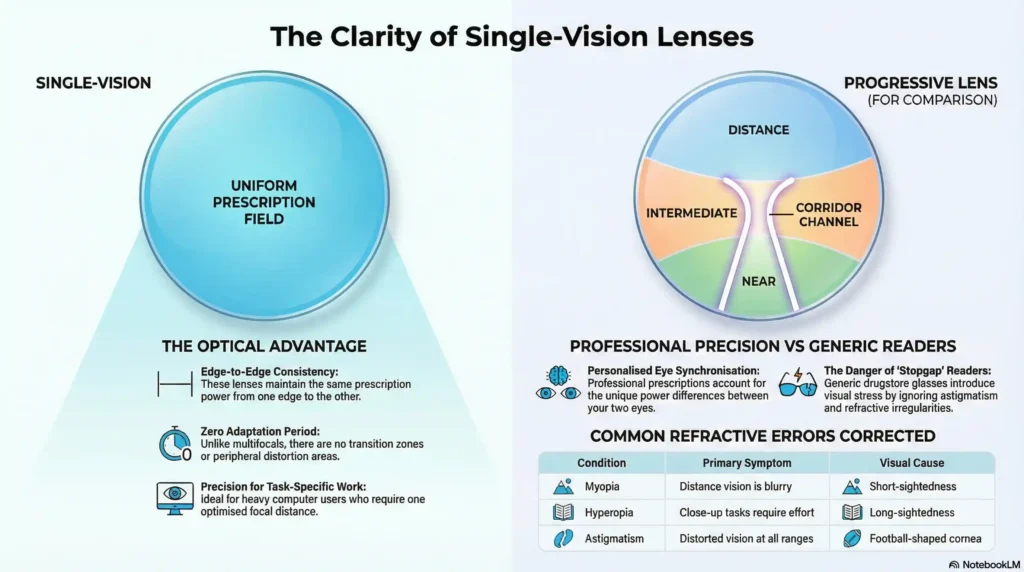
A single-vision lens has the same prescription from edge to edge. That consistency is actually an optical advantage — there is no transition zone, no peripheral distortion, and no adaptation period. You put them on and see clearly at the distance they are designed for.
Single-vision lenses address three types of refractive error:
- Myopia (nearsightedness): Distance is blurry; close vision is clear. For patients under 40 with myopia, single-vision is almost always the right starting point.
- Hyperopia (farsightedness): Close tasks — reading, phone use, fine detail work — require more effort than they should. Younger patients often compensate naturally, but this becomes effortful with age and is frequently the first signal that presbyopia is approaching.
- Astigmatism: Caused by a cornea shaped more like a football than a sphere. Corrected through a cylindrical prescription component and incorporated equally well into single-vision or progressive lenses.
The honest trade-off: If presbyopia develops while you rely on single-vision, you will likely end up managing two or three pairs—one for distance, one for reading, possibly one for screen work. Many patients prefer this arrangement, particularly heavy computer users who benefit from a lens optimized for one specific distance. The tradeoff is convenience versus optical precision.
Important: Over-the-counter reading glasses from a drugstore are not a substitute for a proper prescription. They are made to a generic power and are optically identical in both lenses. If you have astigmatism, a prescription difference between your eyes, or any refractive irregularity, generic readers introduce visual stress rather than relieve it. They are a temporary stopgap — not a long-term solution.
Progressive Lenses: Three Distances, One Seamless Lens
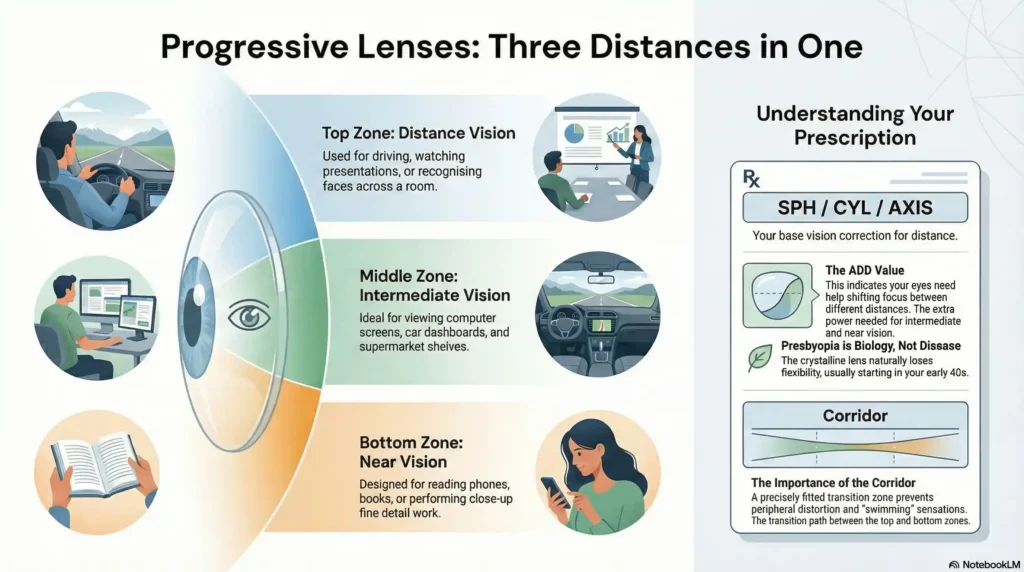
A progressive lens contains three visual zones — distance at the top, intermediate in the middle, near at the bottom — blending into each other through a gradual transition called the corridor. From the outside, they look identical to single-vision lenses.
Here is what each zone handles in a typical day in Tamarac:
- Distance (top): Driving on University Drive, watching a presentation, reading faces across a room.
- Intermediate (middle): Computer screen, car dashboard, supermarket shelves, a restaurant menu at arm’s length.
- Near (bottom): Phone, book, prescription label, fine detail work close up.
The corridor width and its positioning relative to your eye determines how practical the lens actually is in daily use. A well-designed, precisely fitted corridor is wide enough for comfortable viewing at all three distances with natural head movement. A poorly fitted one is narrow, forces awkward posturing, and produces the swimming peripheral distortion that causes so many first-time wearers to give up — usually wrongly concluding that progressive lenses do not work for them.
Understanding your ADD power: If your prescription includes a number in the ADD column, your eyes can no longer shift focus across distances without help. Seeing an ADD value does not mean your vision is severely compromised — it means your crystalline lens has begun losing flexibility, a normal process that typically becomes noticeable in the early-to-mid 40s. Presbyopia is not a disease. It is biology.
Which Lens Is Right for You: Real Patient Scenarios
Quick Answer: The right lens depends on your prescription’s ADD value, your daily visual demands, and whether any underlying eye health conditions affect the decision. The five scenarios below cover the clinical situations we see most often in Tamarac.
Scenario A: Under 40, One Vision Problem, No ADD Power
Single-vision is the right lens. Your eyes still have enough natural accommodation to compensate across distances, and a single-vision lens delivers excellent optical clarity at your target distance with no adaptation period and meaningfully lower cost. For this situation, single-vision is not the budget option — it is the optically correct option. A progressive lens in this scenario adds complexity without adding benefit.
Scenario B: 40+ and Noticing Near Vision Changes
If you are holding your phone further away than you used to, squinting at menus in dim South Florida restaurants, or finding that reading at the end of the day leaves your eyes tired — presbyopia is the likely explanation, and your ADD value will confirm it.
A properly fitted progressive eliminates the need to switch between distance and reading glasses throughout the day. The lens handles the transition automatically as your gaze moves — looking ahead at traffic, down at the dashboard, then at a text message — without any deliberate adjustment on your part. Most patients in Tamarac adapt within a few days to two weeks of consistent wear.
Scenario C: You Tried Progressives Before and They Did Not Work
This is the conversation the optical industry rarely has openly, and it deserves a direct response.
Most progressive lens failures are fitting failures — not lens failures.
When a patient returns progressives after two weeks of headaches and distortion, the cause is almost always one of the following:
- Pupillary distance was measured with a basic ruler rather than monocular digital measurement
- The chosen frame has inadequate lens height — progressives need a minimum of 28–30mm — and the reading zone was cut off entirely
- The corridor width was not matched to the prescription’s ADD value and complexity
- The frame was never properly adjusted after dispensing, misaligning the optical center
A patient who failed with chain-store progressives often succeeds with a properly fitted progressive at a practice that takes the fitting process seriously. If you have given up on progressives after a bad experience elsewhere, that experience is worth revisiting with a full precision fitting before concluding they are not for you.
Scenario D: High Myopia, Significant Astigmatism, or Keratoconus
Complex prescriptions introduce fitting demands that standard optical dispensing frequently does not address.
High minus prescriptions produce thick, heavy lenses in standard materials. High-index lens materials reduce thickness significantly — but they also interact with progressive corridor design in ways that affect the usable viewing zones. Keratoconus creates an irregular corneal surface that standard progressive fitting does not account for.
At West Broward Eye Care, the SMap3D 3D corneal mapping we use for Keratoconus diagnosis gives a precise topographic picture of your actual corneal shape — information that informs how a progressive should be positioned and designed for your specific eye, not a population average.
Significant astigmatism combined with a high ADD power is technically demanding to fit. It requires monocular PD measurement, verified combined prescription accuracy, and follow-up assessment. It is not a case for guessing.
Scenario E: You Have Diabetes or a Retinal Condition
This is the clinical conversation that almost never happens at a retail optical counter — and it should.
Diabetic patients can experience prescription fluctuations tied to blood sugar levels. When glucose is elevated, the crystalline lens can swell slightly, temporarily shifting the prescription toward nearsightedness. Investing in progressive lenses during a period of unstable blood sugar risks producing lenses that underperform once glucose is better managed.
At West Broward Eye Care, we manage Diabetic Retinopathy and factor prescription stability into every lens recommendation for diabetic patients — not as a formality, but because it directly affects your outcome.
Patients with Macular Degeneration face a different set of considerations. Progressive lens design depends on accurate use of the central corridor. When central vision is compromised, peripheral distortion becomes less tolerable and the usable corridor narrows effectively. These patients benefit from an honest conversation about whether a progressive is the most functional choice for their current level of vision — a conversation that requires knowing your retinal health, not just your refractive error.
Why the Fitting Matters More Than the Lens Brand
Quick Answer: The most important factor in progressive lens performance is not the brand or price tier — it is the precision of the fitting. A correctly prescribed progressive fitted imprecisely will underperform. A thorough fitting transforms the same lens into something patients can wear comfortably from day one.
This is not a marketing claim. It is a mechanical reality of how progressive lens corridors work.
What Retail Optical Fitting Typically Involves
In most retail optical settings, fitting means measuring pupillary distance with a basic automated system, selecting a frame based on style preference, and handing over the lenses with general adaptation advice. For a simple prescription with a low ADD power, this often produces an adequate result. For any prescription with real complexity, adequate fitting produces lenses that work less well than they should.
Digital Freeform Lens Surfacing
Once fitting measurements are complete, the lens is manufactured using digital freeform surfacing technology. Instead of selecting from pre-made progressive templates, freeform surfacing calculates every point on the lens surface individually based on your specific measurements. The result: a wider, more accurate corridor and meaningfully reduced peripheral distortion.
The technology only delivers its potential when the fitting measurements feeding into it are accurate. Precise measurements plus digital surfacing equals a progressive lens that performs the way progressive lenses are supposed to perform.
What to Do If Your Progressive Lenses Are Not Working
Quick Answer: If your progressive lenses cause persistent headaches or distortion beyond two weeks of consistent daily wear, the problem is almost certainly a fitting or prescription issue — not lens incompatibility. Most cases are correctable without replacing the lenses entirely.
Normal Adaptation vs. a Real Problem
Normal during the first one to two weeks:
- Mild swim or wobble sensation in peripheral vision when moving your head
- Needing to consciously position your chin slightly downward to access the reading zone
- Brief dizziness when transitioning between zones while walking
Not normal — return for assessment:
- Persistent headaches or eye strain beyond two weeks of consistent wear
- Blurry central vision at any distance after the first few days
- Reading zone is practically inaccessible without extreme chin-tuck posturing
- Vertical lines appear to lean or curve noticeably
- Nausea or significant disorientation that has not improved after 10 days
Authoritative Local Resources
| Resource | How It Helps You |
|---|---|
| Florida Department of Health | Verify state-regulated standards for licensed optometric practice and confirm your provider holds a current Florida optometric license. |
| Florida Board of Optometry | Confirm board certification status and active license for any optometrist in Tamarac before scheduling. Public record, searchable by name. |
| National Eye Institute — NIH | Evidence-based clinical definitions of presbyopia, age-related lens changes, and the medical basis for multifocal lens prescribing — the federal standard of reference. |
| American Optometric Association — Clinical Guidelines | Published clinical guidelines on comprehensive exam standards and progressive lens prescribing — useful for understanding what a thorough lens consultation should include. |
Your Next Step
If you need correction at one distance and have no ADD power on your prescription, single-vision is the right lens — optically excellent, immediately comfortable, and cost-effective for your situation.
If you are noticing near vision changes, holding your phone further away, or currently managing two pairs of glasses throughout the day, a properly fitted progressive will simplify your daily life in ways that are difficult to appreciate until you experience it.
If your situation is more complex — a history of failed progressives, a high or irregular prescription, diabetes, or a retinal condition — the most important step is a comprehensive exam with a practice that sees your full clinical picture before making any lens recommendation.
West Broward Eye Care serves Tamarac, Coral Springs, Margate, Coconut Creek, Lauderhill, North Lauderdale, and communities throughout West Broward. Most major vision insurance plans are accepted, and our staff can verify your benefits before your appointment. The lens consultation is part of your comprehensive exam — no separate visit required.
If you are currently unhappy with progressive lenses purchased elsewhere, a second-opinion fitting assessment is welcome. Bring your current glasses and your most recent prescription.
“At West Broward Eye Care, we have been helping Tamarac families see their world clearly for 35 years — and we would be honored to help you see yours.”
FAQs
-
Single-vision lenses have one consistent power for either distance or reading. Progressive lenses provide a seamless transition between distance, intermediate (computer), and near vision in a single, “no-line” lens