Diabetic Eye Exam in Tamarac, FL: What Medicare Covers & Why You Can’t Skip It
Medicare Part B covers one dilated diabetic eye exam per year for patients diagnosed with diabetes — at no extra cost beyond the standard Part B deductible and 20% coinsurance. This benefit is separate from routine vision coverage and applies specifically because diabetic eye exams are classified as medically necessary. Diabetic retinopathy, the leading cause of vision loss among working-age adults, produces no symptoms in its earliest and most treatable stages, making annual exams critical for preserving long-term sight. West Broward Eye Care, located at 7822 N. University Dr., Tamarac, FL 33321, has served the Broward County community for 35 years, providing Medicare-covered diabetic eye exams using advanced Optomap and Optovue technology. To schedule your exam or verify your coverage, call or text 954-726-0204.
If you or someone you love is living with diabetes in Tamarac, there is one annual appointment that no busy schedule, no tight budget, and no “I feel fine” should ever be allowed to cancel: your diabetic eye exam.
Diabetes is one of the most common chronic conditions in Broward County — and one of its most quietly destructive complications targets your vision. The dangerous reality is that diabetic eye disease steals sight gradually, invisibly, and without warning. By the time most patients notice something is wrong, irreversible damage has already taken hold.
The good news? Medicare covers this exam. Local expertise is available. And early detection with the right technology can protect your vision for decades to come. At West Broward Eye Care, board-certified physicians have been helping Tamarac families navigate exactly this for 35 years.
Here is everything you need to know.
What Is a Diabetic Eye Exam — And How Is It Different From a Regular Checkup?
Many patients assume their annual eye exam and their diabetic eye exam are the same visit. They are not — and understanding that difference could be the single most important thing you read today.
A routine eye exam checks your vision prescription and screens for common conditions. A diabetic eye exam goes significantly deeper, specifically examining the delicate blood vessels inside your eye for the early warning signs of diabetes-related damage.
What Your Doctor Is Actually Looking For
Inside your eye sits the retina — a thin layer of light-sensitive tissue that functions like the film in a camera. It is fed by a dense network of tiny blood vessels. When blood sugar levels are consistently elevated, as they are in uncontrolled or even well-managed diabetes, those vessels become weakened, leaky, and prone to abnormal growth.
Your doctor is specifically examining your eyes for:
- Diabetic Retinopathy — damage to the retinal blood vessels, ranging from mild leakage to advanced proliferative growth that can cause retinal detachment
- Diabetic Macular Edema (DME) — swelling in the macula, the central region of the retina responsible for sharp, detailed vision
- Glaucoma — diabetic patients face a significantly elevated risk of developing this pressure-related optic nerve condition
- Cataracts — diabetes accelerates the formation of lens clouding, often decades earlier than in non-diabetic patients
Each of these conditions is detectable at a stage when intervention is still highly effective. That window of opportunity only exists if you show up for the exam.
The Silent Threat: Why Diabetics Have No Warning Signs Until It’s Too Late
This is the part of the conversation that most patients find genuinely surprising — and that makes it the most important to communicate clearly.
Diabetic retinopathy in its early stages produces absolutely no symptoms. No blurry vision. No pain. No floaters. Nothing that would prompt a person to pick up the phone and schedule an appointment. Patients feel perfectly fine while retinal damage is actively developing behind their eyes.
By the time vision changes become noticeable — blurring, dark spots, difficulty reading — the disease has typically progressed to a moderate or severe stage. Treatment at this point is more complex, more invasive, and significantly less likely to fully restore what has already been lost.
This is not meant to alarm you. It is meant to empower you. Because the solution is straightforward: one exam, once a year, with a physician who has the right technology to see what the naked eye cannot.
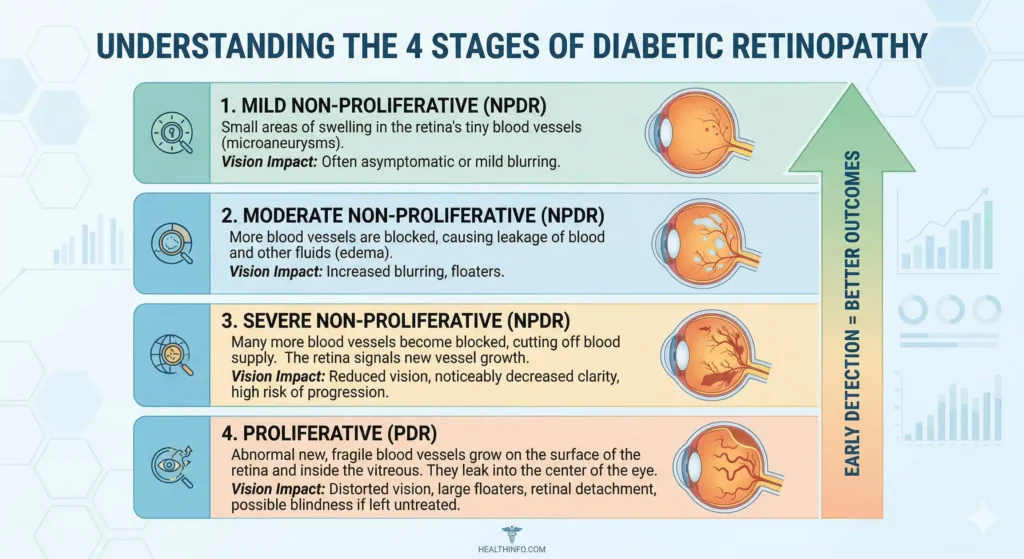
| Stage | Name | Key Characteristics | Vision Impact |
|---|---|---|---|
| Stage 1 | Mild Non-Proliferative | Microaneurysms form in retinal vessels | Usually none — detectable only by exam |
| Stage 2 | Moderate Non-Proliferative | Vessel blockage begins; retinal swelling possible | Mild blurring may begin |
| Stage 3 | Severe Non-Proliferative | Large areas of retina lose blood supply | Noticeable vision changes; high risk of progression |
| Stage 4 | Proliferative Diabetic Retinopathy | Abnormal new blood vessels grow; risk of retinal detachment | Severe vision loss; potential blindness without treatment |
What Medicare Covers for Diabetic Eye Exams in Florida
One of the most underutilized healthcare benefits available to seniors and diabetic patients in Florida is Medicare’s coverage for diabetic eye exams. Many patients are paying out of pocket for an exam that their existing coverage already includes — simply because no one explained it to them.
Medicare Part B — The Coverage Most Patients Don’t Know They Have
Medicare Part B, which covers medically necessary outpatient services, includes one dilated eye exam per year specifically for patients who have been diagnosed with diabetes. This is a critical distinction: the exam is covered not because it is a routine vision screening, but because it is classified as a medically necessary procedure for managing a diagnosed chronic condition.
Here is what that means in practical terms for patients in Tamarac:
- Who qualifies: Any Medicare Part B beneficiary with a diagnosis of Type 1 or Type 2 diabetes
- How often: Once every 12 months
- What is covered: A comprehensive dilated eye exam performed by a qualified eye care provider
- What you pay: After your Part B deductible is met, Medicare covers 80% of the approved amount. You are responsible for the remaining 20% coinsurance — which a Medigap supplemental plan may cover entirely
It is also worth noting that Medicare does not cover routine vision exams, standard eyeglasses, or contact lenses under Part B. The diabetic eye exam is covered precisely because of its medical necessity classification — a distinction your provider must correctly document at the time of the visit.
Medicare Advantage & Supplemental Plans — What Changes?
If you are enrolled in a Medicare Advantage plan (Part C) rather than Original Medicare, your diabetic eye exam benefit structure may differ — and in many cases, may be more generous. Many Medicare Advantage plans offered in Broward County include enhanced vision benefits, reduced copays, or even coverage for eyewear alongside the medically necessary exam.
The most reliable way to understand exactly what your specific plan covers before your visit is simply to call our office. Our team at West Broward Eye Care is experienced in navigating Medicare and supplemental insurance on behalf of our patients, and we are happy to help verify your benefits before you arrive.
📞 Not sure what your Medicare plan covers? Call or text our team at 954-726-0204 — we will help you verify your benefits before your visit. West Broward Eye Care is located at 7822 N. University Dr., Tamarac, FL 33321.
The Real Risk of Skipping Your Annual Diabetic Eye Exam
Understanding what Medicare covers is important. But understanding what is at stake when you skip this exam is what truly makes the case for never missing it.
How Diabetic Retinopathy Progresses Without Treatment
Diabetic retinopathy does not pause while you reschedule. It does not wait until a more convenient time. Each year without a comprehensive retinal examination is a year during which early-stage, highly treatable damage can silently advance toward a stage where treatment options become limited and vision loss becomes permanent.
According to the American Diabetes Association, diabetic retinopathy is the leading cause of new cases of blindness among adults aged 20 to 74 in the United States. The National Eye Institute estimates that approximately 40% of Americans with Type 2 diabetes have some degree of diabetic retinopathy — the majority of whom are unaware of it.
Early detection does not just preserve vision. It dramatically expands the treatment toolkit available to your physician. Laser therapy, anti-VEGF injections, and surgical interventions are all significantly more effective when applied at earlier disease stages. The exam itself is not the inconvenience — skipping it is.
South Florida’s Unique Risk Factors for Diabetic Eye Disease
Patients in Tamarac and broader Broward County face a specific combination of risk factors that make the annual diabetic eye exam even more critical than the national average suggests.
Florida consistently ranks among the top states in the country for diabetes prevalence, with Broward County reflecting those elevated rates across its diverse population. The region’s significant retiree and senior population — a demographic already at higher risk for diabetic complications — further amplifies the local urgency.
Add to that South Florida’s year-round high-UV environment. Prolonged ultraviolet exposure is independently associated with accelerated cataract formation and retinal stress — conditions that compound the damage already being done by diabetic changes at the vascular level. This makes comprehensive retinal imaging not just a best practice for Tamarac patients — it is an essential local standard of care.
What to Expect at Your Diabetic Eye Exam at West Broward Eye Care
One of the most common reasons patients delay scheduling any medical appointment is simple anxiety about the unknown. If you have never had a dilated diabetic eye exam, or if it has been several years since your last one, knowing exactly what the visit involves can make all the difference.
A Step-by-Step Walkthrough of Your Visit
From the moment you walk into our practice at 7822 N. University Dr., Tamarac, FL 33321, our team’s entire focus is on making you feel comfortable, respected, and genuinely cared for. Patients consistently describe our staff as “super friendly” and “helpful” — and that is not an accident. It is the culture our practice has built over 35 years.
Here is what your diabetic eye exam visit looks like:
Step 1 — Check-In & Insurance Verification Our front desk team will confirm your Medicare or insurance information and answer any coverage questions before your exam begins. No surprises at checkout.
Step 2 — Preliminary Testing A technician will conduct initial measurements including visual acuity, intraocular pressure, and color vision assessments. These baseline readings provide important context for your physician.
Step 3 — Advanced Retinal Imaging Before you see the doctor, our technology does the work of capturing a comprehensive picture of your retinal health using Optomap and Optovue — two of the most advanced diagnostic tools available in any eye care practice.
Step 4 — Physician Examination Your board-certified optometric physician will review your imaging results, conduct a thorough dilated examination, and discuss their findings with you in language you can actually understand. Patients at West Broward Eye Care have described leaving their appointment feeling like they received a “mini PhD” on their own eye health — that level of clear, patient-centered communication is our standard, not our exception.
Step 5 — Care Plan & Next Steps Whether your eyes show no signs of diabetic changes or your doctor identifies early-stage retinopathy that needs monitoring, you will leave with a clear, confident understanding of your eye health status and a defined plan for protecting it.
The Technology That Makes the Difference — Optomap & Optovue
The quality of a diabetic eye exam is only as good as the technology supporting it. At West Broward Eye Care, our investment in advanced diagnostic equipment is a direct investment in your outcomes.
Optomap Ultra-Widefield Retinal Imaging Traditional retinal exams capture only a fraction of the retinal surface. Optomap technology captures up to 82% of the retina in a single, non-invasive scan — providing our physicians with an unprecedented view of the peripheral retina where early diabetic changes frequently begin. The result is earlier detection, greater diagnostic confidence, and a more comfortable experience for patients who may be sensitive to standard dilation procedures.
Optovue OCT (Optical Coherence Tomography) Optovue generates microscopic cross-sectional images of retinal tissue layers — revealing structural changes at a cellular level that are entirely invisible to standard examination. For diabetic patients, this means detecting macular edema and retinal thinning before they produce any measurable impact on vision. This is the technology to detect eye disease at its earliest, most treatable stage.
Together, these tools do not just improve the exam — they fundamentally change what is possible in terms of early detection and disease management.
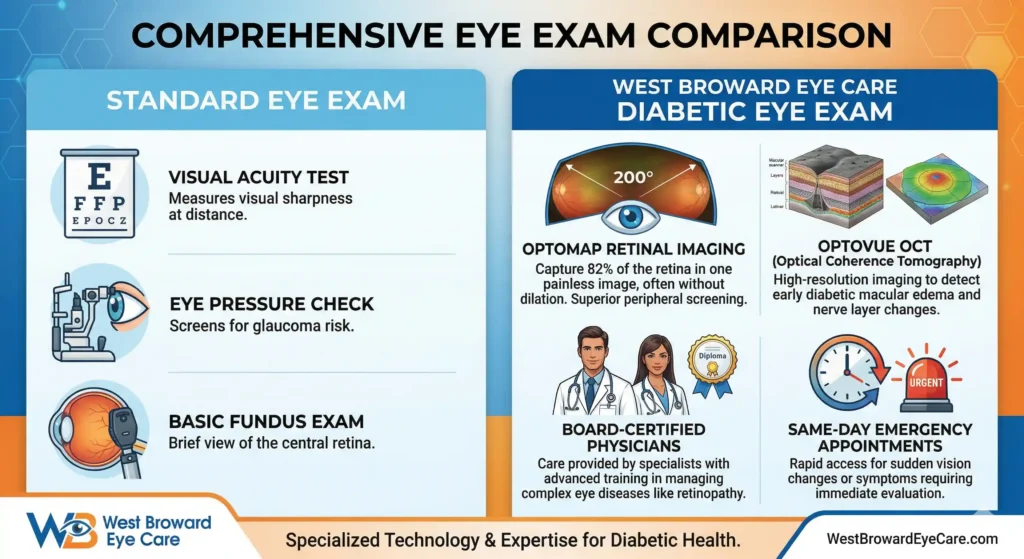
| Feature | Standard Eye Exam | West Broward Eye Care Diabetic Eye Exam |
|---|---|---|
| Retinal Coverage | Partial (~15% of retina) | Up to 82% with Optomap ultra-widefield imaging |
| Structural Detection | Surface level | Microscopic layer analysis via Optovue OCT |
| Physician Credentials | Varies | Board-certified optometric physicians |
| Disease Monitoring | General screening | Targeted diabetic retinopathy & macular edema detection |
| Emergency Access | Appointment required | Same-day emergency appointments available |
| Community Legacy | N/A | 35 years serving Tamarac, FL · 885 Google reviews |
📞 Ready to see the full picture of your eye health? Book your Medicare-covered diabetic eye exam at West Broward Eye Care — serving Tamarac, FL for 35 years. Call or text 954-726-0204.
Why Tamarac Patients Trust West Broward Eye Care for Diabetic Eye Health
Choosing an eye care provider for diabetic monitoring is not the same decision as choosing where to buy a new pair of glasses. You are selecting a long-term medical partner — one who will track the health of some of the most delicate and irreplaceable tissue in your body, year after year.
35 Years. Board-Certified Physicians. 885 Google Reviews.
West Broward Eye Care has been a cornerstone of the Tamarac healthcare community since before many of our current patients were old enough to drive. That 35-year legacy is not simply a number — it represents decades of families who have trusted us with their most precious sense, generation after generation.
Our team of highly-skilled, board-certified optometric physicians brings clinical authority that goes far beyond what a standard optical center can offer. The difference shows up in the exam room. One patient, after receiving a thorough explanation of their diagnosis, described the experience as receiving a “mini PhD” on what was happening with their eye. That is the West Broward Eye Care standard — not a lucky visit, but a consistent commitment to empowering every patient with genuine knowledge about their own health.
With 885 Google reviews validating that experience across hundreds of patient encounters, you are not taking a chance on a new provider. You are choosing the practice that Tamarac has trusted for over three decades.
Specialized Care That Goes Beyond the Basic Exam
For patients with diabetes, the annual eye exam is the beginning of a relationship — not a one-time transaction. At West Broward Eye Care, diabetic eye care is embedded within a comprehensive disease management framework. If early-stage retinopathy is detected, your physician will establish a monitoring schedule calibrated to your specific risk level. If more advanced changes are identified, our team will coordinate the appropriate next steps to ensure continuity of care.
This is what separates a specialty practice from a routine vision center. Our experience managing chronic ocular diseases — including Diabetic Retinopathy, Macular Degeneration, and Glaucoma — means that whatever your exam reveals, you are already in the hands of a team equipped to manage it.
How to Prepare for Your Diabetic Eye Exam — A Patient Checklist
Walking into your appointment prepared makes the experience faster, smoother, and more productive for both you and your physician. Here is exactly what to bring and what to expect:
What to Bring:
- ✅ Your Medicare card and any supplemental insurance cards
- ✅ A photo ID
- ✅ A complete list of your current medications, including dosages
- ✅ Your most recent blood sugar readings or A1C results if available
- ✅ The name and contact information of your primary care physician or endocrinologist
What to Expect During the Visit:
- ✅ Dilating eye drops will be administered — your vision will be temporarily blurry and sensitive to light for 2 to 4 hours afterward
- ✅ Bring sunglasses to wear after the appointment
- ✅ Plan to avoid driving immediately after dilation — bring a trusted friend or family member if possible
- ✅ The full exam typically takes between 60 and 90 minutes
What to Ask Your Doctor:
- ✅ Are there any early signs of diabetic retinopathy in my eyes?
- ✅ How does my current blood sugar control appear to be affecting my eye health?
- ✅ How frequently should I be scheduling follow-up exams given my specific risk profile?
🔗 Local Resources & Citations
1. Medicare.gov — Eye Exams for Diabetes Coverage The official U.S. government Medicare portal where patients can verify their Part B diabetic eye exam benefit, confirm eligibility, and find Medicare-approved eye doctors in their area.
2. Florida Department of Health in Broward County (DOH-Broward) The official state health authority serving Tamarac and all of Broward County’s 1.9 million residents — check here for local chronic disease programs, community health initiatives, and public health resources relevant to diabetes management in South Florida.
3. National Eye Institute (NEI) — Diabetic Retinopathy The NIH’s primary eye health authority, providing clinically verified information on diabetic retinopathy stages, symptoms, and treatment options — the same evidence base your West Broward Eye Care physicians use to guide patient care.
4. CDC — Vision Loss and Diabetes The Centers for Disease Control and Prevention’s dedicated resource on diabetes-related eye complications, confirming that diabetic retinopathy is the leading cause of blindness in working-age adults and that annual dilated eye exams can prevent vision loss in up to 90% of cases.
Book Your Diabetic Eye Exam in Tamarac Today
Your vision is not replaceable. Diabetic retinopathy is not reversible once it reaches advanced stages. And your Medicare benefit for this exam resets every single year — whether you use it or not.
The team at West Broward Eye Care has spent 35 years earning the trust of this community, one patient at a time. With board-certified physicians, state-of-the-art Optomap and Optovue technology, and a practice culture built on genuine compassion and clear communication, we are not just the most experienced diabetic eye care provider in Tamarac — we are your neighbors, and we are here to help you protect your sight for life.
Do not wait for symptoms. Do not let another year go by unexamined. Your Medicare coverage is ready. We are ready. The only step left is yours.
📍 West Broward Eye Care 7822 N. University Dr., Tamarac, FL 33321 📞 Call or Text: 954-726-0204 ✉️ info@wbeca.com 🕐 Monday–Thursday: 9:00 AM–5:00 PM | Friday: 9:00 AM–4:00 PM
Book your diabetic eye exam today. Your vision depends on it.
Frequently Asked Questions
-
Yes. Medicare Part B covers one dilated diabetic eye exam per year for patients diagnosed with Type 1 or Type 2 diabetes. This benefit applies specifically because the exam is classified as medically necessary — not as routine vision care. After your Part B deductible is met, Medicare covers 80% of the approved amount, leaving patients responsible for 20% coinsurance. Medicare Advantage plans in Broward County may offer additional coverage. To confirm your specific benefits before your visit, call or text West Broward Eye Care at 954-726-0204.
Disclaimer:
This article is for informational purposes only and does not constitute medical advice. Always consult a qualified healthcare provider regarding any medical condition or treatment. Medicare coverage details may vary by plan; contact your provider or insurance representative to confirm your specific benefits.