Understanding Lens Options: Anti-Reflective, Blue Light, Photochromic
Eyeglass lens options include anti-reflective coatings (glare reduction), blue light filtering lenses (screen protection), photochromic lenses (adaptive sun darkening), UV coatings (retinal protection), polarized lenses (reflective glare elimination), and high-index lenses (thinner profiles for strong prescriptions). The right combination depends on your lifestyle, prescription, and daily visual environment.
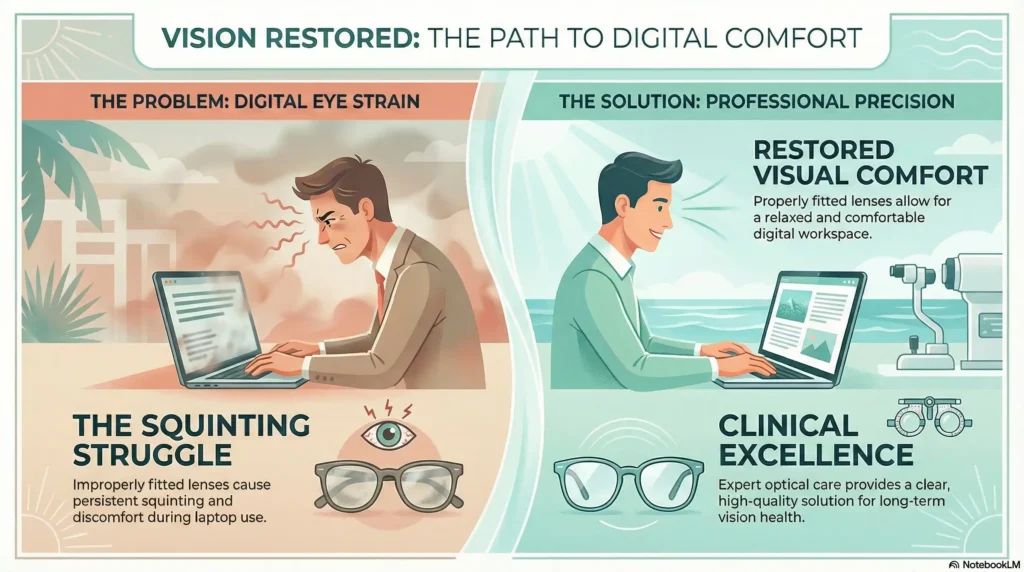
Most patients walk out of their eye exam with a precise prescription in hand and immediately face a second, often more confusing decision: which lenses actually go in the frames? Anti-reflective coating or blue light filtering? Photochromic or polarized? High-index or standard? For many people, this moment in the optical feels overwhelming — and the wrong choice can mean spending the next year squinting at screens, struggling with nighttime glare, or reaching for sunglasses every time you step outside.
At West Broward Eye Care, this conversation happens every day. For 35 years, our board-certified optometric physicians have been helping patients in Tamarac and the surrounding Broward County community navigate exactly these decisions — matching the right lens technology to each patient’s unique prescription, lifestyle, and visual environment. This guide is designed to give you the knowledge to walk into that conversation fully prepared.
Our board-certified optometric physicians at West Broward Eye Care are here to help. Call or text 954-726-0204 to book your comprehensive eye exam and lens consultation. Located at 7822 N. University Dr., Tamarac, FL 33321.
Why Your Lens Choice Matters as Much as Your Prescription
A prescription tells your lenses how to bend light so your eyes can focus correctly. But it says nothing about glare, UV radiation, digital eye strain, or how your lenses will perform at 10 PM on a rain-slicked Broward County highway. That is where lens technology steps in.
The lenses in your frames are not passive pieces of optical glass. They are engineered systems — and the coatings, materials, and treatments applied to them determine how comfortable, protective, and functional your vision is across every environment you move through in a day. For patients in South Florida specifically, this is not a trivial consideration. The region’s near-year-round sunshine, high UV index, and warm outdoor lifestyle create visual demands that patients in northern climates simply do not face to the same degree.
Beyond the environment, the way we live has changed dramatically. The average American adult now spends over seven hours per day looking at digital screens. Children are following the same pattern. This shift has made lens selection a genuine clinical decision — one with real consequences for long-term eye health, daily comfort, and quality of life.
At West Broward Eye Care, our full-service optical carries a complete array of eyewear options for all ages and budgets, supported by the latest in digital lens technology. Every recommendation our team makes is grounded in the diagnostic precision of tools like Optovue and Optomap — ensuring your prescription is accurate before a single lens decision is made.
Anti-Reflective Coating — The Most Recommended Upgrade in Optometry
What Is Anti-Reflective Coating?
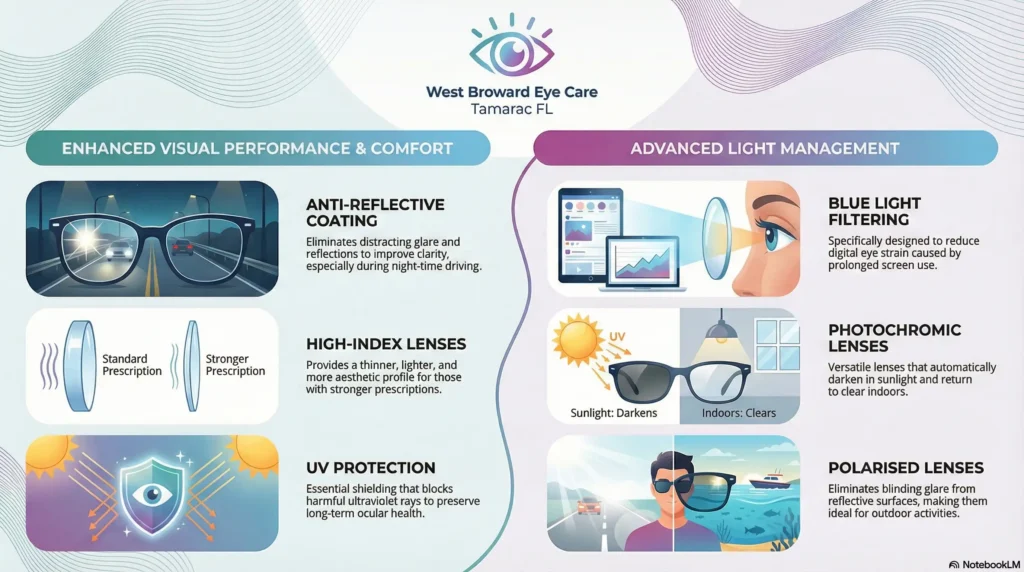
Anti-reflective (AR) coating — sometimes called anti-glare coating — is a microscopically thin layer applied to the surface of eyeglass lenses that significantly reduces the amount of light reflected off the lens. Standard uncoated lenses reflect approximately 8% of incoming light back toward your eyes and away from your vision. A quality AR coating reduces that reflection to less than 1%, allowing nearly all available light to pass through to your eye where it belongs.
The practical result is dramatically sharper, clearer vision — particularly in high-contrast and low-light situations. Halos around headlights shrink. The glare off a computer monitor softens. The reflection of overhead fluorescent lighting — a persistent irritant in offices and classrooms — is significantly reduced. For patients who wear glasses full-time, AR coating is not an upgrade. It is the standard of care.
Who Benefits Most from AR Coating?
The short answer is: virtually every glasses wearer. But certain patients experience particularly transformative results. Professionals who spend their workday under office lighting or in front of monitors notice an immediate and significant reduction in visual fatigue. Night drivers — especially those navigating the busy intersections along University Drive or I-95 after dark — report a meaningful reduction in the glare and halo effect from oncoming headlights that can make nighttime driving genuinely stressful.
Students and children in classroom settings benefit from reduced glare off whiteboards and screens. Patients with higher prescriptions, whose lenses tend to have more noticeable reflections due to greater curvature and refractive index, often find AR coating nearly transformative in how natural and comfortable their vision feels.
Is Anti-Reflective Coating Worth the Extra Cost?
Consistently, yes — and for reasons that go beyond comfort. Modern AR coatings are engineered with additional functional layers: scratch-resistant treatments that extend lens life, smudge-resistant and hydrophobic surfaces that make cleaning faster and easier, and in many formulations, built-in UV protection. When you factor in the improved visual clarity, reduced eye fatigue, and extended lens durability, the cost difference between a standard lens and a quality AR-coated lens is one of the highest-value investments available in optical care.
Blue Light Filtering Lenses — Protection for the Screen Generation
What Is Blue Light and Why Does It Matter?
Blue light — technically high-energy visible (HEV) light — occupies the 380 to 500 nanometer range of the visible light spectrum. It is emitted naturally by the sun, but also intensively by the LED screens of smartphones, tablets, computer monitors, and televisions. Unlike UV light, blue light passes through the cornea and lens and reaches the retina directly.
The clinical conversation around blue light has evolved considerably. The most well-established concern is its role in digital eye strain — formally recognized as computer vision syndrome — a constellation of symptoms including eye fatigue, dryness, headaches, blurred vision, and difficulty refocusing that affects an estimated 50 to 90% of regular computer users. Emerging research also points to blue light’s role in disrupting melatonin production, affecting sleep quality in patients with significant evening screen exposure. While the long-term retinal implications of blue light exposure continue to be studied, the short-term symptomatic relief that blue light filtering lenses provide is well-documented and clinically meaningful.
Who Should Consider Blue Light Filtering Lenses?
Any patient who spends three or more hours per day on digital devices is a strong candidate. This encompasses a vast and growing portion of the adult population — remote workers, office professionals, students, and increasingly, children whose academic and recreational lives are screen-centric. At West Broward Eye Care, we pay particular attention to blue light filtering as a complement to our Myopia Management program for pediatric patients, where reducing overall visual stress from screens is a component of the comprehensive care strategy.
Patients who notice afternoon headaches, evening eye fatigue, or difficulty sleeping after screen use are often experiencing classic blue-light-related symptoms — and frequently report significant improvement within weeks of switching to blue light filtering lenses.
Can You Combine Blue Light Filtering with Anti-Reflective Coating?
Yes — and this combination is what our optical team recommends most frequently for everyday wear. Many premium lens formulations incorporate both technologies into a single, unified lens coating. The AR layer eliminates surface glare and reflections while the blue light filter addresses the HEV wavelengths passing through the lens. Together, they address the full spectrum of visual discomfort associated with modern screen-heavy environments. Our board-certified optometric physicians at West Broward Eye Care can assess your specific screen habits and visual demands and recommend the right formulation for your daily life.
Photochromic Lenses — One Pair for Every Environment
How Do Photochromic Lenses Work?
Photochromic lenses — most widely recognized under the Transitions® brand name — contain photosensitive molecules embedded within or applied to the lens material. These molecules react to ultraviolet radiation: in the presence of UV light, they undergo a chemical change that causes the lens to darken. Remove the UV source — step indoors, for instance — and the molecules return to their clear state, typically within a few minutes. The result is a single pair of glasses that functions as clear optical lenses indoors and as sunglasses outdoors, adapting automatically to changing light conditions.
Modern photochromic lenses have advanced considerably from early generations. Today’s formulations darken faster, clear faster, achieve deeper tint levels in bright conditions, and maintain better clarity in their clear state. Many are also available with polarization integrated, combining adaptive darkening with glare-reduction for outdoor use.
Are Photochromic Lenses Worth It in Florida’s Climate?
This is one of the most common questions our Tamarac patients ask — and the answer is nuanced. South Florida’s near-constant sunshine and high UV index make photochromic technology highly relevant. Patients who move regularly between indoor and outdoor environments throughout the day — running errands, walking between buildings, spending time on patios or in outdoor settings — experience genuine convenience from not having to manage a separate pair of prescription sunglasses.
However, there is an important clinical caveat specific to driving: most standard photochromic lenses do not darken significantly inside a vehicle. Modern car windshields are treated to block UV radiation — the same UV that triggers photochromic activation. This means that while photochromic lenses are excellent for outdoor pedestrian environments, they may not provide adequate tint while driving. Patients who spend significant time commuting should discuss this with our optical team and consider whether a dedicated pair of prescription polarized sunglasses is a better complement to their primary photochromic pair.
How Long Do Photochromic Lenses Last?
The photochromic molecules in the lens do degrade over time with repeated UV exposure. Most quality photochromic lenses perform optimally for approximately two to three years before the darkening response begins to slow and the maximum tint level begins to diminish. This aligns naturally with the recommendation for annual comprehensive eye exams — allowing our doctors to monitor both your vision prescription and the functional performance of your lenses on a consistent schedule.
UV Protection, Polarized & High-Index Lenses — The Complete Picture
Do You Need UV Coating If You Already Have AR Coating?
This question reflects a common and understandable confusion. Anti-reflective coating and UV coating are functionally distinct — they address entirely different types of light interaction. AR coating manages visible light reflections off the lens surface. UV coating blocks ultraviolet radiation — the invisible, high-energy wavelengths that cannot be seen but cause cumulative biological damage to the cornea, lens, and retina over years of exposure.
In South Florida, UV protection is not optional. Broward County consistently records among the highest UV index readings in the continental United States. Long-term unprotected UV exposure is a documented contributing factor to cataracts, macular degeneration, pterygium, and photokeratitis. Many modern premium lens materials — particularly polycarbonate and high-index lenses — incorporate UV400 protection inherently within the lens material itself, blocking 100% of UV radiation up to 400 nanometers. Your optometric physician at West Broward Eye Care will confirm your lens material’s UV protection level and recommend additional coating if indicated.
Polarized Lenses — When Are They the Right Choice?
Polarized lenses work differently from standard UV coatings. Rather than blocking UV radiation, they contain a laminated filter oriented to block horizontally polarized light — the specific type of glare produced when sunlight reflects off flat surfaces like water, wet roads, sand, and car hoods. For patients in South Florida who boat, fish, spend time at the beach, or face intense driving glare on flat, sun-drenched roadways, polarized lenses offer a qualitatively different and superior visual experience compared to standard tinted sunglasses.
The honest clinical note: polarized lenses can make LCD screens — on dashboards, ATMs, and certain phones — difficult to read due to the filtering effect. For patients whose outdoor activities are water- or sun-glare-intensive, the benefits overwhelmingly outweigh this limitation. For patients who primarily need sun protection without intense glare environments, a high-quality UV-blocking tinted lens may serve equally well.
High-Index Lenses — Who Needs Them?
High-index lenses are manufactured from materials with a higher refractive index than standard plastic — meaning they bend light more efficiently, allowing the same optical correction to be achieved with significantly less material. The result is a lens that is thinner, flatter, and lighter than a conventional lens of equivalent prescription power.
Patients with moderate to strong prescriptions — typically those with a spherical power beyond ±3.00 diopters — are the primary beneficiaries. Standard plastic lenses at these prescription levels produce noticeable edge thickness and lens magnification that affects both aesthetics and comfort. High-index materials minimize this substantially. At West Broward Eye Care, our full-service optical carries high-index options across a range of budgets, and our optical team routinely recommends the appropriate index for each patient’s prescription and chosen frame style.
Which Lens Is Right for You? — A Decision Guide
| Lens Option | Primary Benefit | Best For | South Florida Relevance |
|---|---|---|---|
| Anti-Reflective | Glare elimination, visual clarity | All-day wear, drivers, screen users | High — bright ambient light year-round |
| Blue Light Filter | HEV reduction, strain relief | Screen-heavy lifestyles, children | High — remote work, student populations |
| Photochromic | Adaptive darkness, UV protection | Active patients, indoor/outdoor transition | High — with driving caveat noted |
| UV Coating/UV400 | Long-term retinal protection | All patients — non-negotiable in FL | Critical — highest UV index in continental US |
| Polarized | Reflective surface glare elimination | Boating, fishing, beach, driving | High — water, sand, wet road environments |
| High-Index | Thinner, lighter lenses | Strong prescriptions (±3.00 and above) | Moderate — comfort and frame aesthetics |
Why Tamarac Patients Trust West Broward Eye Care for Their Lens Decisions
Choosing the right lens is not something that should happen at a display counter under sales pressure. It should happen as a natural extension of a thorough clinical examination — informed by an accurate prescription, a clear understanding of your daily visual environment, and the guidance of a physician who has seen the real-world outcomes of these choices across thousands of patients over decades of practice.
For 35 years, West Broward Eye Care has served as the trusted optical resource for families, professionals, seniors, and children throughout Tamarac and Broward County. Our board-certified optometric physicians bring the same level of clinical rigor to lens selection that they apply to disease detection and specialty contact lens fitting. The same Optovue and Optomap technology that allows us to detect retinal changes at the microscopic level ensures that the prescription driving your lens selection is as accurate as modern optometry allows.
Our 885 Google reviews consistently reflect a patient experience built on thorough explanations, unhurried appointments, and a team that takes the time to ensure every patient understands their options — what one patient memorably described as receiving a “mini PhD” on their own eye health. That same educational commitment extends to every lens consultation that happens in our optical.
We carry a full array of eyewear options for all ages and budgets — from designer frames and premium lens packages to practical, insurance-covered selections that meet the needs of every family. Our optical team works alongside our physicians to ensure that what ends up in your frames reflects both your clinical needs and your real life.
Expert lens guidance, personalized for your visionVisit the West Broward Eye Care optical at 7822 N. University Dr., Tamarac, FL 33321 or call/text 954-726-0204. Our team will match the right lens technology to your prescription, lifestyle, and South Florida environment.
Local Resources & Citations
West Broward Eye Care | Lens Options Topic | Tamarac, FL
1. U.S. Environmental Protection Agency — UV Index for South Florida The EPA’s official UV Index resource confirms why UV-protective lens coatings are a clinical necessity in Broward County — check here to see real-time UV exposure levels for the Tamarac area and understand the daily risk to unprotected eyes.
2. National Eye Institute (NEI) — Refractive Errors & Corrective Lenses Published by the National Institutes of Health, this federal resource provides clinically verified explanations of how prescription lenses correct refractive errors — supporting the medical context behind every lens selection made at West Broward Eye Care.
3. Florida Department of Health in Broward County — Healthy Vision Resources The official Broward County public health authority provides community health guidance relevant to South Florida residents, including preventative care priorities — reinforcing the importance of annual comprehensive eye exams and UV eye protection in the local region.
4. American Optometric Association (AOA) — Computer Vision Syndrome The AOA is the foremost professional authority in U.S. optometry — their clinical guidelines on computer vision syndrome directly validate the medical rationale for blue light filtering and anti-reflective lenses recommended by West Broward Eye Care’s board-certified physicians.
The West Broward Eye Care Lens Consultation Experience
Patients who come to West Broward Eye Care for a comprehensive eye exam receive far more than a prescription. The examination begins with advanced diagnostic imaging — Optomap for a wide-field view of retinal health, Optovue for microscopic structural analysis — that establishes a complete clinical picture of your eye health before any corrective lens recommendation is made.
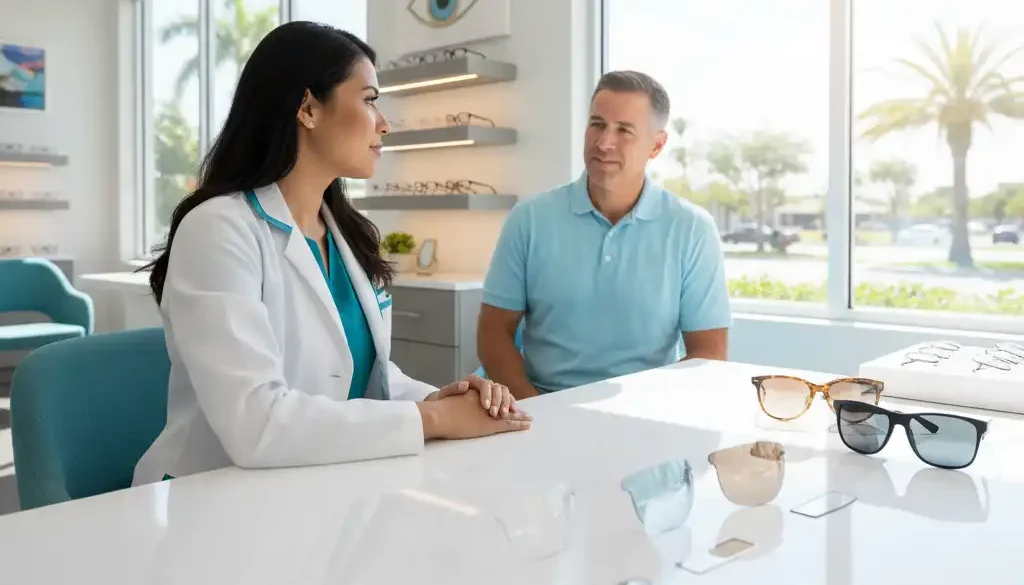
Once your prescription is confirmed with precision, the lens consultation begins. Our optical team reviews your daily routine: how many hours you spend on screens, how much time you spend outdoors, whether you drive at night, whether you have children who need their own eyewear, and what your budget and insurance coverage allows. From this conversation, a personalized lens recommendation emerges — not a generic package, but a specific combination of materials, coatings, and technologies matched to you.
For patients with complex conditions — those managing Keratoconus, requiring specialty contact lenses fitted with our SMap3D technology, or navigating lens choices alongside Myopia Management for their children — this consultation becomes a clinical collaboration. Our physicians are directly involved in ensuring that the optical solution supports the broader treatment plan.
West Broward Eye Care accepts a wide range of insurance plans, and our team works diligently to maximize your benefits while ensuring you have access to the lens technology that genuinely serves your vision needs. Same-day emergency eye care is also available for patients experiencing acute symptoms — because protecting your vision should never have to wait.
📍 Book your comprehensive eye exam and lens consultation at West Broward Eye Care. Call or text 954-726-0204 · 7822 N. University Dr., Tamarac, FL 33321 · Monday–Thursday 9:00 AM–5:00 PM · Friday 9:00 AM–4:00 PM
Frequently Asked Questions
-
Anti-reflective (AR) coatings eliminate glare and “ghost images,” significantly reducing eye strain during night driving and computer use. They also make your lenses nearly invisible for better eye contact.