Personalized Lens Recommendations | Tamarac, FL
Your eye prescription directly determines which lens type, thickness, material, and coatings will give you the clearest, most comfortable vision. A mild prescription may require only basic single-vision lenses, while a high prescription for myopia or astigmatism demands specialized high-index materials and precision fitting technology. Patients with conditions like Keratoconus require custom specialty lenses fitted with advanced corneal mapping. At West Broward Eye Care in Tamarac, FL, board-certified optometric physicians use state-of-the-art diagnostic technology to translate your unique prescription into a truly personalized lens recommendation — not a generic one-size-fits-all solution.
You just walked out of your eye exam holding a slip of paper covered in numbers, abbreviations, and medical shorthand. OD. OS. SPH. CYL. You know it means something important about your vision — but what does it actually mean for the lenses you should be wearing every single day?
This is one of the most common and most consequential questions patients bring to West Broward Eye Care. For 35 years, our board-certified optometric physicians have helped patients in Tamarac, Broward County, and throughout South Florida transform a confusing prescription into a lens choice they feel genuinely confident about. This guide will walk you through exactly how your prescription numbers connect to your lens options — and why that connection is more personalized, and more important, than most people realize.
What Your Eye Prescription Actually Means
Before you can understand your lens options, you need to understand the language of your prescription. Think of this as your foundation — the “mini PhD” on your own eye health that every patient deserves before making any lens decision.
Breaking Down the Numbers: SPH, CYL, Axis, and Add Power
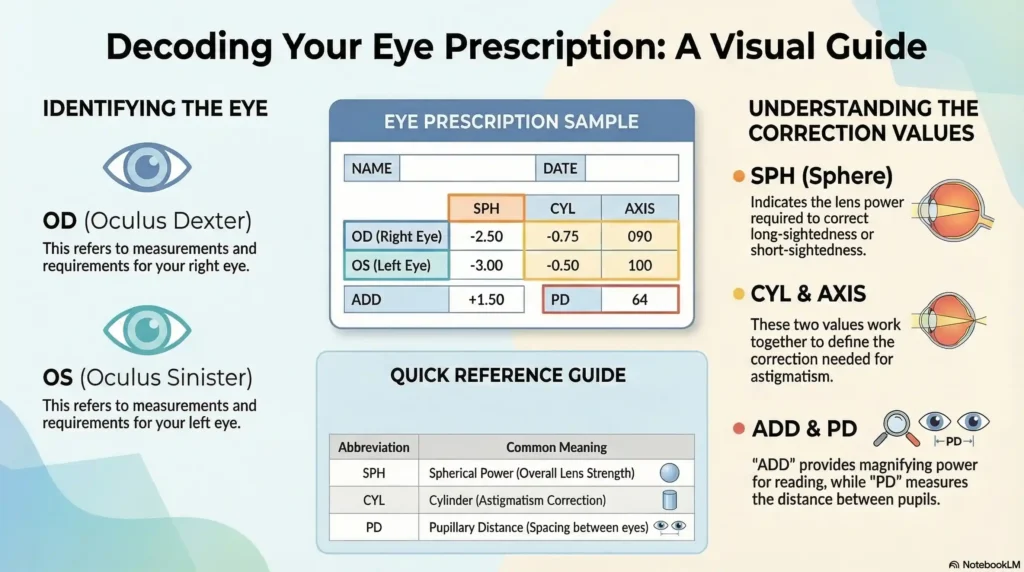
Every prescription contains a set of values that describe the precise optical correction your eyes require. Here is what each one means in plain language:
| Abbreviation | Full Term | What It Measures |
|---|---|---|
| SPH | Sphere | The degree of nearsightedness (−) or farsightedness (+) |
| CYL | Cylinder | The degree of astigmatism present in the eye |
| AXIS | Axis | The orientation of astigmatism correction (0–180 degrees) |
| ADD | Add Power | Additional magnification for near vision (bifocal/progressive) |
| OD | Oculus Dexter | Right eye |
| OS | Oculus Sinister | Left eye |
A negative SPH value means you are nearsighted — you see clearly up close but struggle at distance. A positive value means you are farsighted. The higher the number in either direction, the stronger the prescription. CYL and AXIS values together describe astigmatism — an irregularity in the shape of your cornea or lens that causes blurred or distorted vision at any distance.
The Difference Between Nearsighted and Farsighted Prescriptions
Nearsightedness (myopia) and farsightedness (hyperopia) are not simply opposites — they create different visual challenges and often require different lens strategies. Nearsighted patients typically struggle most with distance tasks like driving or reading a classroom whiteboard. Farsighted patients may experience eye strain, headaches, and difficulty focusing up close, especially as they age.
This distinction matters enormously for lens selection. A nearsighted patient with a strong prescription will benefit from high-index lens materials that reduce thickness and weight. A farsighted patient with Add power may require progressive lenses that seamlessly address both near and distance vision in a single lens.
What “High Prescription” Actually Means for Your Lens Options
A prescription is generally considered “high” when the SPH value exceeds −6.00 or +4.00 diopters. High prescriptions create unique challenges: standard lens materials become thick, heavy, and optically distorted at the edges. Patients with high prescriptions who choose the wrong lens material often end up with lenses that are uncomfortable, cosmetically unflattering, and visually inferior.
This is precisely why a personalized consultation — not a quick selection from a chain optical display — is so critical for high-prescription patients.
| Prescription Field | Plain-Language Meaning | Impact on Lens Choice |
|---|---|---|
| SPH (−6.00 or higher) | High myopia | Requires high-index material (1.67 or 1.74) |
| CYL present | Astigmatism | Requires toric lens design |
| AXIS value | Astigmatism orientation | Must be precisely aligned during fitting |
| ADD power present | Presbyopia | Requires progressive or bifocal lens |
| High SPH + CYL | Complex prescription | May require specialty or custom lens |
How Different Prescription Types Lead to Different Lens Recommendations
Understanding your prescription numbers is step one. Step two is understanding how those numbers translate into specific lens recommendations — and why the wrong choice can undermine even a perfectly accurate prescription.
Lenses for Mild to Moderate Prescriptions
Patients with mild to moderate prescriptions (roughly SPH −0.25 to −3.00 or +0.25 to +2.00) have the widest range of lens options available to them. Standard polycarbonate or Trivex lenses offer excellent clarity, impact resistance, and UV protection at an accessible price point. These patients can comfortably wear a wide variety of frame styles without significant lens thickness concerns.
Even within this “straightforward” category, personalization matters. A mild prescription patient who spends long hours on digital screens will benefit significantly from anti-reflective coatings and blue light filtering. A patient who spends time outdoors in Tamarac’s intense South Florida sun should strongly consider photochromic lenses that automatically darken in UV light.
Lenses for High Myopia or Strong Astigmatism
Patients with high myopia or significant astigmatism require a more sophisticated approach to lens selection. High-index lens materials — rated at 1.67 or 1.74 — are thinner and lighter than standard materials, making them both more comfortable and more cosmetically appealing for strong prescriptions. Aspheric lens designs further reduce distortion and edge thickness, delivering sharper peripheral vision.
For patients with both high myopia and astigmatism, the interaction between SPH and CYL values creates a complex optical prescription that demands precise alignment during fitting. A miscalculation of even a few degrees in AXIS orientation can result in blurred vision, eye strain, and chronic headaches — outcomes that are entirely preventable with proper technology-assisted fitting.
Progressive and Bifocal Lenses for Add Power (Presbyopia)
For patients over 40, the addition of ADD power signals the onset of presbyopia — the natural age-related loss of near focusing ability. This is among the most common vision changes in the Tamarac community’s significant senior population, and it requires a thoughtful transition in lens design.
Progressive lenses are the modern gold standard for presbyopia correction. Unlike traditional bifocals, which have a visible dividing line, progressives offer a seamless gradient of correction from distance at the top to near at the bottom. Premium progressive designs, available through West Broward Eye Care’s full-service optical, offer a wider reading corridor, reduced peripheral distortion, and faster adaptation — a meaningful quality-of-life upgrade over entry-level alternatives.
Specialty Lenses for Keratoconus and Complex Corneal Conditions
For patients diagnosed with Keratoconus or other corneal irregularities, standard soft contact lenses or conventional eyeglass lenses simply cannot provide adequate vision correction. Keratoconus causes a progressive thinning and cone-like bulging of the cornea, creating optical distortions that standard lenses cannot compensate for.
These patients require specialty contact lenses — including rigid gas-permeable (RGP) lenses, scleral lenses, or custom hybrid lenses — that vault over the irregular corneal surface and create a smooth refractive interface. West Broward Eye Care’s extensive experience in prescribing specialty contact lenses, supported by SMap3D corneal mapping technology, makes the practice one of the premier destinations in Broward County for Keratoconus lens fitting.
📞 Ready to Find Your Perfect Lenses?
Not sure which lenses are right for your prescription? Our board-certified doctors at West Broward Eye Care use advanced technology to find your perfect fit — no guesswork, no generic solutions.
Call or Text: 954-726-0204 7822 N. University Dr., Tamarac, FL 33321
The Role of Lifestyle in Your Lens Recommendation
Your prescription tells us what your eyes need to see clearly. Your lifestyle tells us how your lenses need to perform in the real world. At West Broward Eye Care, both conversations happen before any lens recommendation is made.
Lenses for Active Lifestyles and Outdoor Living in South Florida
South Florida’s outdoor lifestyle — from early morning walks along Tamarac’s parks to weekend boating on Broward’s waterways — places unique demands on corrective lenses. Polycarbonate and Trivex materials offer the highest level of impact resistance, making them the preferred choice for active patients and children. Wraparound frame styles with prescription lenses provide additional peripheral protection for sports and outdoor activities.
UV Protection: Why Tamarac’s Sun Makes Lens Coatings Non-Negotiable
Tamarac, FL receives intense year-round UV exposure — one of the highest in the continental United States. Cumulative UV exposure is a documented contributing factor to the development of cataracts, macular degeneration, and pterygium. For patients living and working outdoors in Broward County, UV-blocking lens technology is not an optional upgrade — it is a fundamental component of long-term eye health protection.
West Broward Eye Care’s full-service optical offers the latest in digital UV-blocking lens technology, as well as a comprehensive selection of designer sun wear for patients who prefer dedicated sunglasses for outdoor use.
Digital Screen Users: Blue Light and Anti-Reflective Lens Options
The average American spends over seven hours per day looking at digital screens. For patients in Tamarac who work in front of computers, use tablets, or spend significant time on smartphones, high-energy visible (HEV) blue light exposure contributes to digital eye strain, disrupted sleep cycles, and chronic visual fatigue.
Anti-reflective (AR) coatings eliminate glare from screens and artificial lighting, while blue light filtering lens treatments reduce HEV exposure at the source. These coatings are now considered a standard recommendation for virtually any patient with significant screen time — regardless of their base prescription strength.
The Best Lens Options for Children and Myopia Management
For children in Tamarac’s schools and families, lens selection carries an additional layer of importance. Children’s prescriptions change rapidly, and the type of lens correction chosen can actually influence the rate of myopic progression. Standard single-vision lenses correct a child’s vision — but they do not slow the underlying process driving it.
West Broward Eye Care’s specialized Myopia Management program offers proven interventions that go beyond basic correction. Orthokeratology (Ortho-K) lenses are worn overnight to gently reshape the cornea, providing clear daytime vision without glasses while actively slowing myopic progression. Multifocal soft contact lenses and atropine therapy are additional options tailored to each child’s specific prescription and progression pattern.
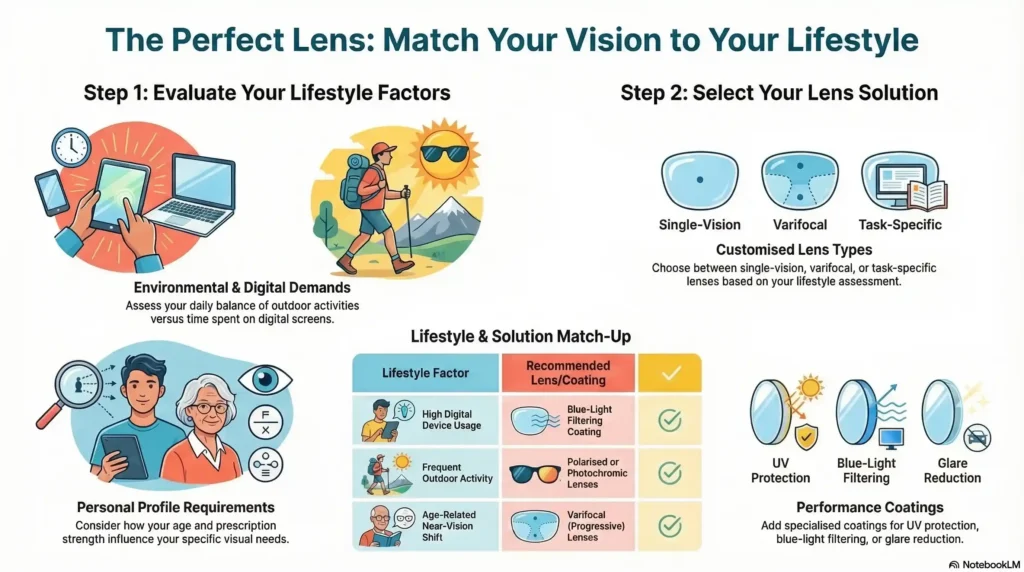
| Lifestyle Factor | Recommended Lens Type | Recommended Coating / Feature |
|---|---|---|
| High outdoor activity | Polycarbonate or Trivex | UV400 + polarized sun wear |
| Heavy screen use | Any base material | Anti-reflective + blue light filter |
| Child with myopia | Ortho-K or multifocal contact | Myopia management program |
| Presbyopia (40+) | Progressive lenses | Premium wide-corridor design |
| Keratoconus | Specialty scleral / RGP | SMap3D custom fitting |
| High prescription | High-index 1.67 or 1.74 | Aspheric design + AR coating |
| Senior patient | Progressive + UV | Blue light + photochromic option |
Why Personalized Lens Fitting Requires Advanced Technology — Not Guesswork
A prescription is a starting point — not a complete lens solution. Translating that prescription into optimal visual performance requires diagnostic technology and clinical expertise that goes far beyond what a retail optical chain can offer.
What SMap3D Technology Means for Your Lens Fit
SMap3D is a corneal topography system that creates a precise three-dimensional map of the cornea’s surface. For patients requiring specialty contact lenses — particularly those with Keratoconus, post-surgical corneas, or irregular astigmatism — SMap3D eliminates the guesswork from the fitting process entirely. The result is a custom-fitted lens that matches the unique geometry of each individual eye, delivering both superior vision and dramatically improved comfort compared to trial-and-error fitting methods.
How Optomap and Optovue Inform Smarter Lens Recommendations
West Broward Eye Care’s investment in Optomap retinal imaging and Optovue OCT technology means that lens recommendations are informed by a complete picture of the eye’s health — not just its refractive error. Optomap captures a wide-field retinal image that can reveal early signs of conditions like macular degeneration and diabetic retinopathy that may affect lens choices. Optovue provides microscopic cross-sectional imaging of retinal and corneal tissue, enabling early detection of structural changes before they affect vision.
For patients managing chronic ocular diseases, this integrated approach ensures that lens recommendations support — rather than conflict with — their broader treatment plan.
Why a Chain Optical Store Cannot Replicate This Level of Care
A retail optical chain can fill a straightforward prescription. What it cannot do is integrate corneal mapping, retinal imaging, disease management, and pediatric myopia protocols into a single, cohesive lens recommendation tailored to one individual patient. The difference is not merely technological — it is philosophical. West Broward Eye Care treats lens selection as a medical decision, not a retail transaction.
🔬 Experience Precision Lens Fitting
State-of-the-art technology. Board-certified expertise. Lenses fitted specifically for your eyes.
📍 7822 N. University Dr., Tamarac, FL 33321 📞 Call or Text: 954-726-0204
What to Expect at Your Personalized Lens Consultation at West Broward Eye Care
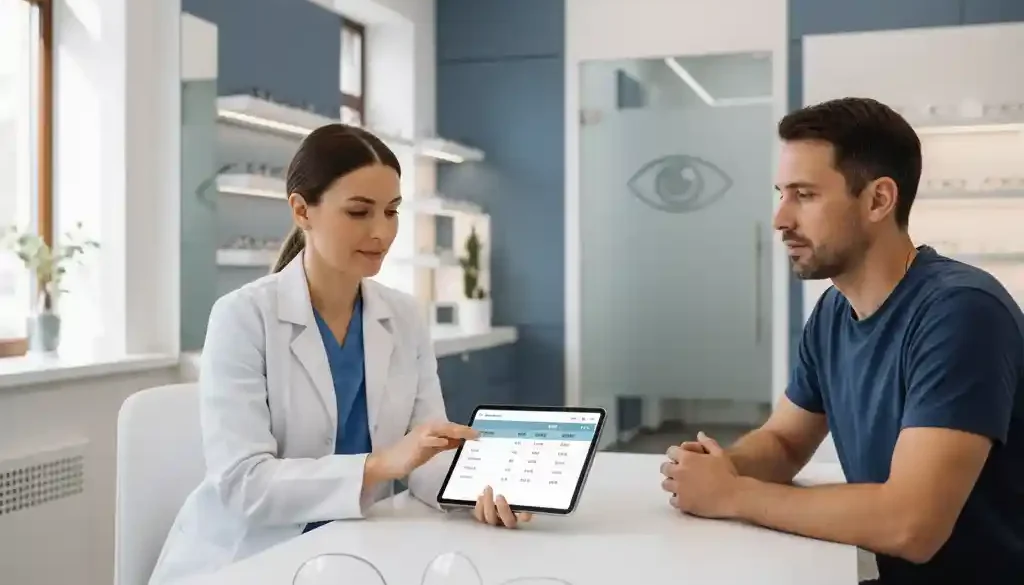
For many patients, not knowing what to expect from an appointment is itself a barrier to booking one. Here is exactly what a personalized lens consultation looks like at our Tamarac practice.
Step 1 — Comprehensive Eye Exam and Prescription Verification
Every lens consultation begins with a thorough, comprehensive eye exam conducted by one of our board-certified optometric physicians. This is not a cursory vision screening — it is a complete evaluation of your visual acuity, refractive error, binocular function, and ocular health. Advanced diagnostic imaging with Optomap and Optovue ensures that no underlying condition goes undetected.
Step 2 — Lifestyle Assessment and Lens Needs Discussion
Following the exam, your doctor will conduct a structured conversation about your daily visual demands. How much time do you spend outdoors? Do you work on screens? Do you play sports? Are you managing a chronic condition like diabetes or macular degeneration? This lifestyle assessment is what transforms a generic prescription into a personalized lens recommendation.
Step 3 — Technology-Assisted Fitting and Final Recommendation
For patients requiring specialty lenses, SMap3D corneal mapping is performed to generate the precise topographic data required for custom lens fitting. For all patients, your doctor will present a clear, explained recommendation — including lens material, design, coatings, and frame considerations — so that you leave your appointment fully informed and confident in your choice.
Our Full-Service Optical: Frames and Lenses for Every Age and Budget
West Broward Eye Care’s full-service optical offers an extensive selection of eyewear for all ages and budgets, including designer frames, sun wear, and the latest in digital lens technology. Whether you need a single pair of progressive lenses, a dedicated set of computer glasses, or specialty contact lenses for Keratoconus, our optical team ensures that your prescription performs at its absolute best in the frames you love.
🏛️ LOCAL RESOURCES & CITATIONS
1. Florida Department of Health — Broward County Health Department. The official county health authority for Broward County residents — check here for local vision health programs, public health resources, and licensed optometry provider verification in the Tamarac area.
2. U.S. Food & Drug Administration — Contact Lens Safety. The federal regulatory authority on contact lens safety standards — reference this page to understand your legal right to a copy of your contact lens prescription and the federal laws that govern lens fitting requirements.
3. National Eye Institute — National Institutes of Health. The U.S. government’s primary eye health research institute — patients can use this resource to access clinically verified information on conditions like Keratoconus, Myopia, Macular Degeneration, and Diabetic Retinopathy, as discussed in this article.
4. City of Tamarac — Official Municipal Website. The official City of Tamarac government portal — relevant for confirming community health and senior services programs available to Tamarac residents, including programs that serve the city’s significant senior population with age-related vision needs.
Serving Tamarac, Broward County, and the Surrounding South Florida Community
West Broward Eye Care proudly serves patients from Tamarac, North Lauderdale, Lauderhill, Margate, Coconut Creek, and the broader Broward County area. For 35 years, families, seniors, children, and patients with complex vision needs have trusted our board-certified optometric physicians to deliver the personalized, technology-driven eye care that makes a genuine difference in their quality of life.
Whether you are a longtime patient or visiting us for the first time, our commitment remains the same: to make every patient feel seen, heard, and confident in their eye health journey — from their first prescription to their perfect pair of lenses.
👁️ Your Perfect Lenses Are Waiting
35 years of vision expertise. State-of-the-art technology. Compassionate, board-certified care. West Broward Eye Care — Tamarac’s trusted eye care home since 1989.
📍 7822 N. University Dr., Tamarac, FL 33321 📞 Call or Text: 954-726-0204 ✉️ info@wbeca.com
Frequently Asked Questions
-
Standard CR-39 plastic or Trivex is ideal for prescriptions between +2.00 and -2.00. Both options offer exceptional optical clarity, are highly cost-effective, and provide sufficient durability for everyday wear.