Why Patients Struggle With Progressive Lenses & How West Broward Eye Care Can Help
Progressive lenses fail when prescription measurements are inaccurate, frame fit is off, or the lens design doesn’t match a patient’s lifestyle. Most patients can adapt within two weeks. Persistent dizziness, headaches, or blurry zones after that period signal a fitting problem — not a patient problem — and require evaluation by a board-certified optometrist.
You picked up your new progressive lenses with high hopes. Your eye doctor assured you they would change your life. But a week later, you’re tilting your head at odd angles just to read a menu, the edges of your vision feel wavy, and every staircase feels like a minor hazard. Sound familiar?
You are not alone — and more importantly, you are not doing anything wrong.
Difficulty adjusting to progressive lenses is one of the most common frustrations patients bring to our doors at West Broward Eye Care. For over 35 years, our board-certified optometric physicians have helped patients throughout Tamarac, FL and the greater Broward County area see clearly and comfortably — including the many who arrive having been told simply to “give it more time” by a previous provider.
In this guide, we’ll explain exactly why progressive lenses cause problems for so many patients, what a truly precise fitting looks like, and how our team can help you finally experience the clear, comfortable vision progressive lenses are designed to deliver.
📅 Ready to stop struggling? Book a Progressive Lens Consultation Today — or call/text 954-726-0204.
What Are Progressive Lenses and How Are They Supposed to Work?
Progressive lenses — also called no-line bifocals or multifocal lenses — are designed to correct vision at multiple distances within a single lens. Unlike traditional bifocals, which have a visible line separating distance and near zones, progressives offer a seamless, gradual transition between prescriptions.
The Three Vision Zones Explained
A well-made progressive lens contains three distinct optical zones:
| Zone | Location in Lens | Purpose |
|---|---|---|
| Distance Zone | Upper portion | Driving, watching TV, seeing across a room |
| Intermediate Zone | Middle corridor | Computer screens, dashboards, shelf-level tasks |
| Near Zone | Lower portion | Reading, texting, fine detail work |
The lens is engineered so that as your eyes naturally move downward — from looking ahead to reading — the prescription smoothly transitions to meet each visual demand. When a progressive lens is fitted correctly, this transition should feel almost invisible.
Who Typically Needs Progressive Lenses?
Progressive lenses are most commonly prescribed for adults over 40 experiencing presbyopia — the natural, age-related stiffening of the eye’s lens that makes it harder to shift focus between distances. In Tamarac and the broader Broward County area, where a significant and growing senior population calls this community home, progressive lenses represent one of the most frequently dispensed optical solutions we provide.
The Most Common Reasons Patients Struggle With Progressive Lenses
When progressives don’t work, there is always a reason. Here are the five most frequent causes we identify at West Broward Eye Care.
1. Inaccurate Prescription Measurements
Progressive lenses are extraordinarily sensitive to measurement precision. Two critical numbers — pupillary distance (PD) and fitting height — must be measured monocularly (for each eye separately) and with millimeter-level accuracy. A small error in either measurement can shift the optical zones, causing the patient to constantly search for the right viewing area rather than naturally landing in it.
This is why a comprehensive eye exam performed by a board-certified optometric physician is non-negotiable before any progressive lens fitting.
2. Wrong Lens Design for Your Lifestyle
Not all progressive lenses are created equal. A lens designed for general everyday use has a different corridor width and zone distribution than one optimized for extended computer work or frequent driving. Fitting a patient with the wrong design — regardless of how accurate the prescription is — will result in a frustrating visual experience.
Digital progressive lenses, which are manufactured using freeform technology, offer far greater customization than conventional designs. They can be tailored to your specific prescription, frame geometry, and even your dominant viewing habits.
3. Improper Frame Fit and Optical Alignment
Your frames are not just a fashion choice — they are a clinical tool. Progressive lenses require a minimum frame depth to accommodate all three zones, and the frame must sit at the correct height on your face. If a frame sits too low, the near zone may fall below your natural reading line. If it tilts too far forward or back, it throws off the entire optical geometry.
Frame adjustments after dispensing are equally important. A frame that shifts out of alignment over time can gradually degrade your visual clarity without you realizing the frame — not your eyes — is the culprit.
4. Insufficient Adaptation Guidance
Many patients leave the optical counter with their new progressives and almost no practical guidance on how to use them. The single most important habit for new progressive lens wearers is to move your head, not just your eyes, to shift your gaze between zones. Swiveling only your eyes creates a swimming or distortion effect — but pointing your nose toward what you want to see brings your target into the optimal zone almost instantly.
Patients who receive this guidance adapt significantly faster than those who don’t. Patient education is a cornerstone of the West Broward Eye Care experience — we make sure you leave not just with the right lenses, but with the knowledge to use them confidently.
5. Underlying Vision Conditions Complicating Adaptation
Sometimes the progressive lens itself is not the primary issue. Conditions like dry eye syndrome, binocular vision dysfunction, or uncorrected astigmatism can adapt dramatically harder. Dry eye, for example, causes fluctuating vision that can be mistakenly attributed to the lens design. Binocular vision issues can make the depth perception shifts of a progressive lens feel disorienting.
A thorough, comprehensive eye exam — using advanced diagnostic technology like Optovue — allows our physicians to identify and address these underlying factors before they become barriers to your optical success.
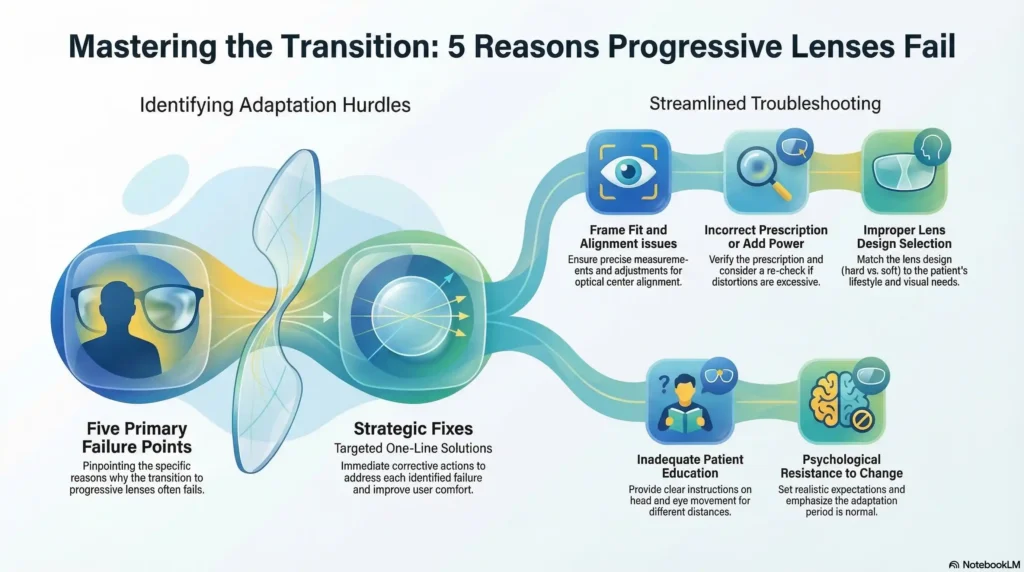
| Reason | Root Cause | Solution |
|---|---|---|
| Blurry zones | Inaccurate PD or fitting height | Precise monocular measurement by a board-certified OD |
| Dizziness/swimming effect | Wrong lens design | Lifestyle-matched digital progressive lens selection |
| Can’t find the reading zone | The frame sits too low | Professional frame fitting and optical alignment |
| General discomfort | No adaptation guidance | Patient education on the head-movement technique |
| Persistent strain | Underlying condition | Comprehensive exam with Optovue diagnostic technology |
How Long Does It Normally Take to Adjust to Progressive Lenses?
Adaptation timelines vary by patient, but a general framework helps set realistic expectations.
The Typical Adaptation Timeline
| Period | What to Expect |
|---|---|
| Days 1–3 | Mild disorientation, peripheral distortion, and awareness of zone transitions — all normal |
| Days 4–14 | The brain begins to neurologically adapt; visual searching decreases; comfort improves |
| 2–4 Weeks | Most patients achieve comfortable, natural vision with consistent wear |
| Beyond 4 Weeks | Persistent issues strongly suggest a fitting, prescription, or lens design problem |
When to Stop Waiting and See a Specialist
If you are beyond two to three weeks and still experiencing significant headaches, nausea, an inability to read comfortably, or distortion that has not improved, the message is clear: stop waiting and get a professional evaluation.
These symptoms are not a sign that you cannot wear progressive lenses. They are a signal that something in the fitting equation needs to be corrected. Our team at West Broward Eye Care specializes in exactly these situations — identifying what went wrong and making it right.
What Makes a High-Quality Progressive Lens Fitting Different?
There is a significant difference between a rushed optical dispensing and a truly clinical progressive lens fitting. Here is what the latter looks like.
The Role of Digital Lens Technology
Conventional progressive lenses are manufactured using standardized molds and offer limited customization. Digital progressive lenses, by contrast, are produced using freeform surfacing technology — essentially, the lens is calculated and ground point-by-point to match your unique prescription data and frame parameters.
The result is a wider, more usable intermediate zone, reduced peripheral distortion, and a more natural transition between zones — particularly important for patients who have struggled with traditional designs.
At West Broward Eye Care, our optical team offers the latest in digital lens technology, ensuring that every progressive lens we dispense is as precisely engineered as your individual prescription demands.
Precision Measurements That Matter
A high-quality progressive fitting involves far more than a standard PD measurement. Our board-certified optometric physicians take into account:
| Measurement | Why It Matters |
|---|---|
| Monocular PD (each eye separately) | Ensures optical centers align precisely with each pupil |
| Fitting Height | Positions the near zone exactly at your natural reading position |
| Pantoscopic Tilt | Accounts for the angle the frame sits on your face |
| Back Vertex Distance | Ensures prescription power is accurate at the correct distance from the eye |
| Frame Wrap Angle | Compensates for curved frames that alter optical geometry |
This level of measurement detail is what separates a comfortable progressive lens experience from a frustrating one.
Frame Selection as a Clinical Decision
Choosing frames for progressive lenses is not purely aesthetic — it is clinical. Our optical team guides every patient toward frames with sufficient vertical depth to accommodate all three lens zones, and with a fit geometry compatible with their prescription’s corridor requirements. A frame that looks perfect on a display may be entirely wrong for a high-powered progressive prescription.
📅 Experience the difference precision makes. Get a Precise Progressive Lens Fitting at West Broward Eye Care — your vision deserves nothing less. Call or text 954-726-0204.
West Broward Eye Care’s Approach to Progressive Lens Success in Tamarac, FL
35 Years of Fitting Expertise in the Tamarac Community
Since 1990, West Broward Eye Care has been a trusted fixture in the Tamarac community — building relationships not just with patients, but with entire families across generations. That depth of experience means our physicians have fitted thousands of progressive lenses across every prescription type, lifestyle, and age group. When you bring us a difficult case — whether it’s your first pair of progressives or your fifth attempt to get them right — we have seen it before, and we know how to solve it.
We proudly serve patients from Tamarac, Broward County, North Lauderdale, Lauderhill, and Coconut Creek — and our 885 Google reviews reflect the trust this community has placed in our care.
State-of-the-Art Technology for Superior Outcomes
Getting a progressive lens fitting right begins long before a lens is ordered. Our technology stack ensures we see the complete picture of your eye health:
| Technology | Role in Progressive Lens Success |
|---|---|
| Optovue | Detects dry eye, corneal irregularities, and retinal conditions that can complicate adaptation |
| Digital Lens Technology | Enables freeform, customized progressive lens manufacturing |
| SMap3D | Provides precision corneal mapping for patients needing specialty lens solutions |
This integration of advanced diagnostics with precision optics is what allows our team to succeed where others have not.
A Patient-First Philosophy That Educates, Not Just Prescribes
One of our patients once described their experience as receiving a “mini PhD on what was going on with my eye.” That phrase captures exactly what we believe every patient deserves — not just a prescription and a handshake, but a genuine understanding of their own vision.
When it comes to progressive lenses, that means explaining exactly which zone does what, demonstrating the correct head-movement technique, setting honest adaptation expectations, and scheduling a follow-up to confirm everything is working as intended. Our caring and dedicated doctors and staff treat every visit as a partnership, not a transaction.
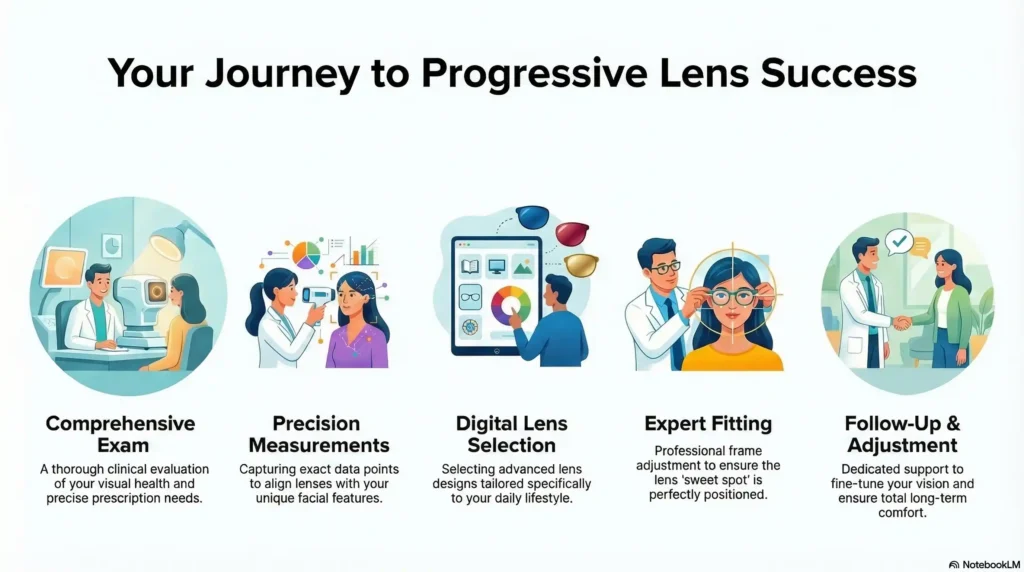
| Step | Action | Technology / Approach Used |
|---|---|---|
| 1. Comprehensive Exam | Identify underlying conditions | Optovue, full diagnostic workup |
| 2. Precision Measurements | Monocular PD, fitting height, tilt, wrap | Board-certified OD measurement protocol |
| 3. Digital Lens Selection | Match design to lifestyle and prescription | Freeform digital progressive technology |
| 4. Expert Fitting | Frame selection, optical alignment | Clinical frame fitting guidance |
| 5. Follow-Up & Adjustment | Confirm comfort and clarity | Patient education + refinement visit |
Serving Patients Across Tamarac and Broward County
West Broward Eye Care is conveniently located at 7822 N. University Dr., Tamarac, FL 33321, making us easily accessible for patients throughout the region. We serve the communities of Tamarac, North Lauderdale, Lauderhill, Coconut Creek, and the broader Broward County area.
South Florida’s lifestyle demands a lot from your lenses. Between the intense UV exposure, active outdoor living, and long hours driving in bright conditions, your progressive lenses need to perform across a wide range of real-world situations. Our team understands the specific visual demands of life in this region — and we select and fit lenses accordingly.
We accept a wide range of insurance plans and offer eyewear options for every budget, ensuring that exceptional progressive lens care is accessible to every member of our community.
🏛️ Local Resources & Citations
1. 🔬 National Eye Institute (NEI) — Presbyopia & Progressive Lenses Patient Guide — nei.nih.gov The NIH’s official eye health authority explains the science behind presbyopia — the age-related condition that makes progressive lenses necessary — helping patients understand why their near vision changes and what corrective lens options exist.
2. ✅ Florida Board of Optometry — Verify Your Eye Doctor’s License — floridasoptometry.gov Florida’s official state licensing board for optometrists — use this tool to instantly verify that your eye care provider holds a current, active, and unencumbered license before your progressive lens fitting appointment.
3. 🏥 Florida Department of Health in Broward County — DOH-Broward Community Health Programs — broward.floridahealth.gov The official Broward County health authority — provides residents with access to community health programs, preventive care resources, and public health guidance relevant to the South Florida population served by West Broward Eye Care.
4. 🧬 Florida Agency for Health Care Administration (AHCA) — Florida Medicaid Visual Care Services Coverage — ahca.myflorida.com Florida’s official Medicaid authority outlines which vision and eye care services — including comprehensive eye exams and specialty optical services — are covered under state insurance programs, helping Tamarac patients understand their benefits before booking.
Ready to See Clearly? Here’s How to Get Started
If you have been struggling with progressive lenses — whether they’re brand new or you’ve been tolerating a mediocre experience for months — West Broward Eye Care is ready to help you get it right.
Our board-certified optometric physicians will conduct a thorough evaluation, identify the root cause of your discomfort, and build a fitting plan tailored specifically to your vision, lifestyle, and goals. With 35 years of excellence, state-of-the-art technology, and a genuinely patient-first approach, we are Tamarac’s trusted destination for progressive lens success.
📍 7822 N. University Dr., Tamarac, FL 33321 📞 954-726-0204 (Call or Text) 🕐 Monday–Thursday: 9:00 AM–5:00 PM | Friday: 9:00 AM–4:00 PM
Don’t settle for blurry or uncomfortable vision. Call or Text 954-726-0204 to Book Your Appointment Today.
Frequently Asked Questions
-
Dizziness happens because your brain is adjusting to multiple magnification zones. Quick head movements can cause a “swim” effect. This usually resolves within one to two weeks of consistent wear.