Contact Lens Prices Explained: What Affects Cost and Value
Contact lens prices in Tamarac, FL typically range from $150 to $700+ per year, depending on lens type, prescription complexity, fitting fees, and insurance coverage. Daily disposable lenses cost more per box but less effort to maintain, while monthly lenses offer savings for consistent wearers. Specialty lenses for conditions like Keratoconus or for Myopia Management in children carry higher upfront costs but deliver long-term medical value. A comprehensive contact lens exam and professional fitting — performed by a board-certified optometrist using advanced technology — is the essential first step to finding the right lens at the right price. West Broward Eye Care in Tamarac, FL has guided patients through this process for 35 years, offering contact lens solutions for every prescription complexity and every budget.
Why Contact Lens Prices Vary So Much
If you have ever compared contact lens prices online or at different eye care offices and walked away more confused than when you started, you are not alone. Contact lens pricing is one of the most misunderstood areas of vision care. A box of daily lenses from one brand may cost $40, while a similar-looking box from another costs $80. Specialty lenses for complex eye conditions can reach several hundred dollars per pair. And that is before factoring in the exam, the fitting fee, and what your insurance will or will not cover.
The truth is that contact lens pricing is not arbitrary. Every dollar reflects something specific — the technology engineered into the lens, the complexity of your prescription, the precision of the fitting process, and the long-term health outcomes that the right lens delivers. Understanding these factors does not just satisfy curiosity. It empowers you to make smarter decisions about your eye health and your budget.
The Hidden Factors Most People Don’t Consider
Most patients focus on the sticker price of a box of lenses. What they miss are the upstream factors that determine whether that box is actually a good value. The fitting exam, the technology used to measure your eye, the brand’s investment in lens materials — these are the invisible forces behind every price tag. A lens that costs more upfront but fits perfectly, stays moist all day, and protects your cornea from South Florida’s intense UV exposure may save you significant discomfort, appointments, and expense over time.
Why Cheaper Isn’t Always Better for Your Eye Health
Bargain contact lenses purchased without a current, accurate prescription or a proper professional fitting carry real risks. Ill-fitting lenses can cause corneal abrasions, chronic dryness, and in serious cases, infections that threaten your long-term vision. In a healthcare category governed by YMYL — Your Money, Your Life — the lowest price is rarely the highest value. The goal is not to spend the least. The goal is to see clearly, comfortably, and safely for years to come.
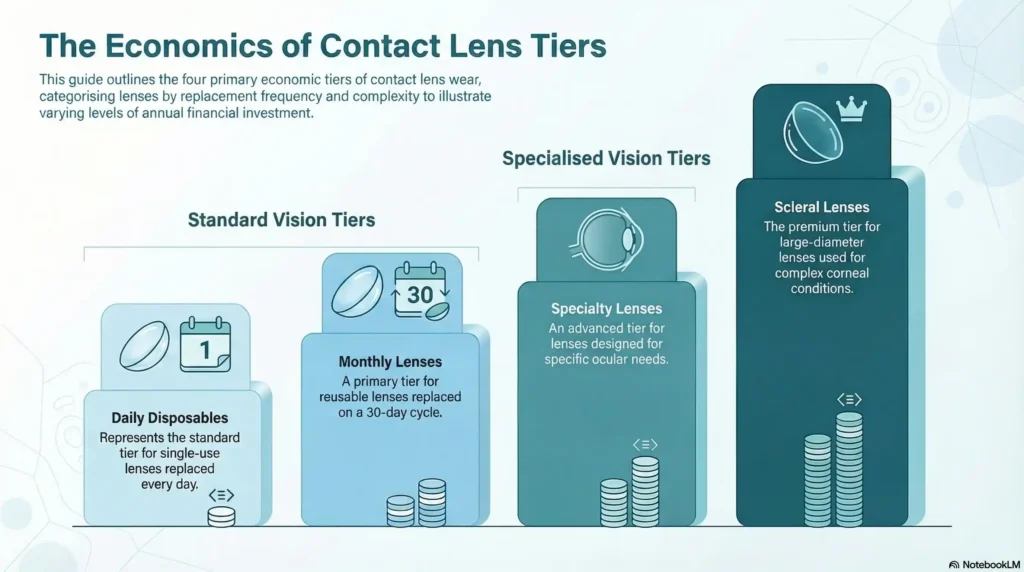
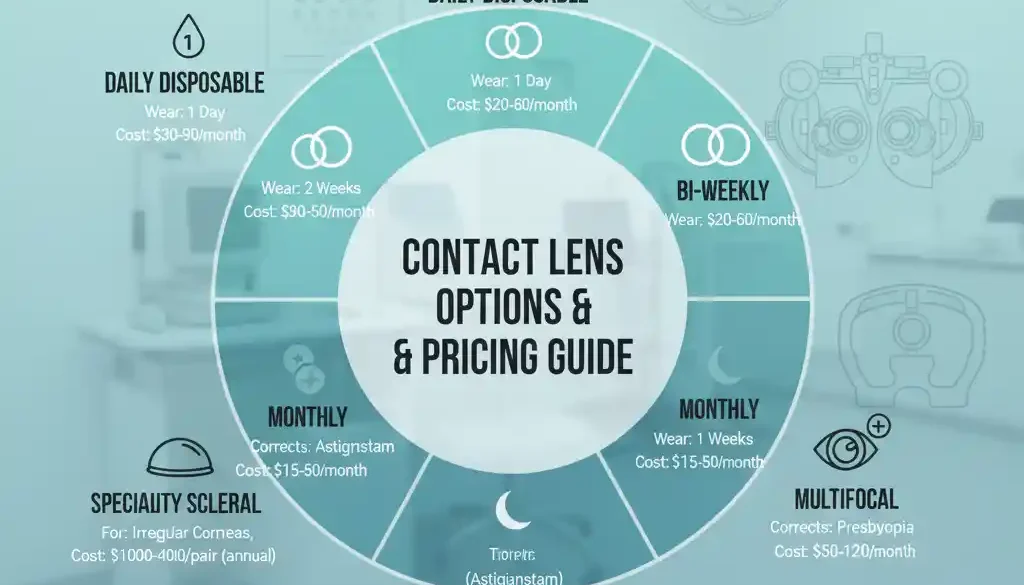
| Lens Type | Wear Schedule | Avg. Annual Cost (Without Insurance) | Best For |
|---|---|---|---|
| Daily Disposable | Single-use, daily | $300 – $700 | Convenience, allergy sufferers, occasional wearers |
| Bi-Weekly Disposable | Replace every 2 weeks | $200 – $400 | Moderate wearers, cost-conscious patients |
| Monthly Disposable | Replace monthly | $150 – $300 | Daily wearers seeking economy |
| Toric (Astigmatism) | Daily or Monthly | $300 – $600 | Patients with astigmatism |
| Multifocal | Monthly | $400 – $700 | Presbyopia, patients 40+ |
| Specialty / Scleral | Custom, long-wearing | $1,000 – $4,000+ | Keratoconus, irregular corneas |
| Orthokeratology (Ortho-K) | Overnight wear | $1,000 – $2,000 | Myopia Management in children |
The 6 Key Factors That Determine Contact Lens Cost
1. Lens Type & Wear Schedule
The single biggest driver of contact lens cost is the type of lens and how often it is replaced. Daily disposable lenses eliminate the need for cleaning solutions and lens cases, making them the most hygienic option — but they also require a fresh pair every single day. For a patient wearing lenses five days a week versus seven, the annual cost difference can be significant.
Monthly lenses require proper cleaning and storage but spread the material cost across 30 days of use, making them more economical for consistent, daily wearers. Bi-weekly lenses split the difference. Understanding your actual wear habits is step one in finding the lens type that delivers genuine value for your lifestyle.
2. Prescription Complexity
A straightforward nearsighted prescription — what eye doctors call a spherical correction — is the easiest and least expensive lens to manufacture. As prescription complexity increases, so does the cost of the lens. Toric lenses, designed to correct astigmatism, require precise axis alignment and more sophisticated manufacturing tolerances. Multifocal lenses, which correct both distance and near vision for patients over 40, involve even more complex optical engineering. The more your prescription demands from the lens, the more the lens demands from your budget.
3. The Contact Lens Fitting & Exam Fee
Many patients are surprised to learn that a contact lens fitting exam is separate from — and in addition to — a standard comprehensive eye exam. This is not a hidden fee. It is a distinct, medically necessary service. During a contact lens fitting, your eye doctor evaluates the curvature of your cornea, the health of your ocular surface, your tear film quality, and the precise dimensions required for a lens to sit correctly on your eye.
At West Broward Eye Care, this process is supported by state-of-the-art technology, including SMap3D, which maps the topography of your cornea with remarkable precision. For patients with standard prescriptions, this streamlines the fitting process and eliminates uncomfortable trial-and-error. For patients with complex corneal conditions, it is the difference between a lens that works and one that simply cannot. This level of technology and clinical precision is what makes the fitting fee one of the highest-value investments in your entire contact lens purchase.
4. Brand & Lens Technology
Not all contact lenses are engineered equally. Premium lens brands invest heavily in materials science — developing hydrogel and silicone hydrogel formulations that allow higher oxygen transmission to the cornea, maintain moisture throughout a long day, and incorporate UV-blocking filters. In Tamarac and across South Florida, where residents face year-round intense sunlight and outdoor exposure, lenses with built-in UV protection are not a luxury feature. They are a practical layer of defense for your long-term eye health.
West Broward Eye Care’s full-service optical stocks the latest in digital lens technology, ensuring patients have access to premium options alongside budget-friendly alternatives — all matched precisely to their prescription and lifestyle.
5. Specialty Lenses for Complex Conditions
For patients with conditions like Keratoconus, a progressive corneal disease that causes irregular thinning and distortion of the cornea, standard soft contact lenses simply cannot provide adequate vision correction or comfort. These patients require specialty lenses — rigid gas-permeable lenses, hybrid lenses, or scleral lenses — that vault over the irregular corneal surface and create a smooth optical interface.
Scleral lenses, which rest on the white of the eye rather than the cornea itself, are among the most effective and comfortable solutions for Keratoconus patients. They are also among the most expensive, reflecting the custom manufacturing, advanced fitting technology, and clinical expertise required to prescribe them correctly. West Broward Eye Care is one of the few local providers equipped with SMap3D corneal mapping technology and the deep specialty lens experience required to fit these lenses with precision — making them a destination practice for patients across Broward County who have struggled to find effective solutions elsewhere.
6. Insurance Coverage & Out-of-Pocket Costs
Vision insurance can significantly reduce your annual contact lens costs, but the specifics vary widely between plans. Most vision insurance plans include an annual materials allowance — typically between $100 and $200 — that can be applied toward contact lenses or frames. Some plans cover the contact lens fitting exam; others treat it as an out-of-pocket expense.
West Broward Eye Care accepts a wide range of insurance plans, and their experienced team can help you navigate your specific benefits to maximize your coverage. For patients without vision insurance, the practice offers eyewear and contact lens options at a range of price points, ensuring that quality eye care remains accessible to every member of the Tamarac community.
📣 Not sure which lens type fits your prescription and budget? Call or text the team at West Broward Eye Care at 954-726-0204. We will help you find the right fit for your eyes and your lifestyle.
Standard vs. Specialty Contact Lenses: Understanding the Price Difference
What Are Standard Contact Lenses?
Standard contact lenses — daily, bi-weekly, and monthly disposables in spherical, toric, and multifocal designs — are manufactured at scale and are widely available through eye care practices and licensed online retailers. For the majority of patients with mild to moderate prescriptions, these lenses deliver excellent vision, comfort, and value. Annual costs with insurance typically fall between $100 and $400 depending on lens type and wear schedule.
What Are Specialty Contact Lenses?
Specialty contact lenses are custom-designed or custom-fitted lenses prescribed for patients whose eyes cannot be adequately corrected with standard soft lenses. This category includes rigid gas-permeable (RGP) lenses, scleral lenses, hybrid lenses, and orthokeratology lenses. Each type requires a higher level of clinical expertise to fit, more sophisticated measurement technology, and in many cases, custom manufacturing. The result is a lens that is precisely engineered for an individual eye — which is reflected in the price.
Keratoconus & Specialty Lens Fitting in Tamarac
Keratoconus affects approximately 1 in 2,000 people and often goes undiagnosed until vision deterioration becomes significant. For Tamarac residents living with this condition, finding a provider with both the diagnostic technology and the clinical experience to fit specialty lenses effectively is critical — and historically difficult.
West Broward Eye Care addresses this gap directly. Using SMap3D corneal topography mapping, the practice’s board-certified optometric physicians can create a precise three-dimensional model of each patient’s corneal surface and use that data to select and fit specialty lenses with a level of accuracy that standard fitting methods cannot match. Patients who have spent years struggling with discomfort or poor vision in standard lenses frequently find that a properly fitted scleral lens — prescribed at West Broward Eye Care — changes their daily experience entirely. This outcome is the definition of value, regardless of the upfront cost.
Myopia Management Lenses: An Investment in Your Child’s Future Vision
Myopia — nearsightedness — is progressing at an accelerating rate among children worldwide, and Tamarac families are not immune to this trend. Left unmanaged, rapidly increasing myopia prescriptions not only mean stronger glasses every year — they mean a significantly elevated risk of serious eye conditions later in life, including retinal detachment, glaucoma, and macular degeneration.
Orthokeratology lenses — specially designed rigid lenses worn overnight that gently reshape the cornea — are one of the most clinically proven methods for slowing myopic progression in children. The upfront cost, typically $1,000 to $2,000, reflects the custom fitting process, the precision of the lenses, and the ongoing monitoring required. But when measured against the cumulative cost of annual prescription increases, the long-term expense of high-prescription eyewear, and most importantly, the protection of your child’s long-term visual health, the value proposition becomes clear. West Broward Eye Care’s Myopia Management program gives Tamarac parents a proactive tool — not just a reactive correction.
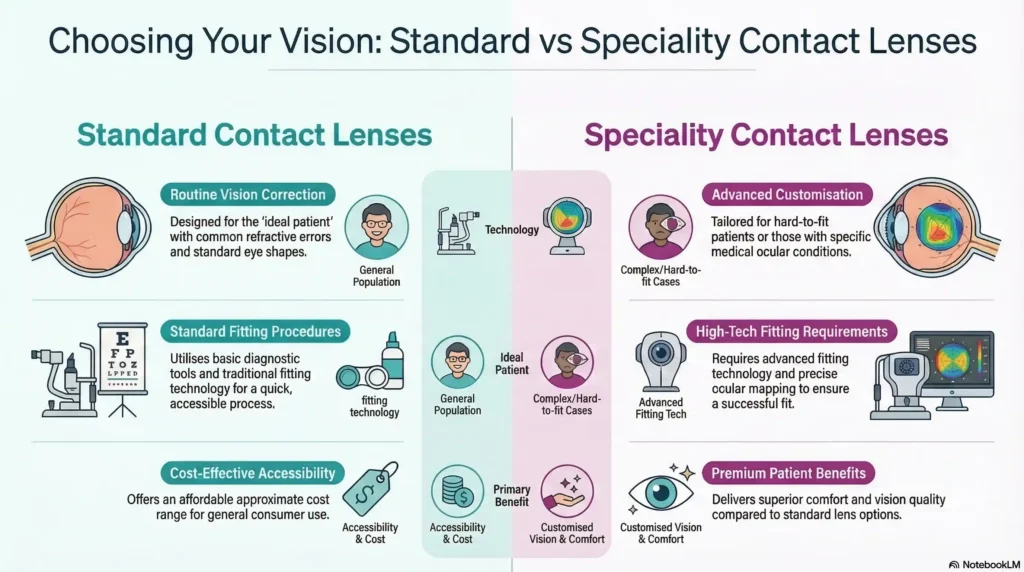
| Feature | Standard Contact Lenses | Specialty Contact Lenses |
|---|---|---|
| Lens Types | Daily, Bi-Weekly, Monthly, Toric, Multifocal | Scleral, RGP, Hybrid, Ortho-K |
| Ideal Patient | Mild to moderate prescriptions | Keratoconus, irregular cornea, Myopia Management |
| Fitting Technology | Standard keratometry | SMap3D corneal topography mapping |
| Avg. Annual Cost | $150 – $700 | $1,000 – $4,000+ |
| Insurance Coverage | Often partially covered | May require medical insurance; varies by plan |
| Key Benefit | Convenience, wide availability | Precision vision, comfort for complex conditions |
| Provider Expertise Required | General optometrist | Specialty-trained optometrist |
How to Get Real Value From Your Contact Lens Investment
Annual Supply vs. Monthly Purchases: Which Saves More?
One of the most practical decisions a contact lens wearer can make is whether to purchase an annual supply upfront or buy boxes throughout the year. In almost every case, an annual supply delivers better value. Manufacturers and eye care practices frequently offer rebates — sometimes $100 or more — exclusively on annual supply purchases. The per-box price is also typically lower when bought in volume. For a patient purchasing daily lenses, the difference between buying quarterly and buying an annual supply can amount to $150 or more in annual savings, before rebates.
The Role of Advanced Fitting Technology in Lens Value
One of the most overlooked sources of contact lens value is the quality of the fitting process itself. A poorly fitted lens — even an excellent lens — will cause discomfort, dryness, and potentially damage the corneal surface over time. Multiple follow-up appointments, trial lens exchanges, and prescription adjustments all add cost and frustration to the contact lens experience.
West Broward Eye Care’s investment in advanced diagnostic technology — including SMap3D for corneal mapping, Optomap for comprehensive retinal imaging, and Optovue for microscopic ocular surface evaluation — means that fitting decisions are based on precise, detailed data rather than estimates. The result is fewer adjustments, greater first-fit success, and a contact lens experience that delivers comfort and clarity from day one. This is where technology and value converge.
Why Your Eye Exam Is the Foundation of Contact Lens Value
No contact lens — regardless of price or technology — can deliver its full value without an accurate, current prescription as its foundation. A comprehensive eye exam does far more than determine your prescription. It evaluates the health of your entire visual system, screens for early signs of conditions like glaucoma, diabetic retinopathy, and macular degeneration, and assesses the specific characteristics of your eyes that determine which lens types are safe and appropriate for you.
At West Broward Eye Care, comprehensive eye exams are performed by board-certified optometric physicians who bring 35 years of clinical experience to every patient encounter. Patients consistently describe leaving appointments feeling like they received — as one patient famously put it — “a mini PhD on what was going on with my eye.” That level of patient education is not a nicety. It is a clinical standard that directly improves outcomes and ensures every contact lens recommendation is grounded in a complete picture of your eye health.
📣 Ready to find contact lenses that truly fit your eyes and your budget? Book your comprehensive contact lens exam today at West Broward Eye Care — 7822 N. University Dr., Tamarac, FL 33321 — or call or text 954-726-0204. Our team is here Monday through Thursday, 9:00 AM to 5:00 PM, and Friday, 9:00 AM to 4:00 PM.
Contact Lens Costs & Vision Insurance in Tamarac, FL
What Does Vision Insurance Typically Cover?
Most vision insurance plans include an annual benefit for contact lenses or eyeglass frames — but rarely both in the same plan year. The contact lens materials allowance typically ranges from $100 to $200 annually, with some premium plans offering higher benefits. Many plans also cover the comprehensive eye exam, though the contact lens fitting exam may be a separate line item with its own copay or cost-sharing requirement.
It is important to understand that vision insurance is a benefit — not a comprehensive coverage plan in the way medical insurance operates. Maximizing your benefit requires knowing exactly what your plan covers, when your benefit resets, and whether your preferred lens brand or type falls within your plan’s covered materials list.
What If You Don’t Have Insurance?
Approximately one in four Americans does not have vision insurance, and many Tamarac residents rely on out-of-pocket payment for their eye care. West Broward Eye Care is built to serve every patient regardless of insurance status. The practice’s full-service optical offers eyewear and contact lens options across a broad spectrum of price points, ensuring that patients without insurance coverage are never forced to choose between quality care and financial reality. The team’s willingness to work with patients to find effective, affordable solutions is one of the core reasons the practice has maintained patient loyalty across 35 years of community service.
How West Broward Eye Care Helps Every Patient Navigate Cost
Whether you are managing a complex vision insurance plan, paying out of pocket, or navigating coverage for a specialty lens that crosses into medical insurance territory, the team at West Broward Eye Care brings clarity to what can be a confusing process. Their experience with a wide range of insurance providers, combined with a genuine commitment to accessibility, means that cost is never a barrier to receiving expert eye care. The practice’s acceptance of multiple insurance plans and its range of budget-friendly options reflect a 35-year promise to the Tamarac community: exceptional care, for every patient, at every stage of life.
🏛️ Local Resources & Citations
1. Florida Department of Health — Vision & Eye Health Resources 🔗 The official state health authority for Florida; patients can verify licensed optometrists, understand patient rights, and access public health guidance on preventative eye care in Florida.
2. U.S. Food & Drug Administration (FDA) — Contact Lens Consumer Information 🔗 The FDA regulates all contact lenses as medical devices in the United States; check here for official safety guidelines, legal prescription requirements, and approved lens classifications that explain why a valid exam is federally required before purchasing contact lenses.
3. Broward County Health Department — Community Health & Vision Programs 🔗 The official Broward County public health authority; residents can find local vision screening programs, insurance assistance resources, and community health initiatives relevant to Tamarac families managing eye care costs.
4. National Eye Institute (NEI) — National Institutes of Health (.gov) 🔗 A division of the U.S. National Institutes of Health, NEI is the country’s leading federal authority on eye disease research; patients can reference clinically validated information on conditions like Keratoconus, Myopia, Diabetic Retinopathy, and Macular Degeneration to understand why specialty lenses and early diagnosis are medically essential.
Why Tamarac Residents Trust West Broward Eye Care for Contact Lenses
35 Years of Contact Lens Expertise in the Community
Healthcare trust is not built overnight. It is earned through consistent, high-quality care delivered to real patients across years and decades. West Broward Eye Care has been fitting contact lenses for Tamarac patients since before most current online retailers existed. That longevity is not just a marketing point — it represents thousands of successful fittings, complex cases resolved, and patients who return year after year because the care they receive is genuinely exceptional. With over 885 Google reviews reflecting that sustained excellence, the community’s voice speaks clearly.
State-of-the-Art Technology That Delivers Better Fitting, Better Value
The practice’s investment in advanced diagnostic and fitting technology — SMap3D, Optomap, and Optovue — is not incidental. It is a deliberate strategic commitment to delivering outcomes that less-equipped practices simply cannot match. For contact lens patients, this technology means a faster, more accurate fitting process, fewer uncomfortable adjustments, and a final lens prescription that is grounded in precise, individualized data. Better technology means better fits. Better fits mean better value.
Board-Certified Optometric Physicians You Can Trust
Every contact lens prescription at West Broward Eye Care is overseen by a board-certified optometric physician — a credential that represents advanced clinical training, rigorous examination, and an ongoing commitment to professional development. In a category as important as your vision, the qualifications of the professional guiding your care matter enormously. Tamarac residents deserve — and at West Broward Eye Care, receive — the highest standard of optometric expertise available in South Florida.
📣 Experience the West Broward Eye Care difference. Call or text 954-726-0204, or visit us at 7822 N. University Dr., Tamarac, FL 33321. Book your appointment today and discover why Tamarac has trusted us with their vision for 35 years.
Frequently Asked Questions
-
Contact lenses are precision medical devices. Their high cost reflects advanced silicone hydrogel materials, oxygen permeability technology, strict sterile manufacturing, and specialized designs for complex prescriptions.